

- Deal qualification preserves startup runway by rejecting poor-fit opportunities before committing engineering hours to custom software pilots.
- A startup sales qualification framework must prioritize verifiable buyer commitments over rep optimism to keep pipeline forecasts accurate.
- B2B sales teams should disqualify prospects who cannot quantify the cost of inaction or introduce the true economic decision-maker.
- Replacing subjective pipeline stages with customer-verified milestones prevents stalled deals and reduces overall customer acquisition costs.
Stop burning cash on bad-fit pipeline. Use our startup sales qualification framework to tighten ICP criteria and build predictable revenue. Schedule a call.
Early-stage B2B startups protect runway and eliminate fake pipeline by enforcing objective qualification gates that require verifiable buyer commitments before allocating engineering or executive time. Instead of relying on founder optimism, teams filter opportunities by urgent business pain, confirmed budget authority, and concrete implementation timelines.

A startup sales qualification framework is an objective evaluation system used by early-stage companies to filter prospective deals by budget, authority, urgency, and technical fit before committing commercial resources.
Without this operating discipline, sales teams pack pipelines with polite conversations that generate activity reports but zero cash collections. Rigorous deal evaluation protects capital and builds a reliable pipeline architecture, which means developers stop building throwaway custom features and stay focused on paid software commitments.
Protecting Startup Runway: The Hard Cost of Weak B2B Deal Qualification
Startups bleed to death when burn outpaces cash collections. Chasing unqualified enterprise leads accelerates that collapse because enterprise sales devour engineering, legal, and executive time. Every week spent customizing software for a tire-kicker shrinks your runway, which means you run out of cash without ever learning whether the broader market wants your product.
The False Pipeline Trap: How Bad Deals Drain Engineering and Founder Bandwidth
Founders frequently mistake prospect courtesy for real buying intent. When enterprise leads ask for custom demos, security reviews, and architecture tweaks, eager founders pull engineers off the core product roadmap. In India, unbilled technical customizations routinely cost emerging software firms upwards of ₹5,00,000 per stalled deal, burning capital that will never produce revenue.
According to research by Gartner, enterprise buyers spend only 17% of their total purchase journey meeting with potential suppliers. When several vendors compete, that interaction drops to roughly 5% each. Pouring engineering hours into custom work based on brief conversations wastes scarce capital on accounts that never planned to buy.
How Does Deal Disqualification Protect Startup Cash Runway?
Deal disqualification protects startup cash runway by ending bad pursuits early, which preserves capital and points engineers toward buyers with funded projects. Disqualifying fast cuts your customer acquisition cost, which means your product roadmap serves committed buyers rather than non-paying accounts that demand endless custom modifications.
A disciplined disqualification metric defends your balance sheet. When reps reject weak inbound leads during a brief triage call, sales cycles shorten and pipeline velocity accelerates. That discipline preserves capital, which means your staff spends their days closing accounts that match your technical stack instead of chasing unviable pilots.
Establishing Non-Negotiable ICP Sales Qualification Criteria
Sustainable growth requires a strict Ideal Customer Profile (ICP) rather than desperate, opportunistic outreach. Founders must set clear operational and financial boundaries before booking calls, which means sales reps stop wasting discovery hours on prospects who lack the budget or technical infrastructure to deploy the software.
Firmographic and Technical Thresholds in the Indian B2B Ecosystem
Indian enterprise accounts bring distinct challenges, including layered procurement committees and long approval cycles. Your discovery process must verify that the prospect uses systems compatible with your API infrastructure. At the same time, confirm the buyer has in-house engineers ready for onboarding, which prevents deals from stalling during integration.
Establish minimum revenue thresholds before opening enterprise discussions. If a client generates less than ₹20,00,000 in monthly recurring turnover, pitching high annual contracts triggers stalled procurement reviews. Match your commercial terms to proven customer readiness, which means you avoid drafting contracts the buyer cannot legally or financially approve.
Economic Urgency: Distinguishing Pain Points from Funded Priorities
Not every corporate headache has an assigned budget. Prospects gladly vent about broken workflows during calls, yet lack executive backing to reallocate company funds. Qualifying for urgency means verifying that ignoring the problem damages the buyer’s quarterly numbers or regulatory standing, which forces leadership to fund the solution.
Research from Dreamdata shows that the average enterprise B2B sales cycle takes 272 days from first touch to closed contract. Without a critical business event driving immediate action, deals stall in review limbo. Review our guide on B2B pricing strategy to tie your contract terms directly to operational deadlines.
Stakeholder Reality Checks: Identifying the True Economic Buyer Early
Mid-level managers often act like enthusiastic champions but lack spending authority. Your qualification process must verify whether that sponsor can release departmental funds without executive sign-off. Teams that rely on friendly technical contacts run into brick walls the moment procurement and finance demand proof of return on investment.
Reaching the real economic buyer demands an understanding of corporate buying dynamics. To map executive gatekeepers without alienating your primary contact, apply a disciplined B2B buying committee strategy during early discovery. That alignment ensures you address financial objections before sending formal proposals.
Evaluating Core Methodologies: BANT vs MEDDPICC vs SPICED
Choosing a framework depends on product maturity, contract value, and buyer complexity. Early-stage teams cannot manage complex enterprise checklists, yet unstructured discovery fills the CRM with fiction. The matrix below compares the top qualification models across startup growth stages.
| Framework | Core Focus | Ideal Startup Stage | Primary Risk |
|---|---|---|---|
| BANT | Budget, Authority, Need, Timeline | Early Seed / Low ACV | Too rigid; disqualifies early-stage problem solvers |
| MEDDPICC | Metrics, Economic Buyer, Decision Criteria, Process, Paperwork | Series A+ Enterprise | Excessive overhead; stalls lean teams |
| SPICED | Situation, Pain, Impact, Critical Event, Decision | Seed to Growth SaaS | Relies heavily on customer self-awareness |
Startups targeting mid-market accounts often pair the urgency tracking of SPICED with the stakeholder verification of MEDDPICC. This hybrid approach ties sales conversations to quantifiable financial impact rather than polite nods, which means deals close based on concrete business cases instead of vague verbal interest.
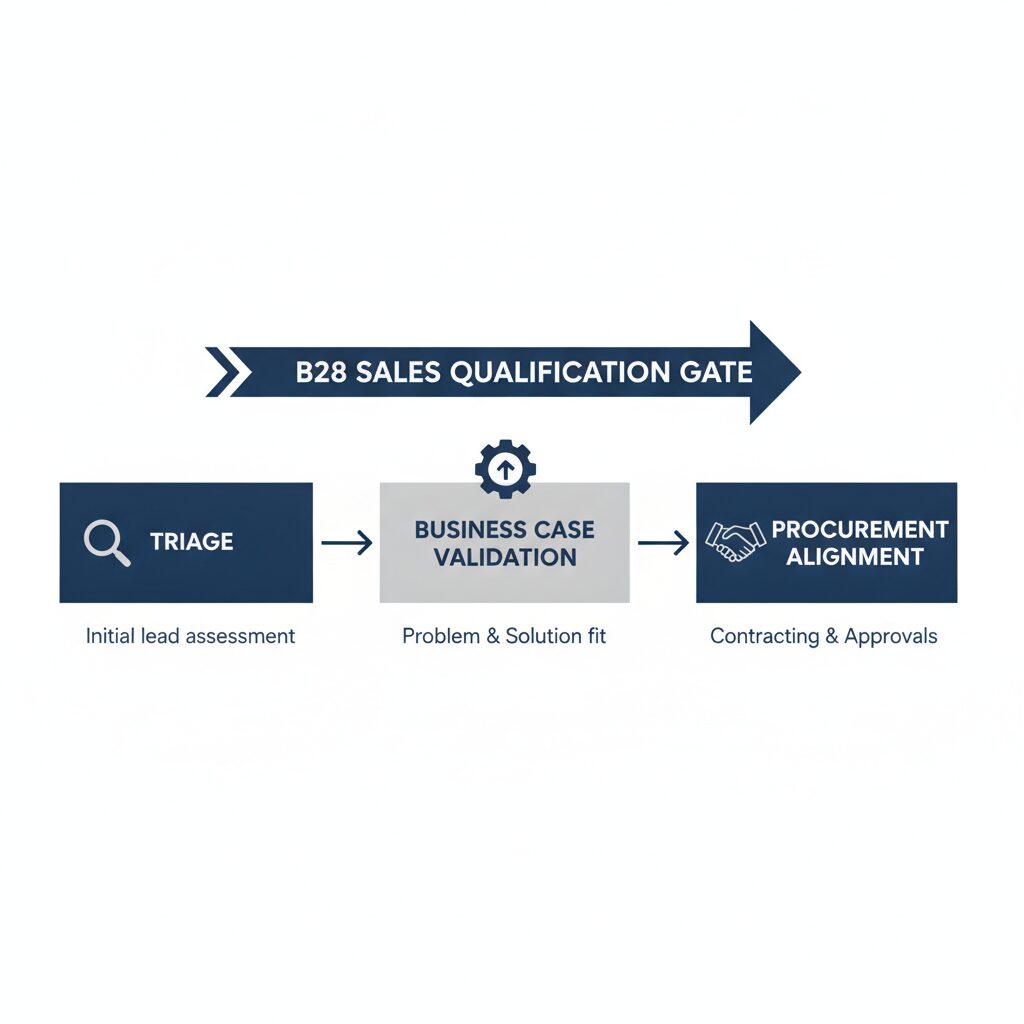
The Three-Stage Qualification Engine for Early-Stage B2B
Deal validation must advance through distinct milestones rather than a single discovery call. Breaking qualification into sequential checkpoints protects technical resources until prospects show reciprocal commitment, which means founders stop offering free consulting to accounts that have no intention of buying.
- Stage 1: Pre-Demo Operational Triage: Screen inbound leads and outbound responses against baseline firmographic and tech-stack requirements before scheduling a customized product walkthrough.
- Stage 2: Business Case and Quantified Impact: Validate that solving the problem creates measurable financial value exceeding your platform fee, confirming executive sponsorship.
- Stage 3: Legal, Security, and Commercial Alignment: Establish procurement requirements, compliance sign-offs, and mutual success criteria before entering final contract execution.
Stage 1: Inbound and Outbound Triage Before Demo Delivery
Never deliver custom demos to unverified inbound leads. Run a brief ten-minute screening call or form check to confirm headcount, current software tools, and target launch dates. If the prospect fails basic ICP criteria, send a recorded product overview instead of booking founder time.
Automate this triage inside your CRM to cut manual data entry. Guarding your calendar from tire-kickers preserves executive energy for high-probability prospects, which means your leadership team spends time closing revenue instead of running repetitive introductory calls.
Stage 2: Discovery Deep-Dive and Business Case Validation
Calculate the exact financial cost of your prospect’s status quo during discovery. If a buyer cannot quantify the hours or revenue lost to their current bottleneck, their chief financial officer will reject the purchase order. Pinpointing that operational waste provides the justification needed to unlock budget.
Ask the buyer to confirm your cost calculations over email. Written agreement on existing financial waste shifts the sales conversation from feature checklists to risk reduction, which means prospects stop pushing for discounts once they see the high price of doing nothing.
Stage 3: Procurement, Legal, and Security Gatekeeping
Deals often die during legal and vendor onboarding reviews. Before deploying technical support for a pilot, lock in agreement on standard contract terms, data compliance standards, and payment milestones. Never build custom integrations without a signed evaluation agreement.
Skipping evaluation guardrails traps founders in endless unpaid trials. Follow our battle-tested guidance to escape pilot purgatory by setting written pass-fail benchmarks before launching test environments, which ensures pilots convert to paid contracts upon completion.
Operationalizing Pipeline Architecture: Moving Past Founder-Led Intuition
Early traction often leans on founder charisma and deep industry knowledge. But junior sales hires cannot replicate intuitive founder selling. Building a scalable commercial engine requires pipeline stages governed by hard customer evidence rather than sales rep optimism.
Replacing Gut-Feel Forecasts with Milestone-Driven Pipeline Stages
Vague CRM stages like ‘Proposal Sent’ or ‘Good Call’ ruin revenue forecasting. Replace rep activity with documented buyer actions, such as sharing procurement guidelines, introducing executive signers, or confirming launch dates in writing.
Tying pipeline progress to customer proof turns your CRM into a realistic forecasting tool. That clarity protects cash flow planning, which means you avoid hiring ahead of revenue based on phantom pipeline numbers.
How a Fractional CSO Installs Embedded Leadership and Process Discipline
Early-stage companies rarely need a full-time sales executive while still validating product-market fit. Bringing in a Fractional CSO installs strict qualification discipline without the heavy burden of executive payroll overhead, which means you gain strategic sales leadership while protecting company cash.
An embedded sales leader works alongside founders to document objection handling, enforce stage criteria, and coach reps on live calls. This hands-on guidance transforms erratic revenue numbers into a predictable sales system.
Real Deals, No Guesswork: Disqualification Scripts and Battle-Tested Workflows
High-performing teams embrace deliberate disqualification. Walking away from bad fits signals authority and protects precious selling hours for high-margin buyers, which means reps spend their time winning deals rather than nursing dead pipeline.
Direct Discovery Questions That Uncover Real Budgets and Timelines
Uncovering real budget constraints takes direct questions rather than cautious hints. Use these clear diagnostic questions during initial discovery meetings:
‘If we establish a viable solution today, what specific operational budget is allocated to deploy it within the current financial quarter?’
‘Whose signature, beyond yours, is legally required on the master service agreement before invoice processing begins?’
‘What specific corporate consequence occurs if your team chooses to maintain the existing workflow for another twelve months?’
Listen closely to their response. Hesitation or evasive answers prove the project lacks executive backing, which means you should deprioritize the opportunity before burning more hours.
Graceful Exit Mechanics: How to Walk Away from Unqualified Opportunities
Disqualifying a prospect does not mean burning bridges. Protect your time while preserving professional goodwill by stating the mismatch plainly:
‘Based on your current engineering priorities, our platform will not generate the immediate return on investment you require this quarter. Rather than deploying half-measures, let us pause conversations until your infrastructure upgrade concludes next fiscal year.’
This direct posture earns respect. Buyers appreciate candid advice, and many return as paying clients once their internal infrastructure catches up to your technical requirements.
Frequently Asked Questions
What is the difference between lead qualification and deal qualification in a startup?
Lead qualification assesses whether an inbound contact matches basic demographic and firmographic profile criteria. Deal qualification evaluates whether an active sales opportunity has sufficient economic urgency, budget authority, and stakeholder consensus to justify continued commercial resource investment.
How does a strict qualification framework protect startup runway?
A rigorous qualification model prevents sales and engineering teams from burning hours on non-converting prospects and custom proofs of concept. This focus reduces customer acquisition costs and preserves operational capital for high-probability revenue opportunities.
When should an early-stage startup disqualify a prospective enterprise deal?
Disqualify immediately when the prospect refuses to grant access to the economic buyer or lacks a funded budget. Continued engagement without verified buyer commitments drains founder time without producing revenue.
Why do standard legacy frameworks fail modern B2B SaaS startups?
Legacy frameworks like traditional BANT assume buyers possess upfront budget line items and follow linear procurement processes. Modern SaaS purchases involve distributed buying committees, making pain-driven frameworks like SPICED and MEDDPICC far more effective.
How can a founder train junior sales reps to qualify prospects without micromanaging?
Replace subjective pipeline updates with required customer-verified milestones before opportunities can advance in the CRM. Requiring written evidence of customer commitments enables objective pipeline reviews without constant founder oversight.
What is the most common deal qualification mistake made by early-stage founders?
Founders frequently mistake prospect curiosity and polite praise for commercial intent, building custom features before securing signed agreements. True qualification requires verifying hard budget allocation and painful consequences of buyer inaction.</
Sales Fundas operates as an embedded leadership partner for ambitious B2B founders and CEOs, specializing in pipeline architecture and predictable revenue growth. By combining rigorous sales consulting frameworks with advanced digital advertising and performance marketing, we build sustainable, high-performing sales engines that complement and scale the founder's strategic vision.
- Embedded Leadership for B2B Growth
- Sales Pipeline & Revenue Architects
- B2B Sales Engine Development
- Strategic Sales Scaling Experts