

Stop scaling a broken sales process. Learn the critical difference between a Fractional GTM Strategist and a Sales Director to build predictable revenue.
The high cost of scaling the wrong machine
Most B2B founders hire a sales leader when revenue plateaus. They bring in a Fractional Sales Director to manage the team, push for more calls, and tighten the pipeline. But if your pricing is off or your distribution channel is leaking, a sales director simply manages the decline more efficiently. They are operators, not architects.

The distinction is simple: a Fractional Sales Director manages the people executing the play, while a Fractional GTM (Go-To-Market) Strategist designs the play itself. Hiring an operator before you have a validated engine leads to the most expensive mistake in B2B growth: scaling a broken process.
The Fractional Sales Director: The Revenue Operator
A Fractional Sales Director focuses on the execution layer. Their primary objective is to turn existing lead flow into predictable revenue by managing human performance. They live in the CRM, obsess over quota attainment, and run the daily cadence of the sales team.
In practice, this role handles the tactical friction of the sales cycle. They ensure the team is following the script, updating the pipeline, and moving deals through the stages. If you have a validated Ideal Customer Profile (ICP) and a product that sells, the Director ensures the team hits the numbers without the founder needing to oversee every call.
The failure mode occurs when a founder hires a Director to “find a market.” Sales directors are built to scale known quantities. When asked to figure out who the customer is or why the product isn’t sticking, they often default to “we need more leads” or “the team needs more training.” This is a symptom of a GTM failure, not an execution failure.
The Fractional GTM Strategist: The Revenue Architect
A Fractional GTM Strategist operates at the design layer. They don’t manage the team’s daily activity; they build the pipeline architecture that the team will eventually use. This involves defining the exact intersection of product-market fit, pricing power, and distribution channels.
Designing a GTM engine means answering three hard questions. First, who is the absolute best customer that will pay a premium? This requires a deep dive into how to define your ICP to avoid chasing dead-end leads. Second, how do we price this for maximum value? This often involves moving toward value-based pricing in the Indian B2B market to stop the race to the bottom.
Third, what is the most efficient path to the customer? Whether it is outbound SDRs, partner ecosystems, or founder-led sales, the GTM strategist builds the distribution map. Without this map, your sales team is just guessing. According to internal data from Sales Fundas, B2B startups that validate their GTM engine before hiring a full-time sales leader see a 40% reduction in Customer Acquisition Cost (CAC) over twelve months.
The Danger of the ‘Scale-Failure Loop’
Many SMEs in India fall into a specific trap. They hit ₹5 crore in Annual Recurring Revenue (ARR) and feel they have “figured it out.” They hire a high-priced sales leader to take the founder out of the loop. However, because the founder was the only one who could sell the product, the “process” was actually just the founder’s intuition.
The new Sales Director tries to systematize that intuition. They implement generic frameworks and rigid scripts. But since the GTM strategy—the pricing, the positioning, and the target segment—was never documented or validated, the sales team starts failing. The founder then blames the Director, and the Director blames the leads.
This is the Scale-Failure Loop. You are paying for management of a system that doesn’t actually work. To break this, you must shift from managing people to designing the engine. This requires focusing on pipeline architecture shifts that stop deals from stalling before they even reach the Director’s desk.
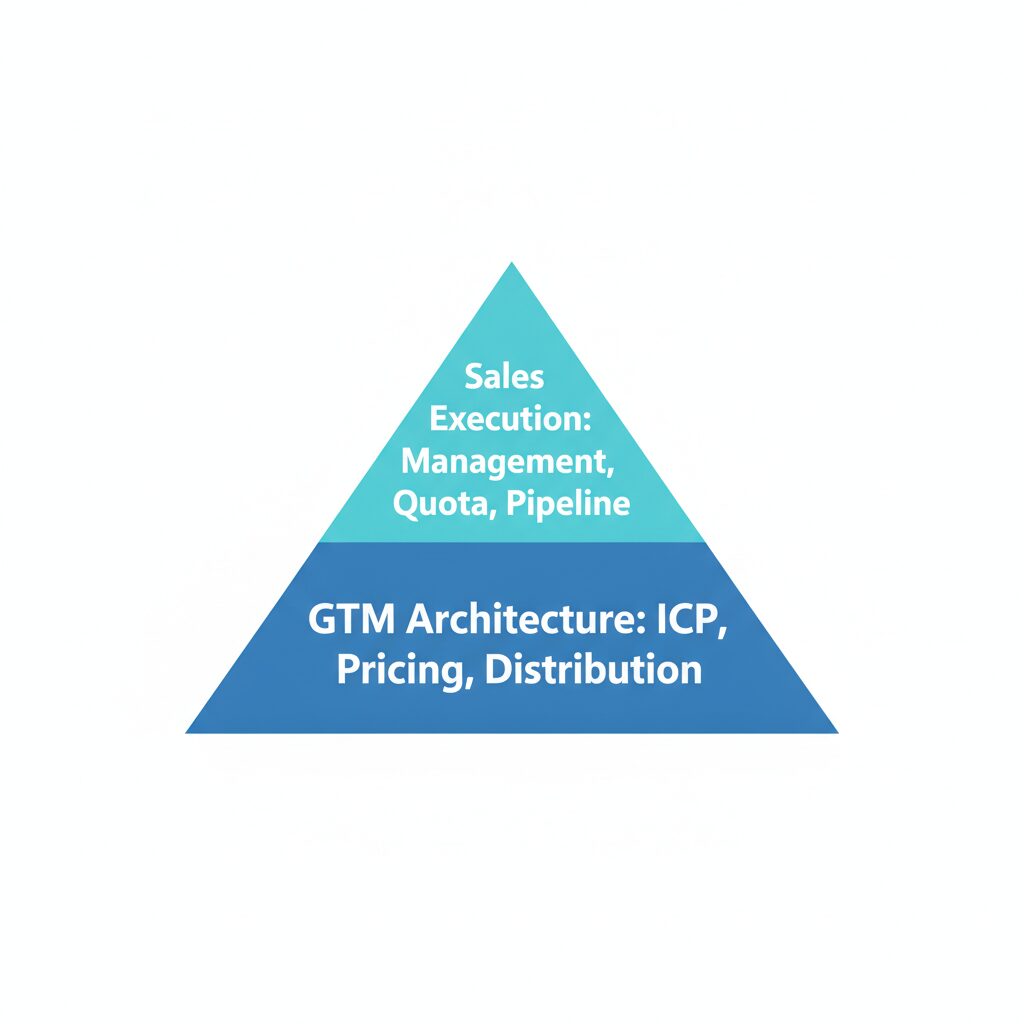
Side-by-Side: Architect vs. Operator
The difference becomes clear when you look at the primary metrics each role owns. A Fractional Sales Director owns Output Metrics: monthly recurring revenue (MRR), quota attainment, and average deal size. They are focused on the ‘what’ and the ‘when’.
A Fractional GTM Strategist owns Input Metrics: LTV:CAC ratio, sales cycle length, and lead-to-close conversion rates. They are focused on the ‘who’, the ‘how’, and the ‘how much’.
Consider a scenario where a B2B SaaS company in Mumbai is seeing a drop in conversions. A Sales Director will likely suggest more aggressive follow-ups or a new sales script. A GTM Strategist will analyze if the current pricing model is misaligned with the perceived value of the ICP or if the distribution channel has become saturated. One treats the symptom; the other fixes the disease.
Which Role Do You Need Right Now?
The decision depends on the current state of your revenue. If you are in the Validation Phase—meaning you have a product but are still tweaking the price or the target customer—you need a GTM Strategist. You cannot manage a team into a product-market fit. You have to architect it.
If you are in the Scaling Phase—meaning you know exactly who your customer is, your pricing is stable, and the founder can no longer handle the volume of deals—you need a Fractional Sales Director. At this stage, you need an operator who can build a repeatable process and manage a team to execute it.
Mixing these up is a recipe for burn. Hiring a Director for a validation problem results in high churn and wasted salary. Hiring a GTM Strategist for a scaling problem results in over-analysis and a lack of daily momentum. In our work at Sales Fundas, we often find that founders need a brief period of GTM architecture to stabilize the engine before the Sales Director can actually drive it forward.
Aligning Your Revenue Engine for 2026
The B2B buying journey in India has shifted. Buyers are more informed and less tolerant of generic pitches. This makes the GTM layer more critical than ever. If your distribution engine is based on 2023 tactics, no amount of sales management will save your pipeline.
You must first remove the friction points in the B2B buyer’s journey. Once the friction is gone and the pricing is anchored in value, the role of the Sales Director becomes a force multiplier rather than a desperate attempt to save a failing quarter.
Frequently Asked Questions
Can one person do both GTM and Sales Direction?
Rarely. The mindset of an architect is analytical and strategic, while the operator is tactical and driving. Combining them often leads to a leader who is too strategic to hit daily targets or too tactical to fix the underlying business model.
How long does a GTM strategy phase usually take?
Usually three to six months. This period is used to validate the ICP, test pricing elasticity, and map the most efficient distribution channels before scaling the team.
Is a Fractional Sales Director better than a full-time hire?
For most SMEs, yes. It provides senior-level leadership without the ₹50L+ annual overhead, allowing you to pivot your strategy without the friction of a permanent executive contract.
Why is my sales team failing despite having a great Director?
Most likely, you have a GTM gap. If the pricing is wrong or the ICP is too broad, even the best manager cannot force the market to buy a product it doesn’t value.
What is the first sign I need a GTM Strategist?
When you see ‘pilot purgatory’—where deals start strong but never close because the value proposition isn’t aligned with the buyer’s actual pain.
Does GTM strategy include marketing?
Yes, but it is not ‘marketing’ in the brand sense. It is distribution strategy: deciding which channels (SEO, LinkedIn, Partners) bring the highest LTV customers at the lowest cost.
How do I measure the success of a GTM Strategist?
Success is measured by improved unit economics, such as a healthier LTV:CAC ratio and a decrease in the time it takes to move a lead from discovery to closed-won.
Can I hire a Sales Director first and a GTM Strategist later?
You can, but you risk spending six months and lakhs of rupees scaling a process that doesn’t work. It is far cheaper to fix the architecture before hiring the operator.
This Fractional GTM Strategy vs Fractional Sales Director choice determines whether you scale your revenue or scale your overhead. Stop guessing and build a predictable revenue engine with Sales Fundas. Book a strategy audit today with no upfront commitment.
Sales Fundas operates as an embedded leadership partner for ambitious B2B founders and CEOs, specializing in pipeline architecture and predictable revenue growth. By combining rigorous sales consulting frameworks with advanced digital advertising and performance marketing, we build sustainable, high-performing sales engines that complement and scale the founder's strategic vision.
- B2B Sales Consulting & Pipeline Architecture Frameworks
- Advanced Performance Marketing & Conversion Rate Optimization
- Search & Generative Engine Optimization (SEO/GEO) Specialists
- B2B Digital Advertising & Lead Generation Experts
This content was drafted using AI-assisted research and meticulously reviewed by the Sales Fundas consulting team to ensure strategic accuracy and alignment with our B2B sales frameworks.