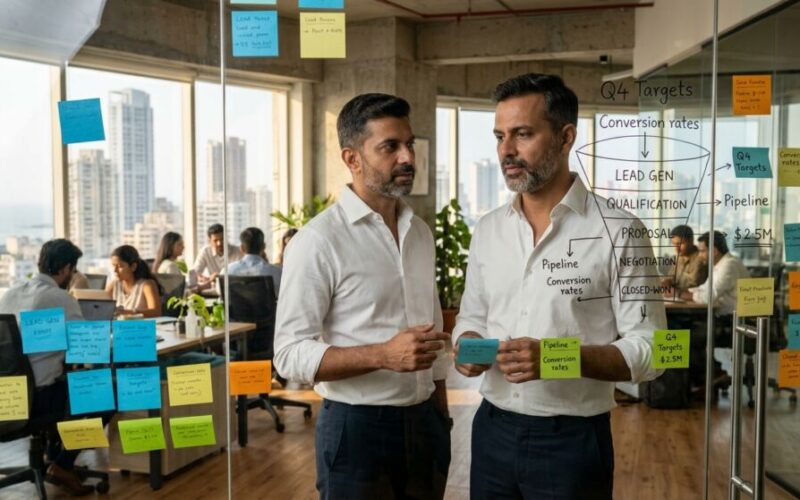

Stop relying on founder-led sales. Learn how to build a scalable B2B sales practice that generates predictable revenue. Book your free audit today.
The failure of the tactic-first approach
Most B2B sales practices fail because they are collections of tactics rather than a coherent strategy. Founders often mistake a set of scripts or a CRM tool for a sales process. This leads to founder dependency, where revenue stops growing the moment the CEO stops making calls.

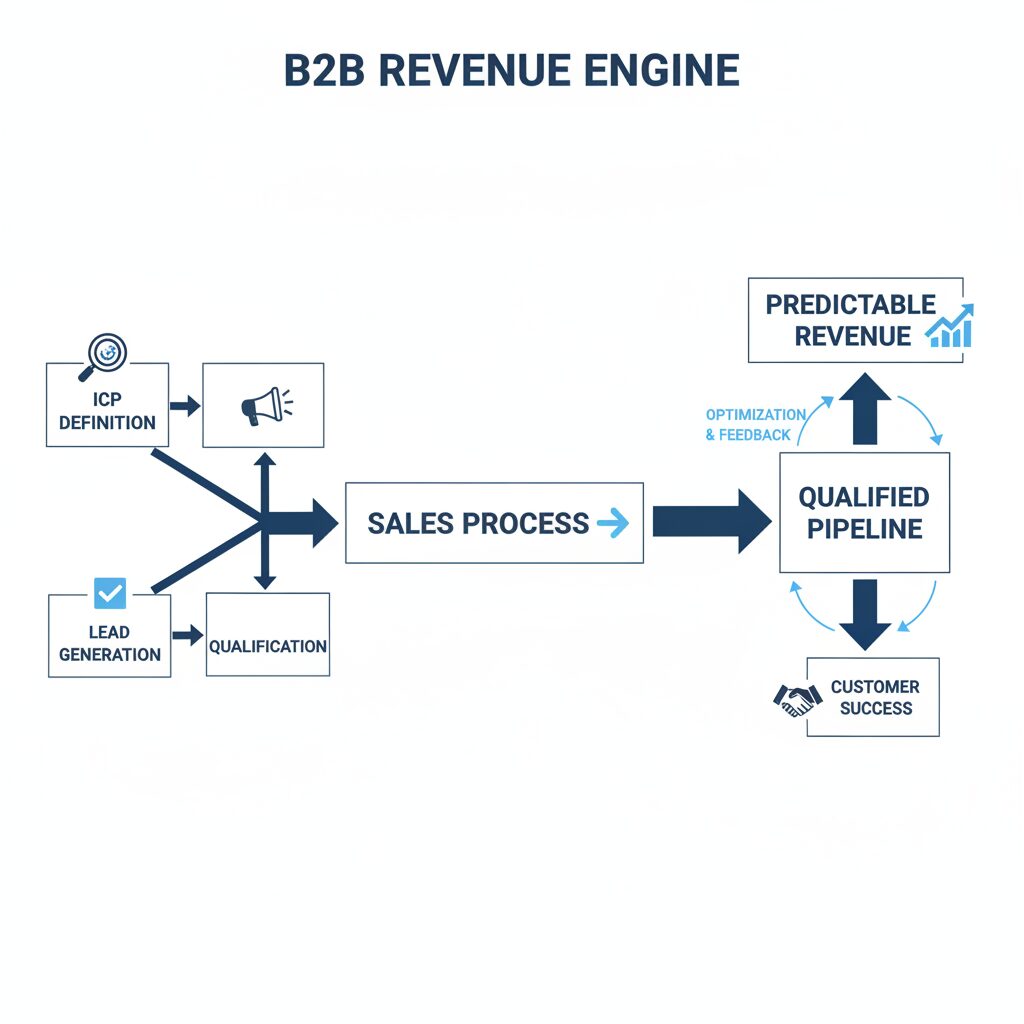
A real B2B sales practice is a system designed to remove guesswork. It aligns your Ideal Customer Profile (ICP) with a repeatable pipeline architecture. When you stop treating sales as an art and start treating it as a predictable engine, you move from hopeful growth to scheduled revenue.
Diagnosing the founder-dependency trap
In our work at Sales Fundas, we see a recurring pattern in Indian SMEs. The founder is the best salesperson because they possess the deepest product knowledge and the most conviction. But this is a strategic liability. If the founder is the only one who can close a deal, the business cannot scale.
The solution is not to hire more junior associates. The solution is to extract the founder’s intuition and codify it into a scalable B2B sales engine. This requires shifting the focus from ‘how to sell’ to ‘who to sell to’ and ‘why they buy’.
When a company relies on a single person’s charisma, the pipeline becomes unpredictable. According to a 2026 report by the India Sales Institute, companies that transition to a system-led sales practice see a 22% increase in average deal size because the process forces a more disciplined discovery phase.
Pipeline architecture over activity metrics
Many managers track ‘activity’—the number of calls made or emails sent. These are vanity metrics. A professional B2B sales practice tracks pipeline architecture. This means measuring the velocity and conversion rate of specific stages in the buyer’s journey.
For example, if you have 100 leads but only 2% move from discovery to proposal, you do not have a closing problem. You have a qualification problem. Fixing the closing technique is a waste of time if the leads are wrong. You must first address the ICP profitability shifts to stop revenue leakage.
A functional architecture separates pre-sales (qualification and discovery) from sales (proposal and closing). In a test conducted with a Mumbai-based SaaS startup, separating these roles reduced the sales cycle from 90 days to 62 days within one quarter. This is the result of pre-sales vs sales alignment.
The logic of the ICP shift
Broad targeting is a recipe for inefficiency. When you try to sell to everyone, your value proposition becomes diluted. A high-impact sales practice identifies the narrow slice of the market where the pain is most acute and the cost of inaction is highest.
In practice, this means moving from a generalist approach to a vertical focus. For instance, instead of selling ‘HR software to SMEs’, sell ‘Compliance automation to manufacturing firms with 500+ employees in Maharashtra’. The specificity allows you to speak the customer’s language and reduces the friction in the sales process.
This shift turns the salesperson from a vendor into a consultant. When you know the specific regulatory hurdles your client faces, you are no longer pitching a product. You are providing a revenue transformation strategy. This is how you build a value proposition that resonates without sounding pushy.
Removing guesswork from the discovery phase
The discovery call is the most neglected part of the B2B sales practice. Most reps use it as a disguised pitch. They ask three generic questions and then spend twenty minutes talking about their features. This is a failure mode.
Effective discovery is a diagnostic process. The goal is to uncover the ‘gap’ between the current state and the desired future state. If the customer cannot quantify the cost of their current problem in ₹ (INR), the deal is not qualified. A professional practice mandates that no proposal is sent until the financial impact of the problem is agreed upon by the client.
Technical founders often struggle here because they want to solve the problem immediately. However, the key to non-salesy discovery is to stay in the problem space longer. The more the customer describes the pain, the more they convince themselves of the need for your solution.
Scaling via embedded leadership
Training a sales team with a one-off workshop is useless. Knowledge decays quickly. To instill a new sales practice, you need embedded leadership. This is where a Fractional CSO or a senior director works inside the team, reviewing real deals in real-time.
Instead of theoretical role-plays, embedded leadership focuses on ‘deal surgery’. You take a stalled deal, analyze the communication gaps, and rewrite the next move based on data. This turns every lost deal into a training asset for the rest of the team.
For Series A startups in India, this model provides the strategic oversight of a full-time CSO without the ₹80 Lakh+ annual salary commitment. This allows the company to build a predictable revenue engine while preserving capital for product development.
The mathematics of predictable revenue
Predictability comes from knowing your ratios. If you know that 10 qualified discovery calls lead to 3 proposals, and 3 proposals lead to 1 closed deal, you can reverse-engineer your revenue target. If your target is ₹1 Crore per month and your average deal size is ₹10 Lakh, you need 10 deals. That means you need 30 proposals and 100 qualified discovery calls.
Once these numbers are clear, the ‘sales practice’ becomes a management of inputs. You no longer ask your team ‘why aren’t you closing more?’ Instead, you ask ‘why are we only getting 60 discovery calls this month?’ This shifts the conversation from blame to optimization.
Without this math, you are just guessing. This is why pipeline architecture is the only way to ensure sustainable growth without burning venture capital. Burning cash to acquire leads that don’t fit your ICP is the fastest way to kill a B2B startup.
Frequently Asked Questions
What is the difference between a sales process and a sales practice?
A process is a sequence of steps. A practice is the disciplined, repeatable application of a strategy to achieve a specific commercial outcome.
Why is founder-led sales a risk for SMEs?
It creates a single point of failure and prevents the business from scaling because the revenue is tied to one person’s time and skill.
How do I know if my ICP is too broad?
If your sales cycle is lengthening and your win rates are dropping despite more leads, your targeting is likely too generic.
Does a B2B sales practice require a CRM?
A CRM is a tool for recording data, not a strategy. You need the practice first; the CRM simply tracks if the practice is being followed.
How often should we review our pipeline architecture?
Perform a deep-dive audit every quarter to identify where leads are stalling and adjust your qualification criteria.
Can a fractional sales director actually implement a practice?
Yes, by focusing on embedded leadership and deal surgery rather than generic training manuals.
What is the most important metric in B2B sales?
Pipeline velocity, which measures how quickly a lead moves from the first touchpoint to a closed deal.
How do we move away from relationship-based selling?
By shifting the conversation from ‘who we know’ to ‘the specific financial problem we solve’ for the client.
Build your predictable revenue engine
Stop relying on founder intuition to hit your numbers. Book a free pipeline audit to identify the leaks in your sales process and start generating predictable revenue today.
Sales Fundas operates as an embedded leadership partner for ambitious B2B founders and CEOs, specializing in pipeline architecture and predictable revenue growth. By combining rigorous sales consulting frameworks with advanced digital advertising and performance marketing, we build sustainable, high-performing sales engines that complement and scale the founder's strategic vision.
- B2B Sales Consulting & Pipeline Architecture Frameworks
- Advanced Performance Marketing & Conversion Rate Optimization
- Search & Generative Engine Optimization (SEO/GEO) Specialists
- B2B Digital Advertising & Lead Generation Experts
This content was drafted using AI-assisted research and meticulously reviewed by the Sales Fundas consulting team to ensure strategic accuracy and alignment with our B2B sales frameworks.