
Stop revenue leakage with a professional B2B pipeline architecture. Learn the 5-stage blueprint, key KPIs, and audit steps to scale Indian mid-market sales.
B2B Pipeline Architecture: The Blueprint for Predictable Revenue in 2026
Most B2B founders in India face a grueling bottleneck: revenue lives and dies by their personal network. It’s a stressful existence where your cash flow looks like a heart-rate monitor rather than a steady climb. When you stop selling to focus on operations, the pipeline doesn’t just slow down—it evaporates. This reliance on founder-led heroics prevents mid-market companies from ever breaking the ₹10–50 Crore ceiling. A scientific B2B pipeline architecture replaces this “hope-based” selling with a scalable B2B sales engine. Below, I’ll show you how to audit your process, align stages with your Ideal Customer Profile (ICP), and bake in a retention strategy that keeps the back door locked while you bring in new logos. By the end of this guide, you’ll have the blueprint to move from being the primary closer to exercising embedded leadership.

Predictable revenue isn’t a stroke of luck or the result of poaching a ‘star’ rep from a competitor. It is the output of a deliberate pipeline architecture that tracks every micro-movement from the first LinkedIn touch to the final signature. In the Indian B2B landscape, where mid-market deals often drag for four to nine months, a lack of structure leads to massive revenue leakage. Internal benchmarks suggest that firms with a documented architecture see a 28% increase in win rates, which means you stop losing deals to “no decision” and start forecasting with 90% accuracy.
Why Most B2B Pipeline Architectures Fail (And How to Audit Yours)
A pipeline without an audit is just a glorified wishlist. I often see Indian SMEs with funnels that look “full,” yet 70% of those deals have been sitting in the ‘Proposal Sent’ stage for 90 days. This stagnation happens because your stages are likely defined by what the salesperson did (e.g., “Sent Quote”) rather than what the buyer did. A sales process audit exposes these friction points, showing you exactly where prospects are falling off the map.
Identifying hidden leaks in the lead-to-cash cycle
At Sales Fundas, we’ve observed that the most expensive leak happens between discovery and solution mapping. Reps often rush to send a PDF quote before they’ve even identified the person holding the checkbook. The result? A “ghosted” deal. An audit uncovers this ‘dead wood’—the 40% of your pipeline that is just taking up space. Purging these leads allows your team to focus on real deals, which means your cost per acquisition (CAC) drops while your reps’ morale actually improves because they aren’t chasing ghosts.
The cost of misaligned sales stages
Vague stages like ‘Lead’ or ‘Meeting’ are dangerous. If your CRM doesn’t mirror the internal procurement hurdles of an Indian enterprise—like the dreaded “Finance Committee Review”—your forecasts will be fiction. Stage misalignment typically costs SMEs about 12% of their potential annual turnover in pure lost productivity. When you fix the architecture, every stage requires a “gate” or a micro-commitment. This could be as simple as the prospect sharing an internal workflow or scheduling a call with their technical lead. If they won’t commit to a small step, they won’t commit to a multi-million Rupee contract.
The 5-Stage B2B Pipeline Architecture Blueprint
To move from ‘hope-based’ selling to a predictable engine, your architecture must be built on buyer-centric milestones, not seller-centric activities. Here is the recommended architecture for B2B mid-market firms in 2026:
- Stage 1: Qualified Lead (MQL/SQL)
Exit Criteria: Prospect matches ICP and has a verified ‘burning house’ pain point. Not just a ‘demo request,’ but a confirmed business problem. - Stage 2: Discovery & Value Alignment
Exit Criteria: The ‘Gap Analysis’ is complete. The prospect has admitted the cost of inaction and agreed that your solution is a viable bridge to their desired state. - Stage 3: Solution Mapping & Technical Validation
Exit Criteria: A tailored proposal is presented and the technical stakeholder has signed off on the implementation feasibility. - Stage 4: Procurement & Stakeholder Consensus
Exit Criteria: The ‘Finance Committee’ or decision-making unit (DMU) has reviewed the commercial terms and provided a verbal ‘yes.’ - Stage 5: Closed-Won / Onboarding
Exit Criteria: Contract signed and the handover to the Customer Success team is scheduled.
By defining these clear ‘gates,’ you eliminate the 70% of dead-wood deals that typically clog Indian B2B pipelines. If a deal cannot meet the exit criteria for Stage 2, it does not move to Stage 3, regardless of how ‘friendly’ the relationship is.

Measuring Architecture Health: The 3 KPIs of Predictable Revenue
A pipeline architecture is only as good as the data it produces. To stop guessing your Q3 targets, you must track these three structural metrics:
- Pipeline Velocity: This measures how fast a lead moves through your architecture.
Formula: (Number of Leads × Average Deal Value × Win Rate %) ÷ Sales Cycle Length. - Pipeline Coverage Ratio: How many times your pipeline value exceeds your quota. For most Indian B2B firms, a 3x to 4x coverage is the safety zone. If your quota is ₹10 Crore, your architecture should hold ₹30–40 Crore in qualified opportunities.
- Stage Conversion Rates: The percentage of deals that move from one gate to the next. A massive drop-off between ‘Discovery’ and ‘Solution Mapping’ indicates a failure in your qualification architecture, not your closing skills.
When these metrics are tracked in real-time, the founder ceases to be the ‘chief rainmaker’ and becomes the ‘chief architect,’ optimizing the flow rather than chasing individual deals.
How to Design a Scalable B2B Pipeline Architecture
Building a scalable B2B sales engine requires you to put down the “spray and pray” shotgun. Your architecture must be precision-engineered for the clients who offer the highest lifetime value and the smoothest implementation. This starts with a cold, hard look at your target.
Defining your Ideal Customer Profile (ICP) for the Indian market
An Ideal Customer Profile (ICP) in India needs to go deeper than “Manufacturing firms in Pune.” You need to look at technographic data, recent funding rounds, and specific “burning house” pain points. Is the founder overwhelmed? Is their data security failing an audit? These are the triggers. When you narrow your focus to a sharp ICP, your discovery calls become 30% more efficient. We help founders build profiles that prioritize companies with an immediate, event-driven need for revenue transformation.
Mapping high-impact touchpoints in the buyer journey
The path to a sale isn’t a straight line anymore. A typical Indian B2B decision now involves six to ten stakeholders. Your architecture needs to account for the “in-between” moments—WhatsApp follow-ups, LinkedIn engagement, and technical deep-dives. We recommend using ‘educational friction.’ This involves giving the prospect a strategic diagnosis or a compelling value proposition early in the game. This filters out the window shoppers, which means your high-value resources are only spent on prospects who have the intent and budget to move forward.
Integrating a customer retention strategy into the sales engine
Acquiring a new client is five times more expensive than keeping one. Yet, many architectures ignore what happens after the “Closed-Won” button is clicked. If your sales team over-promises just to hit a quarterly target, your churn rate will skyrocket, effectively canceling out your growth. Sustainable sales growth demands that you see the customer journey as a circle, not a funnel.
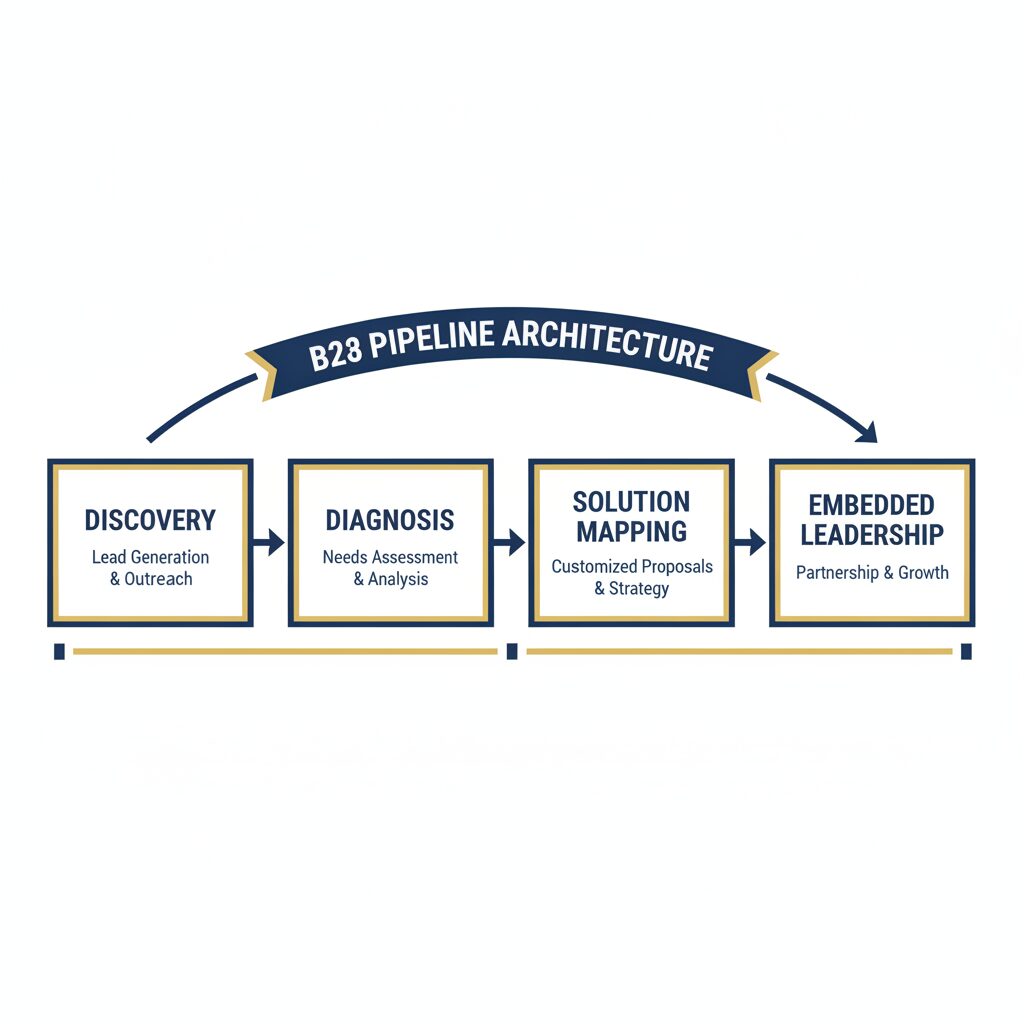
Moving from transactional handoffs to embedded leadership
The moment of handoff from sales to operations is where most Indian B2B relationships break. It’s often a “throw it over the wall” moment that leaves the client feeling abandoned. Instead, use an embedded leadership model. The sales lead should stay visible through the first 30 days of implementation. This overlap prevents the “expectation gap” and builds the trust necessary for upselling and cross-selling later. I’ve seen this one shift increase renewal rates by over 20% in the first year.
Using post-sale data to refine top-of-funnel targeting
Your best future leads are hiding in your current client list. By looking at which customers achieved ROI within the first 90 days, you can reverse-engineer your pipeline architecture to find more of them. This creates a self-optimizing loop. Your sales engine gets smarter with every deal, eventually removing the guesswork and replacing it with data-backed execution.
The Fractional CSO role in maintaining pipeline integrity
Founders usually hit a wall: they can’t afford a ₹1 Crore+ VP of Sales, but they can’t keep managing the team themselves. This is where a Fractional CSO (Chief Sales Officer) or Fractional Sales Director comes in. They provide the high-level governance needed to keep the engine humming without the executive-level salary drag.
Why SMEs struggle with full-time sales leadership hires
Most SMEs hire a “Big Corp” sales leader who is used to having a massive marketing budget and an army of SDRs. When they join a ₹20 Crore company, they freeze. A Fractional CSO, however, is a builder. They bring the experience of scaling ₹100 Crore pipelines and apply it directly to your real deals. They implement the rigor required to make sure your CRM isn’t a graveyard of “following up” tasks.
Managing real deals through pipeline architecture governance
Governance means weekly deal reviews that focus on “Next Steps” rather than “When will it close?” A Fractional CSO hunts for red flags, like a deal that hasn’t had a stakeholder meeting in two weeks or an opportunity where the “Economic Buyer” (the person who actually signs the check) hasn’t been identified. For Series A startups, this level of scrutiny is the difference between a successful round and a bridge loan.
Technical stack and automation for revenue transformation
Your architecture is only as good as the data sitting in your CRM. But let’s be clear: automation shouldn’t replace your voice; it should clear the administrative junk out of your way. For most Indian SMEs, the Zoho vs HubSpot debate is won by whichever tool integrates best with WhatsApp, as that’s where the real business conversations happen in our market.
CRM hygiene: Eliminating data decay in ₹100M+ pipelines
Data decay is a silent profit killer. Every month, about 2-3% of your database goes stale as people change jobs or companies pivot. Maintaining CRM hygiene means every deal must have a loss reason and a hard “Next Action” date. Without this, your pipeline architecture is just a spreadsheet of guesses. Clean data is the first step toward a genuine revenue transformation.
Predictive analytics for mid-market B2B sales
We’re now seeing CRM tools that offer predictive scoring based on how often a prospect opens your emails or visits your pricing page. By weaving these into your B2B pipeline architecture, you can spot which deals are actually “hot” and which are just polite. This turns your sales meeting from a boring status update into a strategic coaching session, helping you build a scalable B2B sales engine that can handle a doubling of lead volume without breaking.
Frequently Asked Questions
What are the core components of B2B pipeline architecture?
It’s a three-legged stool: a hyper-specific Ideal Customer Profile (ICP), buyer-centric stages with defined “exit criteria,” and a tech stack that enforces these rules. Without all three, the system collapses into chaos.
How long does a sales process audit typically take for an SME?
You can usually get a clear picture in two to four weeks. We spend that time digging through your CRM history, interviewing your top performers, and identifying exactly where the “deal rot” is happening.
Why is predictable revenue hard to achieve in founder-led businesses?
Because founders sell on “vibes” and 15 years of industry experience that isn’t written down anywhere. A structured architecture translates that “founder magic” into a repeatable process that a 25-year-old sales rep can actually follow.
How does a customer retention strategy impact short-term sales targets?
It lowers the “acquisition anxiety.” When you know your current clients aren’t leaving, your sales team can focus on high-quality, high-margin deals rather than desperate, low-value wins just to keep the lights on.
What is the ROI of hiring a Fractional CSO for pipeline design?
Usually, the ROI is measured in shorter sales cycles (often by 15-20%) and higher win rates. It also makes your business much more attractive to investors because you’ve proven the revenue isn’t just dependent on you.
How do I identify a ‘real deal’ versus a ‘ghost’ lead?
A real deal involves a “give and get.” If you give a demo, they give you access to the IT head. If you give a proposal, they give you a timeline for the procurement meeting. If it’s all “give” and no “get,” you’re chasing a ghost.
Is a B2B pipeline architecture different for Indian vs. Global markets?
Absolutely. The Indian market is relationship-heavy and requires more touchpoints. You can’t just rely on email sequences; you need a strategy that includes “high-touch” moments like site visits or stakeholder lunches.
Can a CRM fix a broken sales process?
Never. A CRM is a magnifying glass. If your process is broken, a CRM just helps you see how broken it is more clearly. You have to fix the architecture first; the software comes second.
Building a robust B2B pipeline architecture isn’t a weekend project; it’s the bedrock of your company’s future. If your current process feels like a disjointed mess of spreadsheets and “just checking in” emails, you are leaving millions on the table. It’s time to stop relying on individual heroics and start building a scalable B2B sales engine that works while you sleep. At Sales Fundas, we specialize in embedded leadership to help you close real deals with no guesswork. Reach out for a diagnostic call today—let’s start your sales process audit and build a pipeline you can actually trust.
Sales Fundas operates as an embedded leadership partner for ambitious B2B founders and CEOs, specializing in pipeline architecture and predictable revenue growth. By combining rigorous sales consulting frameworks with advanced digital advertising and performance marketing, we build sustainable, high-performing sales engines that complement and scale the founder's strategic vision.
- B2B Sales Consulting & Pipeline Architecture Frameworks
- Advanced Performance Marketing & Conversion Rate Optimization
- Search & Generative Engine Optimization (SEO/GEO) Specialists
- B2B Digital Advertising & Lead Generation Experts
This content was drafted using AI-assisted research and meticulously reviewed by the Sales Fundas consulting team to ensure strategic accuracy and alignment with our B2B sales frameworks.