

Fix your B2B unit economics India. Balance customer acquisition cost vs CLV and build a scalable B2B sales engine for predictable revenue. Get a diagnostic.
Mastering B2B Unit Economics in India: The Math Behind Survival
Most Indian B2B founders eventually hit a painful revenue ceiling because they treat sales as an art form rather than a math equation. As we approach 2026, the era of growth at any cost has evaporated. It has been replaced by a ruthless focus on unit profitability. If you cannot articulate your cost to acquire a customer (CAC) against their lifetime value (LTV), you aren’t running a business. You are managing a series of expensive, high-stakes experiments.

At Sales Fundas, we often see SMEs burning through their reserves by ignoring the fundamental arithmetic of their specific sector. Sustainable growth requires a predictable revenue engine where every rupee spent on marketing and sales returns a measurable multiple. This guide breaks down how to architect a sales engine that prioritizes actual bank balances over vanity metrics. It’s about building a machine that works while you sleep, not one that keeps you awake at 3 AM wondering where the payroll will come from.
The math of customer acquisition cost vs CLV in 2026
Customer Acquisition Cost (CAC) is the total spend required to win a single new account. In the Indian B2B landscape, this figure is often deceptively high. It includes field sales travel to industrial hubs like Pune or Gurgaon, high-touch demonstrations for multiple stakeholders, and procurement cycles that can drag on for six months. If your CAC exceeds the initial contract value, your business model relies on hope. And hope is not a strategy.
Calculating true CAC for Indian B2B cycles
To find your true CAC, add every marketing expense and sales salary—including commissions—and divide it by the number of new customers acquired. Many Indian SMEs forget to include the “Founder Tax.” If the CEO is the one closing every major deal, your CAC is artificially low because you aren’t accounting for your own expensive time. This means your current setup is not a scalable B2B sales engine; it’s a bottleneck.
We suggest using a dedicated CRM platform to track these touchpoints with precision. When you see that a typical lead requires 14 follow-ups and three on-site visits before a signature, you can finally put an honest price tag on that win. For an enterprise deal in India, a healthy CAC might range from ₹5,00,000 to ₹15,00,000. This depends on your total contract value, but the goal is to know your number to the last paisa.
Maximizing Customer Lifetime Value (CLV) beyond the initial contract
CLV is the total revenue you expect from a customer throughout your entire relationship. In the current market, the focus has shifted from the “land” to the “expand” phase via upselling and cross-selling. If your churn rate is high, your CLV drops off a cliff. This makes even a “cheap” CAC unsustainable because you are essentially pouring water into a leaky bucket.
Internal benchmarks show that companies with structured account management see a 40% higher CLV than those treating sales as one-time wins. You increase this value by solving the “next” problem for the client. Once the initial software is installed, what’s the next hurdle? Solving that is where your revenue transformation begins in earnest.
Benchmarks for profitable B2B growth in the Indian market
Profitability isn’t just about having cash in the bank today. It is about spend efficiency. Today’s investors and boards demand specific ratios that prove a business can survive without a constant drip-feed of external capital.
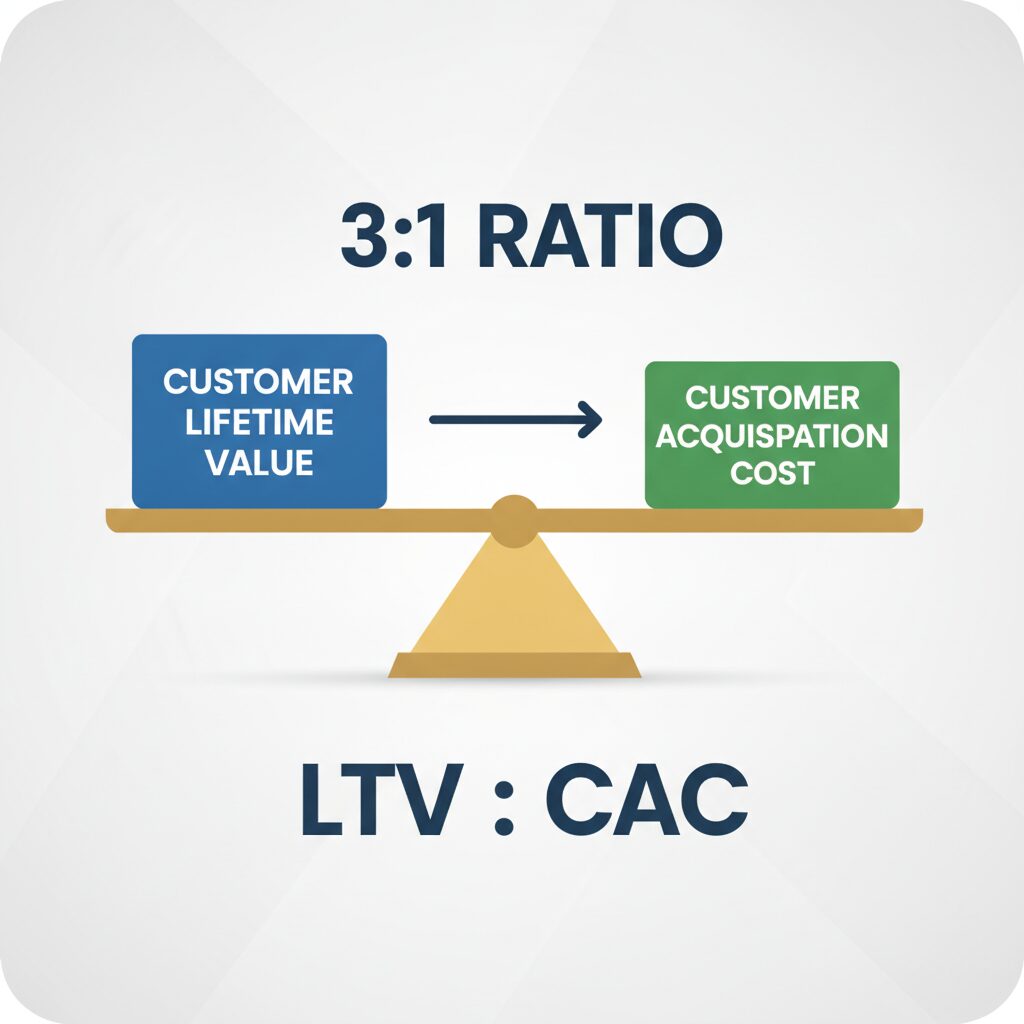
The 3:1 LTV to CAC ratio: Why it is non-negotiable
Your Lifetime Value must be at least three times your acquisition cost. If the ratio is 1:1, you lose money on every deal after factoring in service delivery and office overhead. If it is 5:1, you are likely being too conservative and may be handing market share to your competitors by underspending.
In the field, we see Indian startups operating at a dangerous 1.5:1 ratio because they offer deep discounts just to win “trophy” logos. A Fractional CSO helps you transition from this price-based desperate selling toward value-based pipeline architecture. This protects your margins so you don’t grow yourself into bankruptcy.
CAC payback periods for SMEs: Keeping it under 12 months
The CAC payback period is how many months it takes to earn back the cost of acquiring a customer. For Indian SMEs, the target should be 12 months or less. If it takes 24 months to break even on a customer, but your average contract length is only 18 months, you are effectively paying for the privilege of working for your clients.
Current trends suggest that high-performing B2B firms in Bangalore and Mumbai reduce these periods by automating the discovery phase. By the time a human representative jumps on a call, the prospect is already qualified against a strict Ideal Customer Profile (ICP). This saves hours of expensive sales time on leads that were never going to buy anyway.
SME revenue transformation through pipeline architecture
Real revenue transformation isn’t about hiring a “rockstar” salesperson with a thick Rolodex. It is about fixing the underlying plumbing of your system. This is what we call pipeline architecture.
Moving away from founder-dependent sales
Most Indian B2B companies are trapped in the founder-led sales phase. This works for your first 10 clients because you can use your personal passion to close deals. However, it becomes a massive roadblock for the next 100. A scalable B2B sales engine requires a process that works even if the founder is on vacation.
When you document every step—from the first cold LinkedIn touch to the final signature—you move from guesswork to a repeatable model. This allows the founder to stop doing 10 demos a week and start focusing on the 10,000-foot strategic view. This is the only way to scale past the initial revenue plateau.
Defining your Ideal Customer Profile (ICP) to reduce churn
The fastest way to kill your unit economics is by selling to the wrong people. “Bad-fit” customers require more support, complain more often, and churn within the first year. This destroys your CLV and inflates your CAC through wasted effort.
We have noticed that narrowing your focus to a specific industry vertical—like pharma manufacturing or fintech logistics—actually increases revenue. By defining your ICP, your marketing becomes a laser instead of a floodlight. Your team becomes experts in one niche, allowing you to charge premium rates. This directly improves your unit economics because your expertise justifies your price.
Why a Fractional CSO is the catalyst for unit economic health
Most SMEs cannot afford a full-time Chief Sales Officer (CSO) with a ₹1,00,00,000+ salary. Yet, they also cannot afford to make ₹5,00,00,000 mistakes in their sales strategy. This is where embedded leadership becomes the logical move.
Embedded leadership vs external consulting
External consultants usually give you a shiny PowerPoint and then disappear. A Fractional CSO works inside your team, taking real ownership of sales targets. They help you hire the right reps and set up the CRM systems properly. It is the difference between someone telling you how to fix a car and someone getting under the hood with a wrench.
In our work at Sales Fundas, we focus on the “real deals” in your pipeline. We don’t use generic playbooks. We use your actual CRM data to build a sales engine tailored to your specific product. This hands-on approach ensures that the new processes actually stick and result in closed deals, not just more meetings.
Building a scalable B2B sales engine with no guesswork
A truly scalable engine is one where you know that putting ₹1,00,000 into the top of the funnel will consistently result in ₹4,00,000 at the bottom. This requires knowing your conversion rates at every single stage. If you don’t know the percentage of discovery calls that turn into demos, you are still operating on gut feel. In 2026, gut feel is a liability.
Common pitfalls in Indian B2B sales math
Even with a great product, companies fail because they ignore the “hidden” costs of doing business in India. These calculation errors can turn a “profitable” deal into a net loss once the final bill comes due.
Underestimating the cost of long enterprise sales cycles
Enterprise deals in India can take 12 to 18 months. If your team spends a year nurturing a lead, you must factor their salaries, travel to Mumbai or Bangalore, and technical support costs into that deal’s CAC. Small contracts with long cycles usually deliver a negative ROI. You have to be brave enough to walk away from deals that don’t fit your unit economic requirements.
Ignoring the hidden costs of service delivery
Gross margin is the engine of CLV. If your software requires weeks of manual configuration or your service needs constant on-site hand-holding, your margins are thin. Profitable growth requires high-margin products. If delivery costs eat 50% of your revenue, you need to revisit your pricing or automate your implementation process immediately.
Frequently Asked Questions
What is a good LTV to CAC ratio for B2B SaaS in India?
A ratio of 3:1 is the gold standard. This provides enough margin to cover your operating expenses while allowing you to reinvest in the business for predictable revenue growth.
How do you reduce customer acquisition cost without sacrificing lead quality?
Tighten your Ideal Customer Profile (ICP). Use content-led discovery to filter out prospects who aren’t ready to buy. This prevents your expensive sales reps from wasting time on low-intent leads.
Why do Indian SMEs struggle with unit economics during scaling?
Most fail to account for the “complexity tax”—the fact that management and coordination get more expensive as the team grows. They often try to scale the team before they have a repeatable sales engine in place.
What role does a Fractional Sales Director play in revenue transformation?
They provide the high-level strategy and system design needed to stop founder-dependent sales. They implement the math-driven processes that internal teams often lack, ensuring real deals close without the usual guesswork.
How does pipeline architecture affect long-term profitability?
A solid architecture reduces “leaks” in the sales funnel. By improving conversion rates at each stage, you effectively lower your CAC and make your revenue forecasts much more accurate.
What is a typical CAC payback period for an Indian SME?
Aim for a payback period of under 12 months. If it takes longer than 18 months to recover your costs, you will likely face a cash flow crisis during your next aggressive growth phase.
How do you calculate CLV if you have high churn?
Multiply your average monthly revenue per account by your gross margin, then divide that by your monthly churn rate. If churn is high, this number will be small, indicating that your unit economics are broken and need immediate attention.
Should I focus on CAC or CLV first?
Always focus on CLV first. There is no point in perfecting your acquisition cost if the customers leave after six months. Once retention is stable, then you can optimize your CAC for efficient, predictable growth.
Sustainable growth in the Indian B2B sector requires more than a “hustle” mindset; it demands a rigorous focus on the numbers. By aligning your pipeline architecture with validated unit economics, you eliminate the uncertainty that keeps revenue stalled. If your sales engine is sputtering or your CAC is eating your profits, it is time for a change. Contact Sales Fundas today for a diagnostic of your sales engine and move toward a scalable, predictable revenue model that actually pays for itself.
Sales Fundas operates as an embedded leadership partner for ambitious B2B founders and CEOs, specializing in pipeline architecture and predictable revenue growth. By combining rigorous sales consulting frameworks with advanced digital advertising and performance marketing, we build sustainable, high-performing sales engines that complement and scale the founder's strategic vision.
- B2B Sales Consulting & Pipeline Architecture Frameworks
- Advanced Performance Marketing & Conversion Rate Optimization
- Search & Generative Engine Optimization (SEO/GEO) Specialists
- B2B Digital Advertising & Lead Generation Experts
This content was drafted using AI-assisted research and meticulously reviewed by the Sales Fundas consulting team to ensure strategic accuracy and alignment with our B2B sales frameworks.