

Stop relying on founder-led sales. Learn how to build a scalable B2B sales process in India for 2026. Get predictable revenue and real deals. Start now.
The Revenue Trap of Relationship-First Selling
Most Indian B2B founders rely on personal networks to hit their first ₹5 Crores in revenue. This works until it doesn’t. By June 2026, relying on your personal ‘reach’ creates a ceiling that no junior hire can break. To scale, you need a pipeline architecture that functions without the founder in every meeting. A real sales process is a repeatable sequence of stages that turns a stranger into a paying client using data, not just coffee meetings.

Building a B2B sales process in India requires moving away from ‘guesswork’ and toward a scalable B2B sales engine. In our work at Sales Fundas, we see companies struggle because their steps are vague. If your sales stage is ‘Proposal Sent’ but you have no idea what the buyer’s internal approval logic is, you don’t have a process; you have a hope. You need predictable revenue driven by clear exit criteria at every stage.
Defining Your 2026 Ideal Customer Profile (ICP)
A process starts with knowing who you are not selling to. In the current Indian market, chasing every lead leads to ‘dead deals’ that clog your CRM. Your Ideal Customer Profile (ICP) must be narrow. Focus on the specific industry, revenue bracket, and technographic profile that sees value in your solution immediately. For instance, a SaaS company targeting Mumbai-based logistics firms with over ₹100 Crores in turnover has a clear target. A company ‘targeting all logistics’ has a mess.
According to 2026 market data, Indian SMEs that narrowed their ICP saw a 22% reduction in sales cycle length compared to generalists. This is because your messaging becomes sharper. When you speak the specific language of a CFO in a manufacturing plant in Pune, you build authority faster than a generalist. Use this profile to dictate your lead generation efforts, whether you use vertical B2B SaaS lead generation or traditional outbound methods.
Mapping the Pipeline Architecture
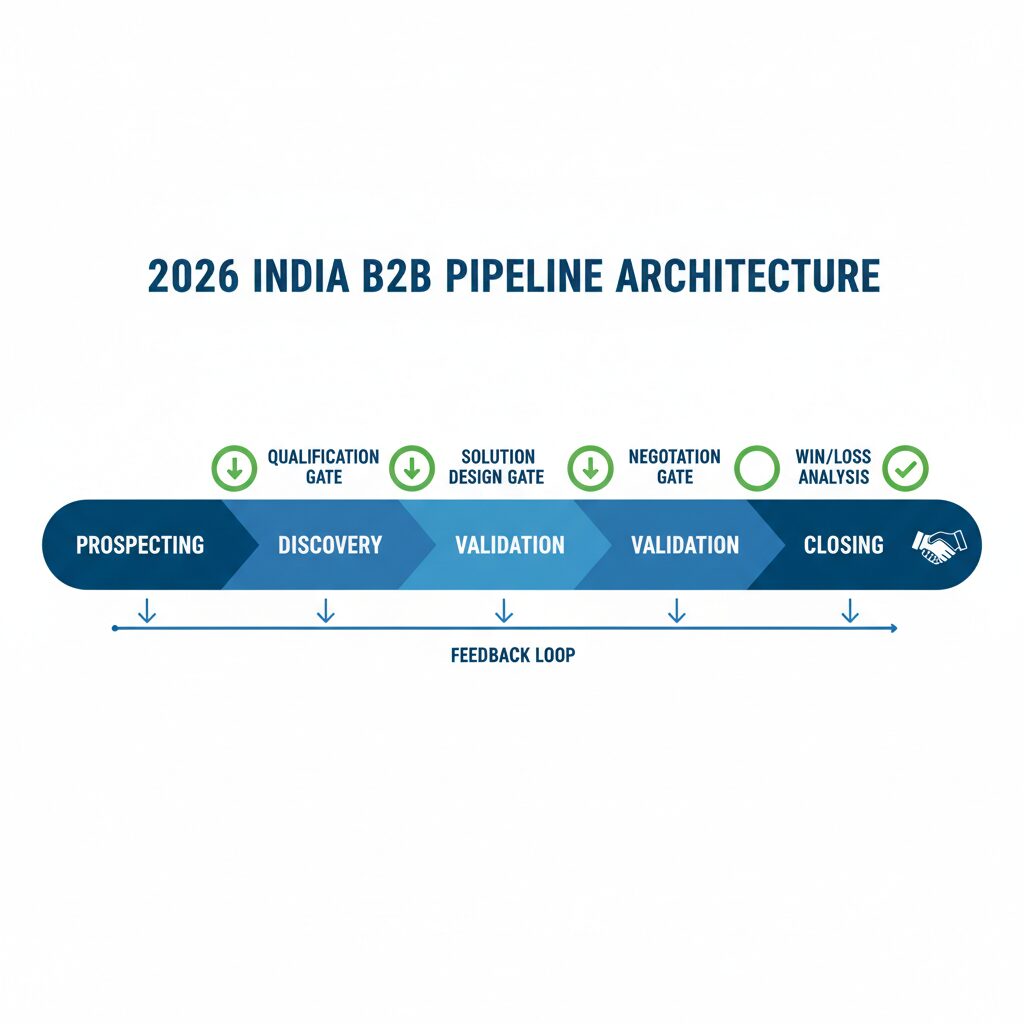
Stop thinking about a funnel and start thinking about a pipeline architecture. A funnel suggests people just ‘fall through’ to the bottom. Architecture is built. Each stage must have a ‘Gate’ that the prospect must pass through. In practice, these stages usually look like this:
Discovery is the most neglected stage for Indian founders. Many jump straight to a demo. Instead, use this stage to find the ‘pain points’ and budget. If the prospect cannot define the cost of their current problem, they will never agree to the price of your solution. For technical founders, this shift is even more vital. You can find more on this in our discovery guide for technical founders.
Validation follows discovery. This is where you prove you can solve the problem. In 2026, this often involves a pilot or a deep-dive workshop. If you are selling high-ticket consulting, this is where a Fractional Sales Director adds value by aligning your solution with the prospect’s long-term business goals. Finally, Closing and Onboarding ensure the deal is a real deal and not just a signed paper that never pays.
Transitioning from Founder-Led to Embedded Leadership
If you are the only one who can close deals, you own a job, not a business. The transition to a professional sales team often fails because the founder hires ‘junior associates’ and expects them to figure it out. This never works. You need embedded leadership to set the pace. This is where the Fractional CSO service becomes a strategic asset for Series A startups. It provides the seniority of a VP of Sales without the ₹1.5 Crore annual salary commitment.
A Fractional Sales Director builds the playbooks, sets the KPIs, and hires the right talent. They ensure the scalable B2B sales engine is actually being maintained. In Mumbai and Bangalore, the talent war for top sales reps is intense in 2026. A structured process makes your company more attractive to high-performers because they see a clear path to hitting their targets and earning commissions.
The Tech Stack for India: Zoho vs HubSpot in 2026
A process is only as good as the data it produces. In India, your CRM choice usually comes down to Zoho vs HubSpot. Zoho remains a favorite for many Indian SMEs due to its localized pricing and deep integration with other business tools. HubSpot often wins for teams that prioritize marketing automation and a cleaner user interface. Regardless of the tool, the rule remains: if it is not in the CRM, it did not happen. You can compare the top free CRM platforms to see which fits your current scale.
Your tech stack should also account for the heavy use of WhatsApp in Indian B2B sales. By June 2026, official API integrations that log WhatsApp conversations directly into the deal flow are standard. This prevents ‘dark social’ where sales data stays trapped on an individual rep’s phone. Transparency in communication leads to better forecasting and fewer surprises at the end of the quarter.
Revenue Transformation through Training
Even the best process fails with poorly trained reps. High impact sales training in 2026 isn’t about teaching people how to talk; it’s about teaching them how to listen. Modern B2B buyers are more informed than ever. They have already researched your competitors and read your reviews before they talk to you. Your team needs to act as consultants, not ‘pitchmen.’
Focus your training on pipeline architecture and closing techniques that work in the Indian context. This includes handling the ‘I will get back to you’ objection which is common in Indian business culture. Training should be ongoing, not a one-time event. For teams in major hubs, specialized sessions like sales training in Bangalore or Mumbai can help localize these global best practices to the specific business environment of those cities.
Frequently Asked Questions
How long does it take to build a B2B sales process in India?
A basic framework takes about four to six weeks to document and implement. Seeing measurable results in predictable revenue usually takes one full sales cycle, which is typically three to six months for Indian B2B firms.
Should I hire a full-time VP of Sales or a Fractional CSO?
A Fractional CSO is better for startups earning between ₹5 Crores and ₹20 Crores who need strategy without the high overhead. Full-time hires make more sense once the process is stable and you are ready for aggressive, high-volume scaling.
What is the biggest mistake Indian founders make in sales?
The biggest error is hiring junior reps too early without a defined process for them to follow. This leads to high turnover and ‘no guesswork’ becoming ‘all guesswork’ as the founder stays stuck in the daily grind.
Is Zoho better than HubSpot for Indian B2B companies?
Zoho is often more cost-effective and offers better local support for Indian businesses. HubSpot is superior for user experience and companies with a heavy focus on content-led inbound marketing.
How do I handle long sales cycles in the Indian market?
Shorten cycles by implementing strict qualification criteria early in the pipeline architecture. If a lead doesn’t meet your ICP requirements, move them to a long-term nurture sequence rather than wasting active sales time.
What is a realistic sales commission structure in India for 2026?
Most 2026 models use a base salary plus a performance-linked incentive ranging from 5% to 15% of the deal value. The exact Fractional CSO pricing or rep salary depends on the complexity of the solution and the seniority required.
How do I stop being founder-dependent for sales?
Document every step of your successful sales calls and turn them into a repeatable playbook. Shift your role from ‘Lead Closer’ to ‘Sales Coach’ by hiring embedded leadership to manage the team.
Can I automate my B2B sales process entirely?
Automation works for lead generation and follow-ups, but high-ticket Indian B2B deals still require human intervention. Use AI to handle the ‘busy work’ so your reps can focus on building real deals through high-level consultation.
If your sales results feel like a roller coaster, your process is likely broken. Stop guessing and start building a scalable B2B sales engine that delivers results month after month. Start your free sales assessment today and identify the gaps in your revenue growth without any upfront cost.
Sales Fundas operates as an embedded leadership partner for ambitious B2B founders and CEOs, specializing in pipeline architecture and predictable revenue growth. By combining rigorous sales consulting frameworks with advanced digital advertising and performance marketing, we build sustainable, high-performing sales engines that complement and scale the founder's strategic vision.
- B2B Sales Consulting & Pipeline Architecture Frameworks
- Advanced Performance Marketing & Conversion Rate Optimization
- Search & Generative Engine Optimization (SEO/GEO) Specialists
- B2B Digital Advertising & Lead Generation Experts
This content was drafted using AI-assisted research and meticulously reviewed by the Sales Fundas consulting team to ensure strategic accuracy and alignment with our B2B sales frameworks.