
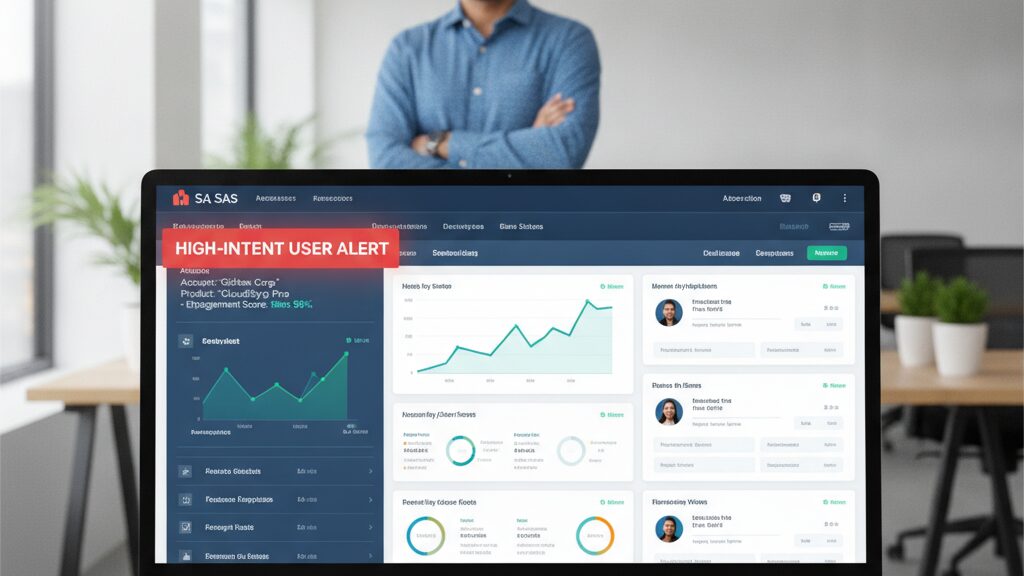
How Indian B2B SaaS teams turn product usage data into sales signals, cut CAC, and close faster. A practical PQL and PQA framework with 2026 benchmarks.
The PLG vs SLG debate is over. Here’s what replaced it.
Ask ten Indian B2B SaaS founders whether they run product-led growth or sales-led growth, and most will hesitate, because the honest answer by 2026 is neither, exactly. A benchmark study of more than 600 B2B SaaS companies found that 58 percent already run some form of product-led growth, and 91 percent of those plan to invest more in it over the next year. What almost none of them have solved is the harder problem sitting underneath that number: knowing which free-trial signup is actually ready to buy, instead of guessing.
That harder problem is what Product-Led Sales, or PLS, is built to solve. It is not a rebrand of PLG and it is not a retreat back to cold calling. PLS uses real product usage data to tell a human sales rep exactly when to step into a self-serve motion, and just as importantly, when to stay out of it entirely.

For a founder running a ten-person team instead of a fully staffed SDR floor, this matters more than the framework name suggests. Every hour a rep spends cold-calling a free user who was never going to convert is an hour not spent on the account that is already trying to buy. Research on B2B software buying behavior backs this up from the buyer’s side too: roughly 65 percent of SaaS buyers say they want a blend of self-serve exploration and sales-assisted help, not one or the other. They are not rejecting salespeople. They are rejecting salespeople who show up too early with nothing useful to say.
What Product-Led Sales actually means
Product-Led Sales is the practice of using in-product behavior, not a lead form or a cold list, to decide the moment a sales rep enters a conversation. In pure PLG, a user can self-serve through the entire lifecycle and a rep might never appear at all. In PLS, a rep steps in at one specific point: after the user has already found real value and hit a wall that only a paid tier, an integration, or an enterprise plan can remove.
The lead that triggers this moment is a Product Qualified Lead, or PQL: a user whose in-product behavior, rather than their job title or a form submission, shows they are close to a purchase decision. The gap between a PQL-driven pipeline and a traditional marketing-qualified pipeline is not small. Benchmark data compiled across recent PLG research puts PQL-to-paid conversion in the 20 to 30 percent range, against roughly 5 to 10 percent for MQLs, a two to three times difference that shows up directly in your CAC.
The catch, and the opportunity, is that most companies have not actually built this yet. Industry surveys put the share of PLG companies running a real PQL framework at around a quarter. The rest are sitting on usage data that never does anything more useful than populate a login count.
Four signals that predict a sale better than a lead score ever could
A PQL framework is only as good as the behavioral signals feeding it. Four have held up consistently across SaaS companies that track this properly.
Usage velocity. A user who performs a core action ten times inside the first two days is a different prospect from one logging in once a week out of habit. A sudden jump in activity, a threefold increase inside a seven-day window for example, usually marks the shift from exploring the product to depending on it.
Feature collision. This happens when a user repeatedly tries to reach a feature sitting behind a paywall. It is one of the clearest signals available precisely because it captures a moment of real friction, not passive browsing. A user who has hit a hard usage limit three times this week is not curious. They are stuck, and they already know what would unstick them.
Pricing page visits. When a free-plan user starts returning to the upgrade or pricing page, that is a hand-raise, even if they never fill out a form. Product teams consistently rank pricing page visits alongside team invitations among the strongest available purchase-intent signals, for the simple reason that nobody browses a pricing page for entertainment.
Organizational density. When several users from the same company domain join a free workspace inside a few weeks, the unit of analysis has to change. This is no longer one user; growth teams call it a Product Qualified Account, or PQA, and it usually calls for a single site-license conversation rather than five separate upgrade emails landing in five different inboxes.
What changes for the sales rep: from prospector to consultant
The most common way founders break this model is by hiring reps who treat a PQL like a cold lead. If a rep’s opening line to a high-intent user is “would you like a demo,” the model has already failed. The user is not curious about the product. They are already inside it, using it, running into its limits.
The role that works instead sounds more like this: “I noticed your team processed 500 invoices this week and you’re close to the API limit on your current plan. I can help you move to a tier that won’t interrupt that workflow.” That is not a pitch. It is what a good account manager already says to a customer they understand, which is exactly the posture a PQL-triggered conversation needs.
This is also why engaging too early shows up again and again as the single most common failure mode in PLS rollouts. A rep who reaches out before a user has felt real friction just feels like an interruption, and an interruption at the wrong moment teaches users to ignore your product’s prompts from then on.
What this does to CAC in an Indian B2B SaaS budget
Customer acquisition cost has climbed 50 to 100 percent across B2B SaaS globally since 2018, and the median payback period on that spend stretched to around 18 months in 2024, up from 14 the year before. Very few early-stage Indian SaaS companies are funded to absorb that kind of drift, which is exactly why the unit economics behind this matter more here than in markets with deeper venture reserves. A PLS motion pushes back on that drift in a specific way: instead of paying for outbound reach to find a handful of ready buyers inside a large cold list, the product narrows that list for free, and the sales budget only has to cover the close, not the search.
The conversation with a PQL-triggered lead is also a shorter conversation by nature. It starts at “how do we scale this across the team” rather than “why would we need this at all,” because the buyer already answered the second question themselves, before sales ever got involved.
Wiring the product to the CRM
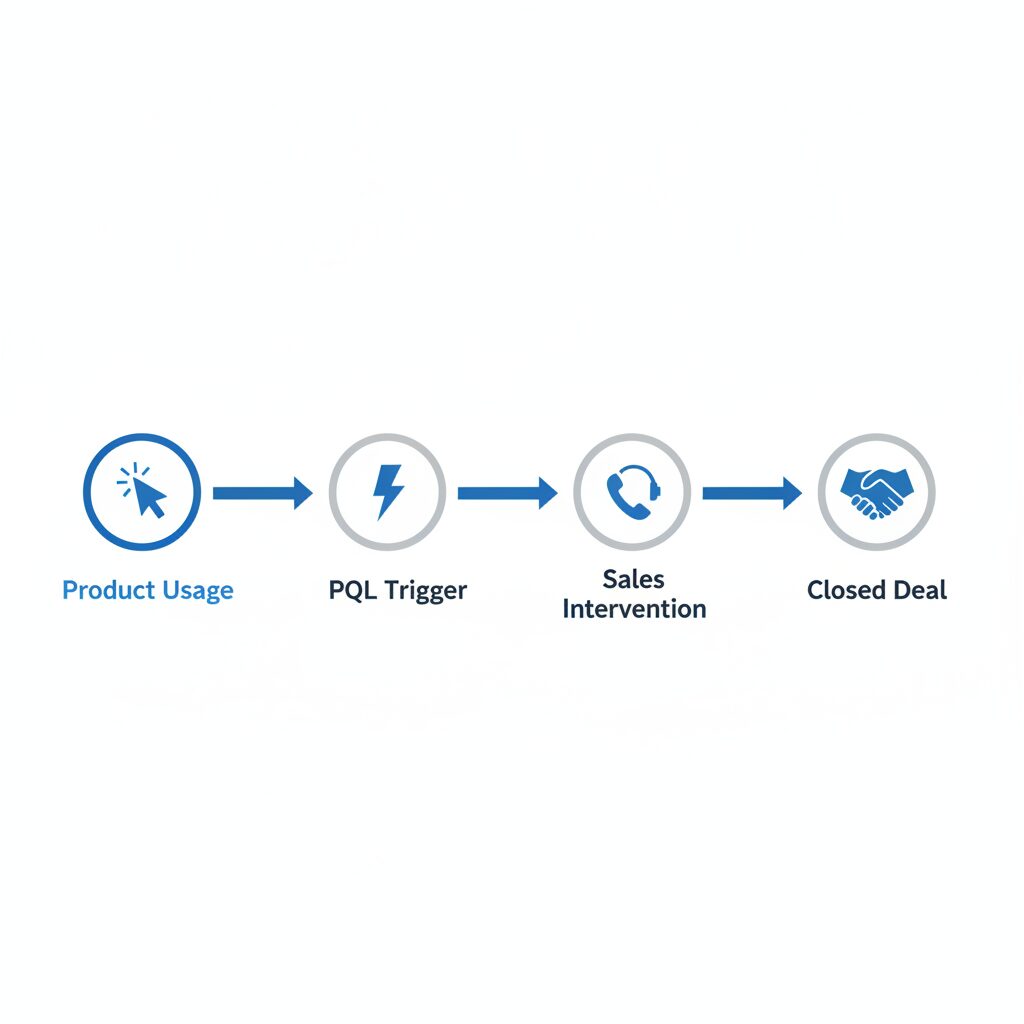
None of this works if usage data lives only in the product database while sales works out of a CRM that has never seen it. The pipeline architecture is simple to describe even though it takes real engineering effort to build: a product event triggers a score, the score crosses a threshold, and that threshold creates a task inside the CRM your reps already use.
For a mid-sized team, this is often no more exotic than a Zoho or HubSpot workflow that fires the moment an account crosses 80 percent of a usage limit. Teams operating at more scale sometimes bring in a layer built specifically for this job: tools like Pocus, Correlated, or Endgame sit between the product analytics stack and the CRM to manage PQL and PQA scoring directly. Most Indian B2B SaaS teams do not need that layer yet. They need the first wire between product and CRM to exist at all.
Where PLS rollouts break
Engaging too early, already covered above, is worth repeating because it remains the single biggest reason these motions fail. A close second is treating every high-usage account as a good account. A freelancer hammering your product daily is a vanity metric. A moderate user inside a 500-person company is the real opportunity, which is why a workable PQL score has to combine behavior with firmographic fit, not usage alone.
A quieter failure sits inside the compensation plan. If reps are still paid on raw call volume or meetings booked, they have no reason to wait for a real signal, and the whole model collapses back into cold-calling with extra steps. Compensation has to reward PQL-to-close and expansion revenue directly, or the behavior change never sticks.
The last one is internal rather than customer-facing: product and sales quietly working from different definitions of “ready.” If product treats a PQL as anyone who finished onboarding while sales treats it as anyone who visited the pricing page twice, reps get routed the wrong accounts, have a bad first call, and stop trusting the score within a month. That alignment needs to be an ongoing conversation between the two teams, not a single kickoff meeting everyone forgets by next quarter.
How to actually start this quarter
Begin with a data audit, not a tool purchase. Pull your last twenty customers who converted from free to paid and find the two or three actions nearly all of them took in the week before they upgraded. That list, not a generic PLG playbook, is your actual PQL definition.
Next, write down exactly who gets notified when each signal fires and what the rep is supposed to say. Skip the generic template. The outreach has to reference the specific behavior the system just observed, or it reads like every other sales email the user has already trained themselves to ignore.
Then watch one number for the whole first quarter: PQL-to-closed-won conversion, measured against your existing lead conversion rate. If it isn’t meaningfully higher, the trigger criteria are too loose. Narrow them until sales only hears about accounts that are close to asking for an enterprise plan on their own.
Frequently asked questions
Is Product-Led Sales the same as PLG?
No. PLG lets the product carry the entire acquisition and expansion motion with little or no sales involvement. PLS adds a human rep back in at one specific, data-triggered moment.
What counts as a Product Qualified Lead?
A user whose in-product behavior, not their title or a form submission, indicates they are close to a purchase decision. The exact definition should come from your own conversion data, not a template someone else built for a different product.
What is a Product Qualified Account, or PQA?
The account-level version of a PQL. When several users from one company are active inside a free workspace, the buying unit is the account rather than any single person, and the right move is usually one company-wide license instead of five individual upgrades.
When should a rep first contact a self-serve user?
Only after the user has reached a value milestone or hit a limitation that a paid tier would remove. Anything earlier reads as an interruption rather than help.
Does PLS remove the need for SDRs?
It replaces cold-calling SDRs with a smaller number of product specialists focused on expansion and conversion, usually a better use of a lean team’s hours than a bigger headcount.
Which CRM works best for a PLS motion in India?
Whichever one your team already uses well and can wire to your product’s event data. Zoho and HubSpot both handle this comfortably for mid-market teams, and larger teams sometimes add a dedicated PQL layer like Pocus or Correlated on top.
Will this increase churn?
Generally the opposite happens. You are only having sales conversations with users who have already found value, which tends to lower churn rather than raise it.
Does this change average deal size?
Often yes, and upward. A rep working from real usage data can point to the specific enterprise feature a team needs instead of guessing at a package.
Most Indian B2B SaaS teams already have the usage data this framework runs on. What’s usually missing is the scoring model and the CRM wiring that turns that data into an actual sales trigger. If your pipeline still depends on the founder personally chasing every deal, or your reps are cold-calling free users with no idea who’s actually close to buying, that gap is worth closing before it gets more expensive. Book a strategy call with our Fractional CSO team and we’ll map out what a PQL pipeline would look like for your product specifically.
Sales Fundas operates as an embedded leadership partner for ambitious B2B founders and CEOs, specializing in pipeline architecture and predictable revenue growth. By combining rigorous sales consulting frameworks with advanced digital advertising and performance marketing, we build sustainable, high-performing sales engines that complement and scale the founder's strategic vision.
- B2B Sales Consulting & Pipeline Architecture Frameworks
- Advanced Performance Marketing & Conversion Rate Optimization
- Search & Generative Engine Optimization (SEO/GEO) Specialists
- B2B Digital Advertising & Lead Generation Experts
This content was drafted using AI-assisted research and meticulously reviewed by the Sales Fundas consulting team to ensure strategic accuracy and alignment with our B2B sales frameworks.