

You close every deal. You take every discovery call. You write every proposal. And somewhere between your third Zoom of the day and a midnight follow-up email, you wonder: Is this what building a company is supposed to feel like?
Here’s the short answer. No. And the longer answer is what this entire guide is about.
If you’re a B2B founder who is still the primary or only salesperson in your company, you have a systems problem disguised as a sales problem. The goal of this guide is to give you a concrete, stage-by-stage plan to stop being the bottleneck. Not someday. Now.
Why Founders Get Trapped as Sole Salespeople (And Why It’s Not Your Fault)
It starts with necessity. In the early days, founder-led sales is exactly right. You need to be in the room. You need to hear objections firsthand. You need to feel the friction of a deal going cold.
But then something strange happens.
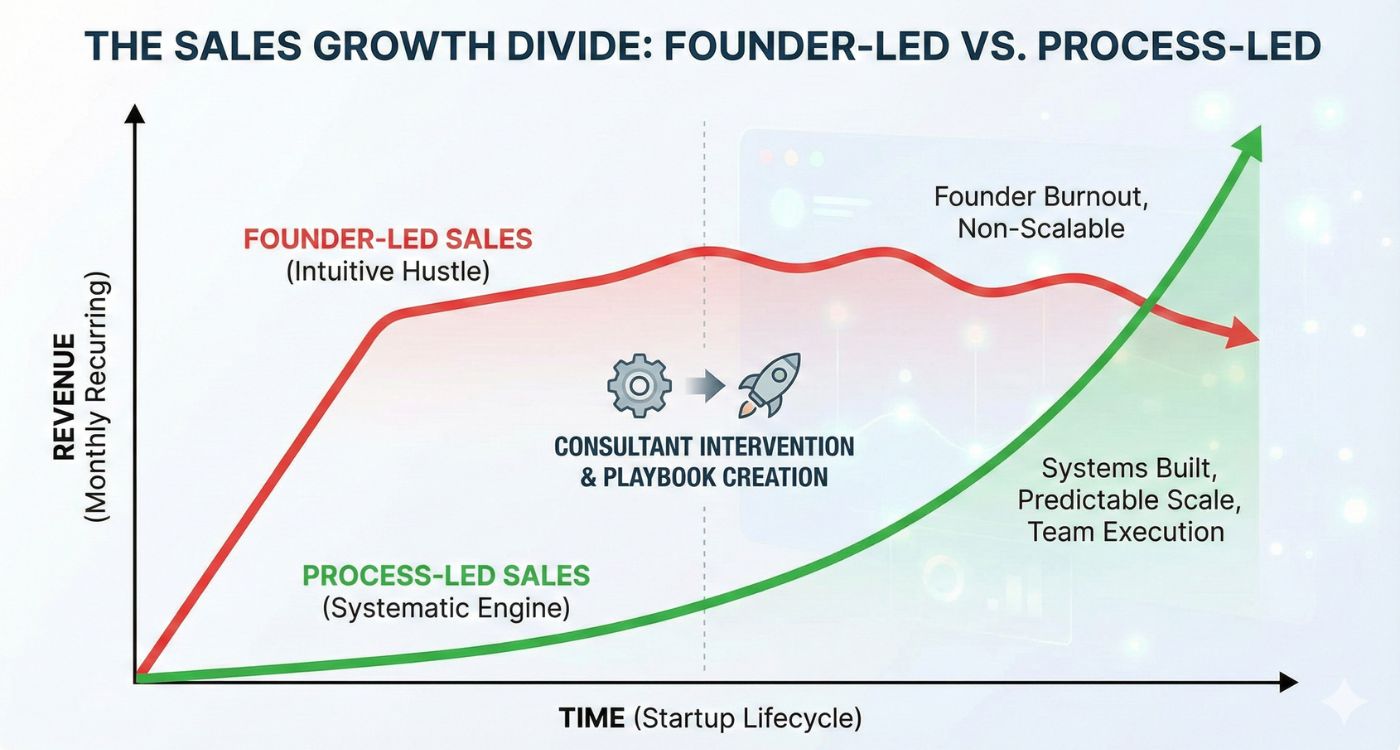
You get good at it. Buyers trust you specifically. Revenue starts flowing but it’s all wired through you personally. And now stepping away feels like pulling the pin on a grenade.
At Sales Fundas, we’ve seen this pattern repeat itself across dozens of founder engagements. The founder becomes the product. Not the company. Not the team. The founder. And that’s when scaling stops.
Key Takeaway: Founder-led sales is a starting point, not a destination. The exit from this stage is a system not a salesperson.
The Founder Bottleneck Index: Where Are You Right Now?
Before you build anything, you need to know what stage you’re actually in. We call this the Founder Bottleneck Index, and it’s something we use at Sales Fundas to diagnose clients before we write a single word of their sales playbook.
Ask yourself these four questions:
1. If you took a two-week vacation, would deals still close? 2. Can you write down, right now, your exact sales process from first contact to signed contract? 3. Have you hired a salesperson who failed within their first 90 days? 4. Do buyers frequently say they want to “talk to the founder” before they’ll commit?
If you answered no to the first two and yes to the last two, you’re at Stage 1. You haven’t built a sales system yet. You’ve built a sales personality.
That’s the starting line not a failure. But you have to know where you are before you can map where to go.
Stage 1: Own the Sale First (And Document Everything While You Do It)
Here is a truth most sales consultants won’t say out loud: you cannot hire your way out of a sales problem you haven’t solved yourself.
If you don’t know why deals close, a new rep won’t figure it out either. They’ll try, fail, and leave within six months. You’ll blame them. The real culprit is a missing system.
So before you think about hiring, run your own sales process and treat every deal like a scientist running an experiment.
What to Document at Stage 1
- The exact triggers that make a prospect raise their hand (what were they Googling, what event prompted them to reach out?)
- The talk track that works not a script, but the language that moves a conversation from “interesting” to “I need this”
- The three objections that appear on every call and the response that neutralizes each one
- The moment deals die is it after the demo? After the proposal? When legal gets involved?
In our work at Sales Fundas, we’ve found that founders who document their first 20–30 deals in this level of detail have a 3x higher success rate when they eventually bring on their first rep. The data is yours. Capture it.
Key Takeaway: Stage 1 is not about closing faster. It’s about learning why you close at all.
Stage 2: Build the Sales Playbook Before You Hire Anyone
The playbook is the bridge between “founder selling” and “team selling.” Without it, you’re handing a new salesperson a puzzle with no picture on the box.
A B2B sales playbook for a scaling company does not need to be a 60-page PDF. It needs to answer five things clearly:
The Five Sections Every Sales Playbook Must Cover
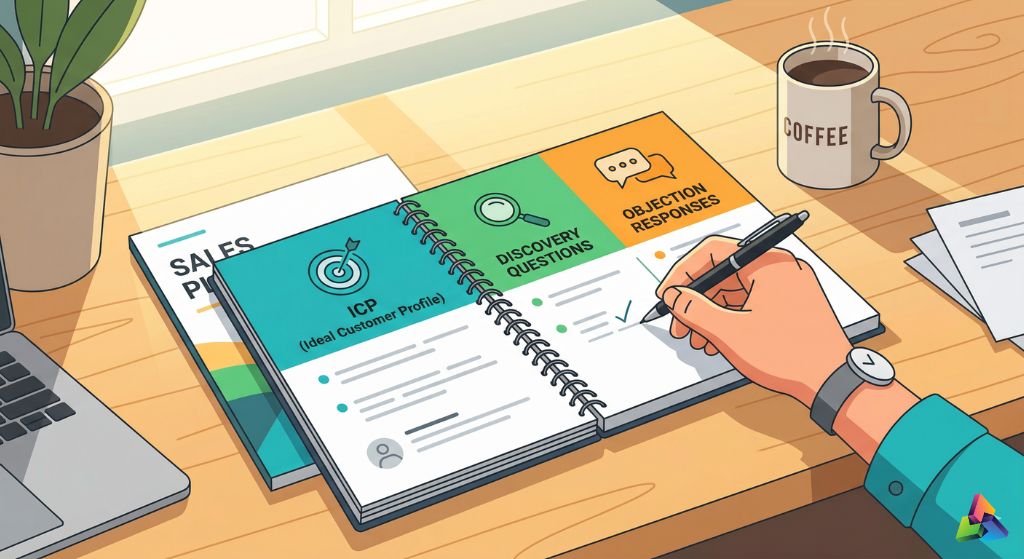
1. Ideal Customer Profile (ICP) Not just industry and company size. The specific trigger events that make a company ready to buy. A company going through rapid headcount growth, a recent leadership change, a failed previous vendor these are the moments. Your ICP should identify them.
2. The Sales Process Map Stage by stage. What happens in each stage. What defines a deal as qualified to move forward. What kills it. Draw it on a whiteboard, photograph it, and turn it into a one-pager.
3. Discovery Call Framework The exact questions you ask and why you ask them in that order. At Sales Fundas, we use a framework called SPIN + Context, where we layer situational questions with specific business-context probes the prospect hasn’t been asked before. It shifts the conversation from vendor evaluation to consulting relationship.
4. Objection Response Library Every objection you’ve heard, and the response that worked. Real language. Not corporate-speak. “We’re already working with X” sounds different from “we don’t have budget right now” they need different responses.
5. Pipeline Stage Definitions What does “Qualified” actually mean at your company? What does “Proposal Sent” mean did they ask for the proposal, or did you just send it? Sloppy stage definitions produce sloppy forecasting, and sloppy forecasting kills credibility with investors and boards.
This is also where internal linking to related resources matters. Our guide on How to Audit B2B sales process from scratch go deeper on these sections.
Key Takeaway: The playbook isn’t admin work. It’s your most important sales asset.
Stage 3: Hiring Your First Salesperson The Only Way That Doesn’t End in Disaster
Most founders hire their first salesperson too early, for the wrong reasons, with no system to support them.
They hire because they’re exhausted. That’s human. But exhaustion is not a hiring strategy.
The signal that you’re actually ready to hire is this: you can predict, with reasonable accuracy, how many deals will close this quarter based on what’s in your pipeline today. That predictability means you have a repeatable process. And a repeatable process is something you can teach.
What to Look For in Your First Sales Hire
This is not the time to hire a hunter who’s closed $2M deals at a large enterprise. That person is trained for a machine they need marketing support, SDR support, a brand that precedes them. You don’t have that yet.
You need someone who is:
- Comfortable with ambiguity (because your process will still have rough edges)
- Genuinely curious, not just confident (curiosity drives discovery quality)
- Willing to be coached not just managed
- Has sold something without a recognisable brand behind them
And here’s something we tell every Sales Fundas client at this stage: the first 90 days of a new rep’s tenure is your performance review, not theirs. If they fail, the first question to ask is whether you gave them a real system or just access to your calendar.
The 90-Day Onboarding Framework
Days 1–30: Shadow only. They watch your calls, read your playbook, talk to your happiest customers. No solo calls yet.
Days 31–60: Joint calls, where they lead and you observe. Debrief every call within 24 hours. Keep written notes.
Days 61–90: Solo calls on warm, mid-funnel leads only. No cold, no enterprise. You’re still reviewing every deal in pipeline.
At the end of 90 days, you’ll know exactly whether they can carry the motion and you’ll have real data, not gut feel, to make that call.
Key Takeaway: The first sales hire is a systems test. If they fail, check the system before you check the person.
Stage 4: The Transition From Seller to Sales Leader
This is the stage most guides skip entirely. And it’s the hardest one.
Because even after the hire, even after the onboarding, founders have a deep instinct to jump back in. A deal is wobbling you step in. A prospect asks for the founder you take the call. The rep loses confidence. The cycle restarts.
Stopping this requires a deliberate practice, not just willpower.
Three Things That Accelerate the Founder-to-Leader Transition
1. The Weekly Pipeline Review Every week, sit with your rep and go through every deal in the CRM. Ask: what’s the next step? What’s blocking movement? What have you heard from the buyer this week? You’re coaching, not closing. The moment you find yourself writing emails for them or making calls on their behalf, you’ve slipped back into Stage 1.
2. The “Deal Escalation” Protocol Create an explicit rule: reps can escalate a deal to the founder only in two scenarios the deal is above a certain contract value, or a specific technical question requires founder expertise. Everything else, they handle. This gives reps ownership and stops the “buyers want to talk to the founder” habit from becoming permanent.
3. Win/Loss Reviews Every closed deal won or lost gets a 30-minute debrief. Why did we win? What did the buyer say about the competition? Why did we lose? Where did the process break down? Over time, this data is more valuable than any individual deal. It’s the feedback loop that keeps improving your system.
Our B2B sales training programmes for growing teams are built specifically around this coaching-led model.
What the Numbers Say About Founder-Led Sales in 2026
According to recent B2B buying research, the average purchase journey now involves only about 17% direct interaction with sales reps across all vendors meaning if three vendors are competing, each salesperson gets roughly 5–6% of the buyer’s time. 180ops That stat should reframe everything.
Buyers are doing the work before you call them. Research shows that around 96% of B2B buyers conduct extensive online research before engaging a salesperson, and projections suggest that by 2027, roughly 85% of B2B sales interactions will happen through digital channels. Martal Group
So the question isn’t just “how do I get my rep to close like me?” It’s “how do I build a system that works even when no one from my team is in the room?”
The answer is content, process, and coaching. Together. Not separately.
The Most Common Reason This All Falls Apart
Founders build the playbook. They hire someone good. And then six months in, the rep is still underperforming and the founder can’t figure out why.
Nine times out of ten, the root cause is that the rep was never coached on the specific kind of deal this company sells. They knew the playbook. But they hadn’t internalised the buyer psychology that makes the playbook work.
At Sales Fundas, we call this the “Map vs. Territory” problem. A playbook is a map. The buyer conversation is the territory. The gap between them is where reps get lost.
This is why ongoing B2B sales consulting matters more than any single training session. Coaching is what turns a rep who knows the process into one who feels the deal.
FAQ: People Also Ask
Q1: When should a founder stop doing sales personally? The right moment is when you have a documented, repeatable sales process that consistently produces closed deals not when you’re simply too busy. Stepping back before that point is likely to set your first sales hire up to fail.
Q2: How do I build a sales team with no prior experience hiring salespeople? Start with one hire, not a team. Prioritise coachability and curiosity over raw experience. Then run a 90-day structured onboarding with call shadowing, joint calls, and regular debriefs before giving them full autonomy.
Q3: What’s the most common mistake founders make when handing off sales? Hiring before the playbook is ready. A new rep without a documented process has no map to follow they improvise, buyers sense the inconsistency, and deals die in ways that are hard to diagnose.
Q4: How do I write a sales playbook that salespeople will actually use? Keep it short and specific. Reps ignore 60-page documents. Write it in the language your actual buyers use, not corporate marketing language. Include real objections and real responses not theoretical ones.
Q5: How long does it take to transition from founder-led sales to a sales team? In our experience at Sales Fundas, most founders need 9–18 months from first playbook draft to having a rep operating independently. Rushing this timeline is the single biggest predictor of early sales hire failure.
Q6: Should founders ever get involved in deals after handing off sales? Yes but only by protocol. Set a clear deal size or complexity threshold above which the founder joins. Everything below that threshold is the rep’s to win or lose. Clear rules prevent constant founder re-entry.
Q7: What CRM should I use when building my first sales team? Start with the simplest CRM your team will actually use consistently. HubSpot CRM (free tier) or Pipedrive work well for early-stage B2B teams. The best CRM is the one where deals actually get updated not the most feature-rich one gathering dust.
Q8: How do I keep good salespeople once I’ve hired them? Reps stay when they have clear targets, good coaching, a working product, and belief that the company can grow. They leave when they feel unsupported, under-coached, or like they’re selling something that doesn’t deliver. Retention starts at onboarding.

Ready to Stop Being the Only Salesperson in Your Company?
If you’ve read this far, you already know what’s holding you back. It’s not talent. It’s not time. It’s the absence of a system that can work without you.
At Sales Fundas, Jayant Kelkar works directly with B2B founders to build exactly that a documented sales process, a rep onboarding framework, and an ongoing coaching rhythm that transitions you from seller to leader.
Book a free 30-minute Sales Audit with Sales Fundas →
We’ll look at your current pipeline, your team structure, and your playbook (or the gaps where one should be). And we’ll tell you, specifically, what to build next.
Because the goal was never for you to be the best salesperson in the building. It was for you to build a building full of them.


[…] your intuition. They need defined deliverables for every call. If you find yourself wondering how to stop being the only salesperson, start by documenting your best discovery questions. Give your reps a framework, not a script. In […]
[…] in the time spent on lead triage. This allowed the CEO to step back from the daily grind of being the only salesperson. The result is a repeatable system where the founder provides the strategy, and the AI maintains […]