

Master founder led sales in India. Learn the 2026 framework to transition from solo selling to a repeatable B2B sales engine. Get your free sales audit now.
The Founder Trap in Indian B2B Sales
Most B2B startups in India fail to scale because the founder is too good at selling. It sounds like a paradox. You built the product, you know the pain points, and you closed the first ten customers through sheer force of will. But if every deal still requires your presence to close in 2026, you have a bottleneck, not a business. This is the founder trap.
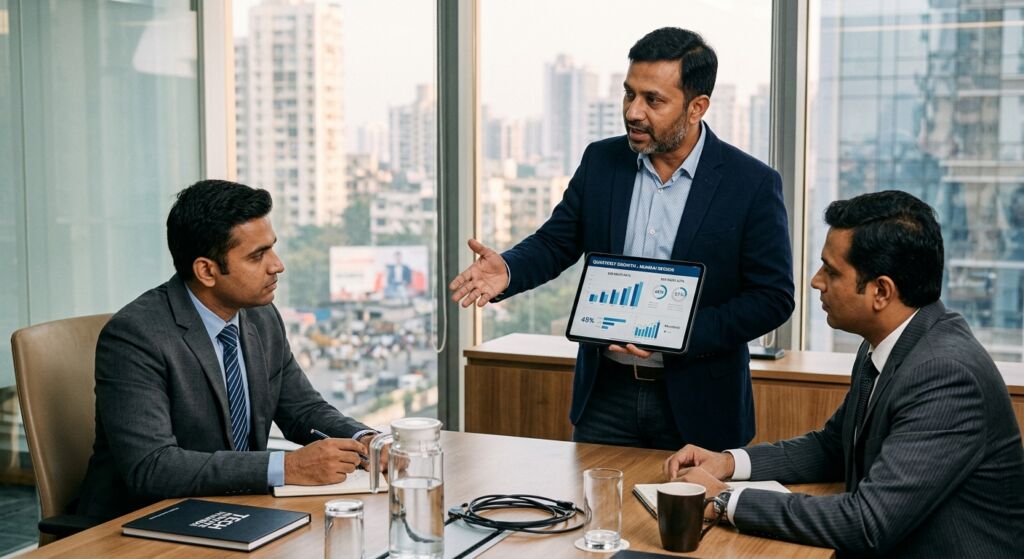
Moving from founder-led sales to a repeatable sales engine is the most difficult transition for any technical or product-focused CEO. In our work at Sales Fundas, Jayant Kelkar has seen that the problem is rarely a lack of talent. The problem is a lack of structured process. You cannot hand over your gut feel to a junior hire. You can only hand over a system.
Why Founder-Led Sales Hits a Ceiling in 2026
The Indian B2B market has matured. Buyers are more skeptical of pitch decks and more focused on documented ROI. If your sales process relies on your personal charisma, it will not scale. When you hire your first salesperson, they usually fail because they are trying to mimic your intuition instead of following a pipeline discipline.
Data from early 2026 shows that Indian startups transitioning to professional sales functions see a 40% drop in sales velocity if the founder has not documented the sales function first. You need a written feedback loop. You need defined deliverables for every stage of the funnel. Without this, your first hire is just an expensive experiment.
The 3 Stages of Scaling Founder-Led Sales in India (2026 Framework)
Transitioning away from being the primary closer doesn’t happen overnight. In the Indian B2B landscape, where relationship-building is deeply cultural, you must navigate three distinct phases to ensure revenue doesn’t dip during the handoff.

Stage 1: The Intuition Phase (0 – ₹1 Crore ARR)
At this stage, founder led sales India is the only way to survive. You are selling the vision, not just the product. Your goal here is not efficiency, but ‘Founder-Market Fit.’ You should be documenting every objection, especially those unique to Indian procurement cycles and budget sensitivities. In 2026, even at this stage, you should be using AI to record and transcribe these calls to build your initial ‘Sales Playbook’ baseline.
Stage 2: The Validation Phase (₹1 Crore – ₹5 Crore ARR)
This is where most Indian startups fail. You hire a salesperson, but you haven’t defined the ‘Sales DNA’ of your company. In this phase, you must transition from doing the selling to co-selling. You need a system where a junior hire handles lead qualification and initial demos, while you still step in for the final negotiation. This is the perfect time to look into fixing your B2B sales process before it breaks under the weight of more leads.
Stage 3: The Engine Phase (₹5 Crore+ ARR)
By now, the founder should only be involved in ‘Strategic Accounts’ or ‘Elephant Hunting.’ The day-to-day pipeline is managed by a professional sales function. In 2026, high-growth Indian firms are increasingly using a Virtual Chief Sales Officer to manage this engine, allowing the founder to return to product innovation and fundraising without the revenue stalling.
Building a Scalable B2B Sales Engine for the Indian Market
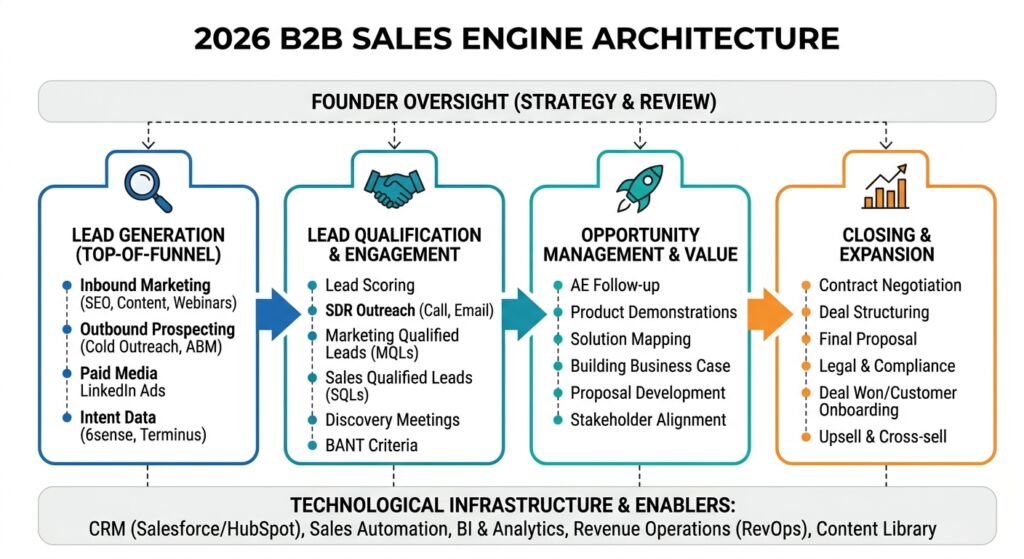
A sales engine is not a CRM full of names. It is a series of repeatable actions that move a stranger to a closed contract. For an Indian founder, this starts with an honest assessment of how you actually close deals. Is it through your network? Is it through technical deep dives? You must isolate the steps that do not require your specific expertise.
Start by building a structured process. This means defining exactly what happens after a lead fills out a form. In 2026, the baseline expectation is a response within 15 minutes. If you are in back-to-back product meetings, you are losing deals. This is why many founders now look toward a Virtual Chief Sales Officer to build the plumbing while the founder stays focused on the vision.
The Shift from Intuition to Pipeline Discipline
Pipeline discipline is the habit of looking at your sales numbers and seeing reality, not optimism. Most founders suffer from happy ears. They hear a prospect say "this looks interesting" and they forecast it as a win. A professional sales function requires a pipeline that reflects reality.
Jayant Kelkar brings 30-year cross-industry B2B experience to help founders identify these "process leaks." When you stop taking every meeting and start qualifying B2B companies based on hard criteria, your win rate goes up. You need to stop being the only salesperson and start being the architect of the revenue system.
Hiring Your First Salesperson in India
Do not hire a "rockstar" from a big corporate. They are used to having a brand name and a marketing department behind them. They will struggle in a startup where they have to build their own leads. You need a builder, not just a driver. We have seen that the Virtual Chief Sales Officer vs VP of Sales debate usually ends with the founder realizing they need a builder first.
Your first hire should focus on repeatable tasks: lead research, initial outreach, and qualifying calls. Keep the high-stakes closing for yourself initially, but document every objection you hear. This documentation becomes the training manual for your next three hires. This is how you stop the feast or famine quarters that plague founder-led organizations.
The Founder’s Handoff Checklist: 5 Assets You Need Before Hiring
Before you post that job description on LinkedIn, ensure you have these five assets ready. Without them, your first hire is flying blind in a highly competitive 2026 Indian market.
- The Ideal Customer Profile (ICP) 2.0: Beyond just industry and size, define the ‘Trigger Events’ that make an Indian B2B buyer move from ‘interested’ to ‘urgent.’
- The Objection Handling Matrix: A living document that lists every reason an Indian CFO says ‘no’ (e.g., ‘we will build it in-house,’ ‘budget is frozen until Q4’) and the proven rebuttal.
- Defined Sales Stack: Don’t just give them a seat in a CRM. Provide them with the AI-driven outreach tools and automated follow-up sequences that are now standard in 2026.
- The 15-Minute Response Protocol: As mentioned, speed is a differentiator. Document exactly who handles inbound leads when the founder is unavailable.
- A Scientific Onboarding Plan: A 30-60-90 day plan that focuses on ‘Time to First Demo’ rather than just ‘Time to First Close.’
If you lack these, you aren’t ready to hire. You are likely better off performing a 30-point B2B sales health check to identify where your current manual process will fail a new hire.
Why Founder-Led Sales Mentorship Trumps Generic Training in 2026
Sales training in India often fails because it is too theoretical. You do not need a motivational speaker to fire up your team. You need a practitioner who delivers directly. At Sales Fundas, we focus on practical monthly milestones. We don’t use junior consultants. Jayant works directly with your team to build a system built around your reality.
This involve a 3-month minimum commitment because habits take time to change. You get a written 2–3 page feedback note within 48 hours of our first call. This is an honest assessment of where your sales function stands today. It is about building a reliable system that works even when you are not in the office.
Frequently Asked Questions
When should a founder stop doing sales? You should never stop selling entirely, but you must stop being the only person who can close. Once you have a repeatable process, hire someone to execute the top-of-funnel activities.
Is founder-led sales better than hiring an agency? Founder-led sales is essential for product-market fit because you hear the feedback directly. Agencies often lack the deep product knowledge required for early-stage B2B closing.
How do I hire my first salesperson in India? Look for someone with high curiosity and a track record of building processes, not just hitting quotas. Avoid those who rely on a big brand name to get meetings.
What is a Virtual Chief Sales Officer? It is a fractional leader who builds your sales engine without the cost of a full-time executive. They provide the strategy and the execution framework for your junior reps.
Why is my sales pipeline inconsistent? Inconsistency usually stems from a lack of lead generation discipline or poor qualification. You are likely taking too many meetings with people who cannot buy.
What CRM is best for Indian B2B startups? Start with something simple that your team will actually use daily. We recommend checking our 2026 guide on free CRM solutions for the best options.
How long does it take to build a sales engine? A robust sales function takes at least three to six months to stabilize. You need enough time to test the process and see a full sales cycle play out.
Do I need a sales consultant or a trainer? Trainers teach skills, while consultants like Jayant Kelkar build systems. If your process is broken, skills training will not fix your revenue problems.
Get a Direct Assessment of Your Sales Function
If you are tired of deals stalling and feel trapped in the daily sales grind, it is time for a change. Jayant Kelkar offers a Free Sales Audit Call to qualifying B2B companies in India. This is not a sales pitch. It is a focused conversation that results in a written feedback note within 48 hours. Stop guessing why your revenue is flat and start building a structured sales engine today.
Sales Fundas operates as an embedded leadership partner for ambitious B2B founders and CEOs, specializing in pipeline architecture and predictable revenue growth. By combining rigorous sales consulting frameworks with advanced digital advertising and performance marketing, we build sustainable, high-performing sales engines that complement and scale the founder's strategic vision.
- B2B Sales Consulting & Pipeline Architecture Frameworks
- Advanced Performance Marketing & Conversion Rate Optimization
- Search & Generative Engine Optimization (SEO/GEO) Specialists
- B2B Digital Advertising & Lead Generation Experts
This content was drafted using AI-assisted research and meticulously reviewed by the Sales Fundas consulting team to ensure strategic accuracy and alignment with our B2B sales frameworks.



[…] cost of their current problem, they won’t pay for your solution. This is especially true for founder-led sales in India, where the founder’s passion often blinds them to the fact that the prospect isn’t a fit. […]
[…] dry because no one was prospecting while you were busy closing. You can read more about navigating Founder Led Sales India: The 2026 Guide to Scaling Revenue to see how to break this […]
[…] major takeaway from the Mumbai tour is the focus on founder-led sales and how to transition out of it. Most B2B startups in Pune, Bangalore, and Mumbai fail to scale […]
[…] sales function; you have built a job for yourself. This April, your goal should be to move toward a structured process that junior reps can follow without your constant […]
[…] Deals do not die; they simply enter a state of permanent hibernation. This is the classic founder led sales India trap where the CEO becomes the most expensive bottleneck in the […]