

Is your B2B sales process broken? Use our 2026 framework to fix Indian sales engines, eliminate founder bottlenecks, and scale revenue beyond ₹10Cr ARR.
Why the B2B Sales Process is Broken in India: 5 Structural Failures
Most B2B companies in India are running a sales process that worked fine in 2022 and quietly stopped working somewhere along the way. The symptoms are always the same: a pipeline full of deals that never close, a founder who’s still the only person who can bring in real revenue, and junior reps making calls every day while the revenue line stays flat. This isn’t a motivation problem. Most Indian startups treat sales as an activity instead of an engine built on a structured process, and the two produce very different results.

The Indian B2B buyer has also changed. Buyers are tired of AI-generated spam and generic LinkedIn outreach, and a sales function that runs on high-volume hustle without a repeatable system tends to hit a ceiling around ₹10Cr ARR that no amount of extra effort breaks through. Across three decades of consulting in Indian B2B sectors, the pattern holds up again and again: the problem is rarely the people. It’s an architecture that rewards optimism over pipeline discipline.
Why founder-led sales becomes a growth bottleneck
In the early stages, the founder really is the best salesperson in the building. They have the passion and the product knowledge nobody else has yet. That’s exactly what creates the founder trap: because deals close through sheer force of will, nobody ever writes down how it actually happens. Every lead gets a meeting regardless of fit, every close depends on the founder being in the room, and by the time a sales rep finally gets hired, there’s no process to hand them, just a personality to imitate.
That gap shows up as a predictable cycle. A founder who’s still doing discovery calls, demos, and closing personally has very little time left for the prospecting that keeps the pipeline full, which produces exactly the feast-or-famine pattern most founders describe: one big deal closes and the team celebrates, then the pipeline runs dry for a month because nobody was filling it while everyone was busy closing. You can read more about navigating this in Founder Led Sales India: The 2026 Guide to Scaling Revenue.
The myth of the “bad” sales hire
VPs of Sales often complain they can’t find good talent in India, blaming work ethic or skill gaps. More often, they’re hitting a ceiling created by the absence of pipeline discipline. Hand a new rep a laptop and a CRM login and tell them to “go sell,” and they’ll revert to whatever worked at their last job, which may have nothing to do with your buyer or your product.
A broken process makes even a genuinely good rep look bad. If your sales stages aren’t defined by specific buyer actions, your pipeline is really just a list of wishes with rupee signs attached. Jayant Kelkar has seen this play out the same way across dozens of companies: “In Discussion” ends up meaning anything from a first call to a final contract negotiation, and that lack of specificity is exactly why sales teams fail to hit targets. Every stage needs a specific deliverable and a clear exit criterion, or the whole pipeline is unreliable by design.
Fixing Your Sales Pipeline: Moving from Optimism to Discipline
India’s “ghosting” culture makes this worse. Prospects agree to a second meeting to be polite, not because they intend to buy, and a broken sales process counts every one of those as an active deal. The fix isn’t measuring activity harder. It’s measuring progress, and being honest about what counts as progress. A deal that’s stalled for 45 days isn’t a deal anymore. It’s a distraction wearing a deal’s clothing.
Real pipeline discipline starts with an honest look at lead quality: are you actually qualifying companies on budget and authority, or just relieved to have someone willing to talk? That distinction is the whole difference between a pipeline that predicts revenue and one that just reflects who picked up the phone this week.
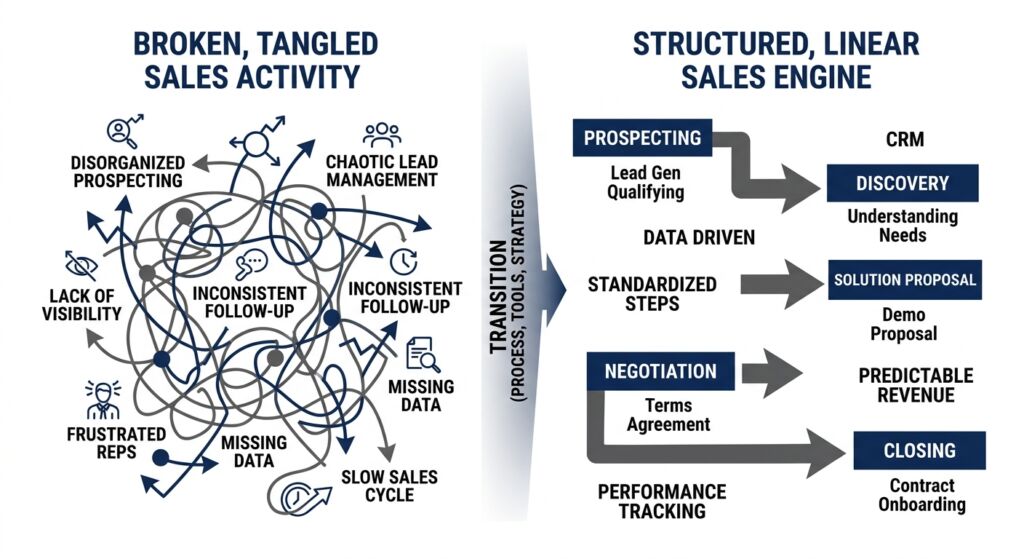
The 5-Step Framework to Fix Your B2B Sales Engine
Fixing a broken B2B sales process takes more than hustle. It takes a structural overhaul. Here’s the blueprint, drawn from three decades of consulting history at Sales Fundas:
- Step 1: The 30-point process audit. You can’t fix what you haven’t measured. A deep-dive audit identifies exactly where deals are leaking, whether that’s at discovery or the final procurement hurdle.
- Step 2: Define exit criteria for every stage. Eliminate “In Discussion” as a status entirely. A deal only moves forward when a specific buyer action happens, sharing a technical spec, introducing the CFO, something concrete.
- Step 3: Decouple prospecting from closing. Closers shouldn’t be doing cold outreach. A dedicated layer focused on high-intent qualification keeps your senior people talking only to companies that are actually ready to buy.
- Step 4: Build a ghosting protocol. Given how common polite hesitation is in Indian B2B sales, a short sequence to disqualify non-responsive leads quickly keeps the pipeline honest instead of bloated.
- Step 5: Move toward RevOps. Break down the silo between sales and marketing. Integrate your CRM with the rest of your customer data to track the full journey from first touch through expansion.
Why volume is no longer the answer
The biggest mistake Indian firms make when a process breaks is trying to fix it with more volume. More leads bought, more emails sent, more SDRs hired onto the same broken foundation, and all of it accelerates the failure rather than fixing it. A broken process just turns more volume into more noise, and burns brand reputation in the market along the way. What actually helps isn’t more meetings. It’s better ones, built around a real sales strategy that prioritizes relevance over reach.
Jayant Kelkar’s approach centers on practical, hands-on written feedback that shows exactly where leads are leaking. Often the fix isn’t a new tool. It’s a return to fundamentals: clear qualification, milestones agreed upon monthly, and a pipeline that actually reflects reality instead of hope. For founders ready to stop being the only salesperson in the company, a Virtual Chief Sales Officer can build that engine while you run the rest of the business.
Using Sales Tech to Repair Process Leaks
The gap between high-performing Indian sales teams and everyone else increasingly comes down to the tech stack behind them. If the underlying process is broken, adding more SDRs is like pouring water into a sieve. Three tech-driven fixes actually move the needle:
- AI-driven lead scoring. Stop chasing every LinkedIn profile that fits a vague description. Predictive modeling identifies the firms with the highest actual propensity to buy based on their current fiscal-year budgets.
- Automated sales playbooks. Embedding the playbook directly into the CRM means junior reps follow a defined approach by default, which removes “bad hire” as an excuse for a process problem.
- Real-time pipeline analytics. Monthly reports are too slow. A dashboard that flags a stalled deal the moment it misses a milestone lets a sales director step in immediately instead of finding out at quarter close.

How to start re-engineering your revenue engine
Fixing a broken process starts with a free sales audit call. It isn’t a sales pitch. It’s a structured look at your current sales function, and within 48 hours you get a written two to three page feedback note detailing the actual gaps, with a focus on defined deliverables and repeatable systems built around the team you already have.
The engagement runs on a three-month minimum, with milestones agreed upon monthly and no middlemen or junior consultants in between. You work directly with Jayant Kelkar, drawing on three decades of cross-industry B2B experience, to build a sales engine that outlasts the engagement itself. The alternative is staying in the feast-or-famine cycle and hoping this quarter is different.
Frequently Asked Questions
How do I know if my B2B sales process is actually broken? If the founder is involved in every closing conversation and the pipeline hasn’t grown despite hiring more reps, the process is likely broken. Another tell: a high number of deals sitting in “Proposal Sent” for months without moving.
Why is my sales team failing to close deals? Buyers are more skeptical and better informed than they used to be. A team following a generic script instead of a structured process built around specific buyer pain points will struggle regardless of individual talent.
What is the “founder trap” in sales? It’s when a business can’t grow because the founder remains the only person capable of closing. It keeps the founder from focusing on strategy and keeps the sales team from ever becoming independent.
How long does it take to fix a broken sales process? Small changes can show results within weeks, but building something genuinely repeatable typically needs a three-month minimum commitment. It’s as much about changing habits as implementing a new process.
Do I need a new CRM to fix my sales process? Rarely. Most companies already have the tools they need and are missing the structured process to use them well. Fix the sales engine first, then make sure the tools support it.
What is a Virtual Chief Sales Officer? A senior expert who works with a company on a fractional basis to build and lead the sales function, a practical option for founders who can’t yet justify a full-time VP of Sales.
How does Jayant Kelkar’s approach differ from other consultants? Direct, hands-on involvement with no junior consultants in the loop. The focus stays on practical results from three decades of experience, not theory or the latest growth-hacking trend.
What happens during a free sales audit call? An honest assessment of the current sales situation. Within 48 hours, a written feedback note identifies the specific process leaks, with no obligation to hire.
Build a sales engine that scales
A broken B2B sales process doesn’t need a mindset shift or a “sales ninja.” It needs structure, accountability, and pipeline discipline. If the feast-or-famine cycle is getting old, book a free sales audit call with Sales Fundas and get a written two to three page feedback note on exactly where the leaks are.
Sales Fundas operates as an embedded leadership partner for ambitious B2B founders and CEOs, specializing in pipeline architecture and predictable revenue growth. By combining rigorous sales consulting frameworks with advanced digital advertising and performance marketing, we build sustainable, high-performing sales engines that complement and scale the founder's strategic vision.
- Embedded Leadership for B2B Growth
- Sales Pipeline & Revenue Architects
- B2B Sales Engine Development
- Strategic Sales Scaling Experts



[…] four months to close, the revenue you need in August 2026 must be in your pipeline today. When the b2b sales process is broken, it usually shows up as a "pipeline that reflects optimism" rather than reality. You must […]
[…] Trust in B2B is earned through consistency, not just a good relationship over coffee. When the b2b sales process is broken, the buyer senses the chaos and retreats to the safest option: doing […]