

Stop losing B2B deals to unpredictable cycles. Learn how to build a predictable pipeline architecture and increase velocity. Book your diagnostic call today.
The core failure of most B2B sales cycles
Most B2B founders treat their sales cycle as a linear conveyor belt. They assume that if they push enough leads into the top of the funnel, a predictable percentage will emerge at the bottom as closed deals. This is a fundamental misunderstanding of how high-ticket B2B sales work. A sales cycle is not a conveyor belt; it is a series of critical hurdles.

When a deal stalls, it is rarely because the salesperson lacked ‘persistence’ or the prospect lacked ‘interest’. It is because a specific hurdle—a lack of perceived risk, a missing stakeholder, or a misalignment of value—was not identified and removed. Mastering the sales cycle means moving from a ‘hope-based’ pipeline to a pipeline architecture where every stage is a rigorous filter.
The strategic diagnosis of revenue leakage
Revenue leakage happens when your sales process is a black box. You know the start date and the end date, but the middle is a blur of ‘follow-up calls’ and ‘checking in’. In practice, this lack of visibility leads to founder-dependent revenue. If the CEO is the only one who can close the deal, you do not have a sales process; you have a founder’s intuition.
To fix this, you must diagnose where the cycle breaks. According to the 2026 B2B Revenue Report, 42% of B2B deals in the SME sector stall during the ‘Evaluation’ phase. The cause is usually a failure to anchor the solution to a specific, quantified business pain. If you are selling a service for ₹15,00,000 but the client only perceives a ₹2,00,000 problem, the deal is dead before the proposal is even sent.
The first step in mastering the cycle is defining your Ideal Customer Profile (ICP). Without a strict ICP, your sales cycle becomes bloated with ‘curious’ leads who will never buy, artificially inflating your pipeline and wasting your team’s time.
Architecting the stages of a predictable cycle
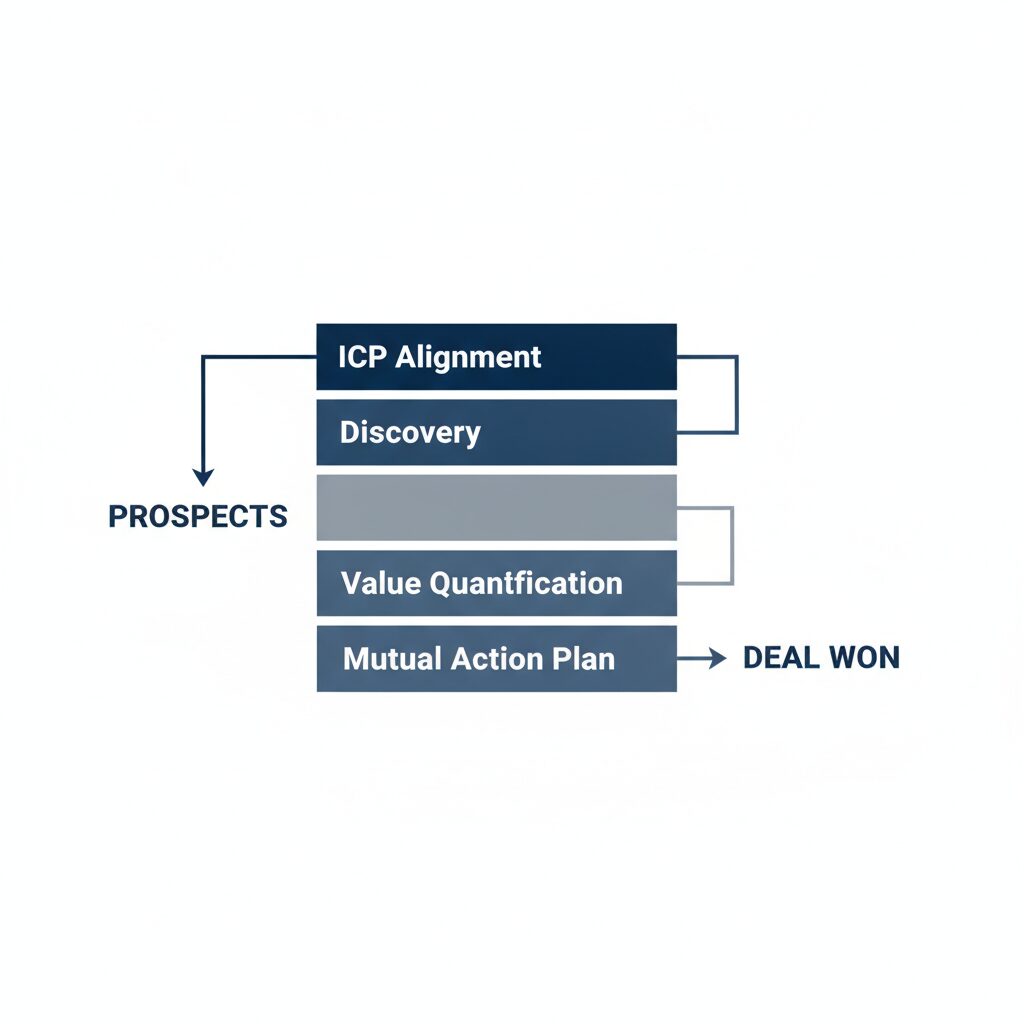
A professional sales cycle is defined by exit criteria. A lead does not move from ‘Discovery’ to ‘Solution Design’ because the salesperson feels the conversation went well. They move because specific information has been captured and a specific agreement has been reached.
The Discovery Stage
Discovery is not a demo. It is a diagnostic interview. The goal here is to uncover the cost of inaction. If the prospect is losing ₹5,00,000 per month due to inefficient lead routing, that ₹60,00,000 annual loss is the anchor for your pricing. When we implement this at Sales Fundas, we see a marked shift in closing rates because the salesperson stops selling features and starts selling the removal of a known cost.
The Qualification Stage
Qualification is where most startups fail. They confuse ‘interest’ with ‘intent’. A prospect who says ‘this looks interesting’ is not qualified. A prospect who says ‘I have a budget of ₹10,00,000 and need this solved by October to hit my targets’ is qualified. You must align this with your ICP profitability shifts to ensure you are not chasing low-margin, high-maintenance clients.
The Value Alignment Stage
This is the bridge between the problem and the price. Most sales teams jump from discovery straight to a proposal. This creates a ‘price shock’ that kills the deal. Instead, you must build a value proposition that quantifies the return on investment. In one case, shifting the conversation from ‘software features’ to ‘reduction in sales cycle length by 20%’ increased the average deal size from ₹8,00,000 to ₹12,00,000.
Managing the ‘Death Valley’ of B2B sales
The middle of the sales cycle is where deals go to die. This is the period between the initial excitement of the demo and the final signature. The failure mode here is the ‘check-in’ email. Emails that start with ‘just checking in’ or ‘following up on my previous mail’ signal that the salesperson has no more value to add.
To avoid this, every interaction must be value-additive. Instead of checking in, share a case study of a similar company in the Indian market that solved a specific problem they mentioned. Or, send a brief analysis of a trend affecting their industry in August 2026. This keeps the momentum without sounding desperate.
If you find your team is struggling with this, it is often a sign that they lack the leadership framework needed to guide a client through a complex purchase. The salesperson must act as a consultant, not a vendor.
The Indian B2B nuance: Relationship vs. Process
In the Indian market, there is a strong tendency to rely on ‘relationships’ to close deals. While trust is necessary, relying solely on relationships is a recipe for unpredictable revenue. Relationships can get you the first meeting, but they cannot sustain a scalable B2B sales engine.
The danger of the relationship-led approach is ‘scope creep’ and ‘discount pressure’. When the deal is based on a personal connection, the client often expects lower prices or additional free services. By implementing a strict B2B sales process in India, you shift the power dynamic. The conversation moves from ‘what can you do for me as a friend’ to ‘how does this solution solve this specific ₹20,00,000 problem’.
Closing without the ‘Hard Sell’
Closing is not a discrete event at the end of the cycle; it is the natural result of a well-executed process. If you have correctly diagnosed the pain, quantified the cost of inaction, and aligned the value, the close is a formality.
The most effective way to close is to use mutual action plans. Instead of asking ‘do you want to buy?’, you say ‘To hit your October deadline, we need to complete the security review by Friday and sign the agreement by next Tuesday. Does that timeline work for your legal team?’. This frames the close as a collaborative effort to achieve the client’s goal.
For founders who struggle with this, learning how to close B2B deals without sounding pushy is the fastest way to increase pipeline velocity.
Measuring cycle health and velocity
You cannot manage what you do not measure. Most companies track ‘Total Pipeline Value’, which is a vanity metric. A ₹10 Crore pipeline is useless if the average deal takes 18 months to close and has a 10% win rate.
Focus on Pipeline Velocity. The formula is: (Number of Qualified Opportunities x Average Deal Value x Win Rate) / Length of Sales Cycle. If you can reduce your cycle from 90 days to 60 days, you effectively increase your revenue capacity by 33% without adding a single new lead.
Also, monitor your LTV to CAC ratio. If the cost of acquiring a customer through a long, complex sales cycle exceeds 33% of their lifetime value, your sales architecture is broken. You are either targeting the wrong ICP or your sales process is too inefficient.
For those scaling rapidly, integrating a Fractional CSO can provide the embedded leadership needed to refine these metrics and build a predictable sales practice.
Frequently Asked Questions
How long should a B2B sales cycle be?
The length varies by deal size, but the goal is the shortest possible time to value. High-ticket B2B deals in India typically range from 30–90 days depending on the number of stakeholders.
What is the biggest reason B2B deals stall?
Deals stall when the prospect does not perceive a high enough cost of inaction. If the pain of staying the same is lower than the pain of changing, they will not buy.
How do I move a prospect from ‘interested’ to ‘qualified’?
Shift the conversation from product features to business outcomes and budget. A lead is qualified only when they confirm a specific budget and a hard deadline for the solution.
Should I use a CRM to manage my sales cycle?
Yes, but a CRM is just a database, not a process. The CRM should track your exit criteria for each stage, not just a list of contacts.
How do I handle objections about pricing?
Reframe the price as an investment against the cost of the problem. If the problem costs them ₹50,00,000 a year, a ₹10,00,000 solution is a 5x return.
What is the difference between a sales process and a sales cycle?
The process is the internal set of steps your team follows. The cycle is the actual time and experience the customer goes through from first touch to close.
How do I reduce my sales cycle length?
Identify the bottleneck stage where deals linger the longest. Apply a stricter filter at the qualification stage to remove low-intent leads early.
Is cold calling still effective in 2026?
Yes, if it is highly targeted and research-driven. Generic cold calling is dead, but ‘insight-led’ outreach to a tight ICP remains a powerful growth lever.
Build a scalable B2B sales engine today. Stop relying on founder intuition and start using a predictable architecture to drive revenue. Book a diagnostic call with a Fractional CSO to identify your revenue leaks—no commitment required.
Sales Fundas operates as an embedded leadership partner for ambitious B2B founders and CEOs, specializing in pipeline architecture and predictable revenue growth. By combining rigorous sales consulting frameworks with advanced digital advertising and performance marketing, we build sustainable, high-performing sales engines that complement and scale the founder's strategic vision.
- Embedded Leadership for B2B Growth
- Sales Pipeline & Revenue Architects
- B2B Sales Engine Development
- Strategic Sales Scaling Experts