

Stop guessing your growth. Master the LTV CAC ratio for B2B to build a predictable revenue engine and scale your startup with data-driven unit economics.
The gap between revenue and efficiency
Most B2B founders obsess over revenue, but almost none track the efficiency of that revenue. If your growth depends entirely on your personal network, you don’t actually have a sales process; you have a series of lucky accidents. This is the brutal difference between a business that scales and one that simply survives on founder charisma.

Mastering the LTV CAC ratio B2B is how you move beyond vanity metrics. It turns your growth strategy into a math problem rather than a guessing game, which means you can stop wondering if you can afford to hire another sales rep and start knowing exactly when to pull the trigger. By pinning down the relationship between what you spend to acquire a customer and what that customer is worth over their lifetime, you build a scalable B2B sales engine based on hard unit economics.
Why unit economics for B2B startups determine your survival
Growth without efficiency is just a faster way to go broke. I’ve seen too many Indian startups chase top-line revenue just to impress VCs, while completely ignoring the cost of acquiring that revenue. This “growth-at-all-costs” mindset creates a fragile business. In these cases, every new customer actually drains more cash from the bank than they provide in the short term. It’s a death spiral disguised as a success story.
The failure happens when you treat acquisition as a marketing expense rather than a capital investment. If your acquisition cost is too high, your runway shrinks every time you sign a new deal. It’s a paradox that kills promising B2B firms—they think they are winning because the revenue line is moving up, but they are actually bleeding out.
Connecting your LTV CAC ratio to your valuation is about one thing: predictability. Investors in 2026 aren’t writing checks for growth alone; they are paying for predictable revenue. A stable ratio proves your pipeline architecture is repeatable, which means your leadership can forecast cash flow with a level of precision that makes investors feel safe.
Calculating the LTV CAC ratio for B2B without the guesswork
Calculating these numbers for high-ticket B2B services is a different beast than simple SaaS. You can’t just plug a monthly subscription into a formula when your deals involve messy consulting engagements or tiered transformations.
To define Customer Lifetime Value (LTV) for high-ticket B2B, you have to calculate the total net profit a customer generates before they leave. For a B2B consulting firm, this is the initial project fee plus any recurring retainers, minus the actual cost of delivering the work. Let’s look at a real example: If a client pays ₹10,00,000 for a transformation and stays on a ₹50,000 monthly retainer for two years, their gross revenue is ₹22,00,000. After accounting for 30% delivery costs, the actual LTV is ₹15,40,000.
Breaking down Customer Acquisition Cost (CAC) in the Indian market requires a ruthless audit of every rupee spent. This includes your LinkedIn Ad spend, the salaries of your sales development reps (SDRs), and your prospecting tools. In our work at Sales Fundas, we often find founders forget to include the overhead of the sales team. This artificially lowers their CAC, giving them a false sense of security right until the cash runs out.
The master formula is simple: (LTV / CAC). If your LTV is ₹15,40,000 and your total cost to acquire that client is ₹3,00,000, your ratio is 5.13:1. That’s a highly efficient engine.
Analyzing customer acquisition cost India trends in 2026
Acquiring B2B leads in India has become an expensive battle. According to the 2026 India B2B Digital Spend Report, the cost per qualified lead on professional networks has jumped 22% since 2025. This isn’t a fluke; it’s the result of thousands of SMEs fighting for the same small pool of decision-makers.
Paid acquisition for Indian SMEs now requires a surgical Ideal Customer Profile (ICP) to stay viable. When you target a broad audience, you burn your budget on “curiosity leads” who can’t actually afford a high-ticket transformation. By narrowing your focus to a specific niche, you might get fewer leads, but you’ll lower your CAC by spiking your conversion rate.
There is also a stark contrast between organic and paid CAC. Organic growth—built on thought leadership and a distinct brand voice—usually has a lower direct cost but demands a massive time investment. For B2B consultants, the winning play is usually a hybrid: using organic authority to warm the market and surgical paid targeting to close the gap.
One detail often missed? Currency fluctuations. For firms using USD-priced tools or running global ads, the volatility of the Rupee can shift your CAC overnight. If you only track these metrics quarterly, you’re flying blind. You need to track them weekly.
Benchmarking your ratio: What is a ‘good’ LTV CAC?
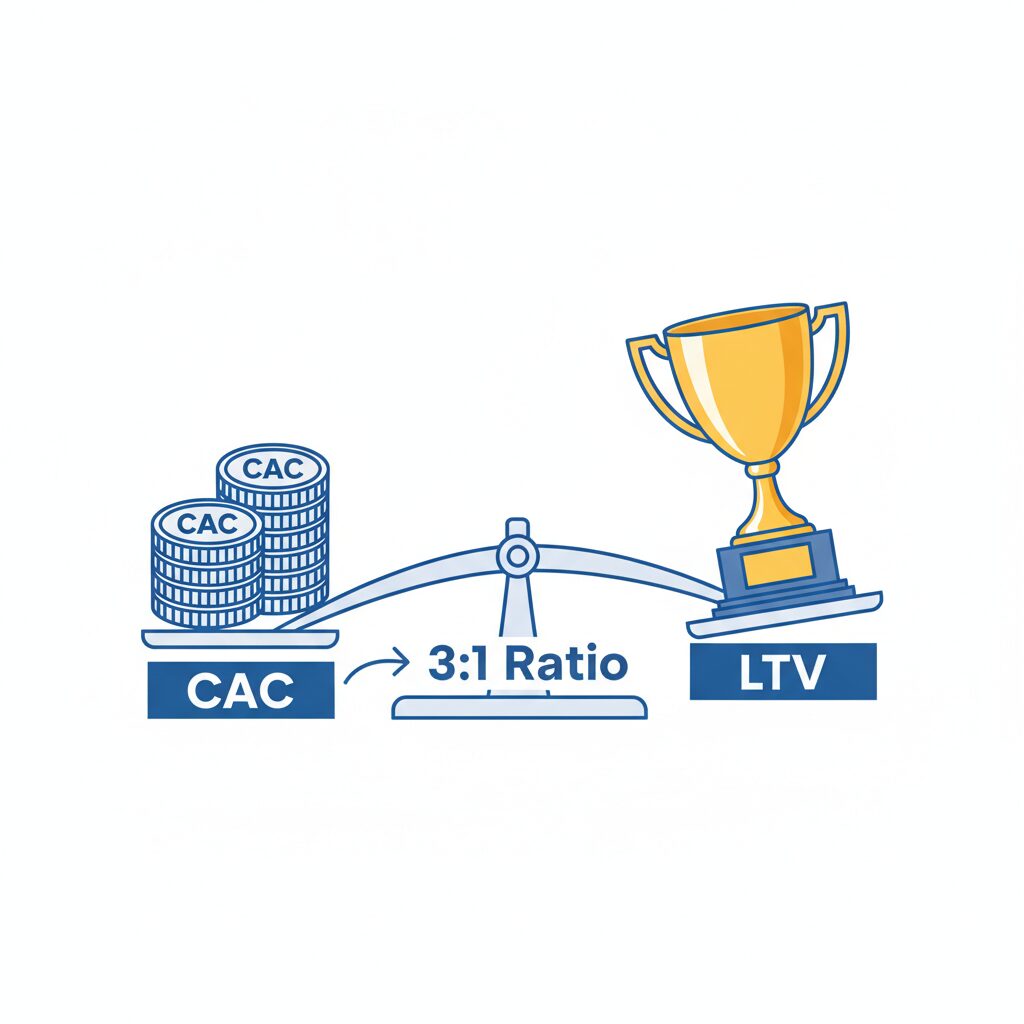
You’ll hear that 3:1 is the gold standard. It suggests a customer should be worth three times what it cost to get them. But here is the catch: that’s a general rule, and rules can be misleading. If you have a very short payback period (getting your money back in 3 months), a 2:1 ratio is perfectly fine. But if your payback period is two years, a 3:1 ratio is a fast track to a cash flow crisis.
Then there is the ‘Death Zone.’ This happens when your ratio drops below 1:1. You are spending more to acquire a customer than they will ever pay you. Unless you are in a hyper-aggressive land-grab phase backed by millions in VC funding, this is suicide. Most B2B firms in this zone are suffering from a blurry ICP definition or a leaky sales process.
Surprisingly, over-optimization is also a risk. A 10:1 ratio looks amazing on a spreadsheet, but it usually means you’re under-investing. If you can acquire customers at 1/10th of their value, you’re essentially handing market share to your competitors on a silver platter because you’re too scared to spend.
Revenue transformation: Strategies to optimize your ratio
Fixing your ratio requires a two-pronged attack: push the value up and pull the costs down.
To increase LTV, you need better pipeline architecture and expansion revenue. Stop selling one-off projects. Move toward an embedded leadership model where you provide ongoing strategic value. When you shift from being a “vendor” to a “partner,” you extend the customer lifespan and naturally increase the total account value.
Reducing CAC starts with a tighter ICP. When your sales team speaks directly to the visceral pain points of a specific persona, the sales cycle shrinks. A shorter cycle means fewer man-hours per deal, which drops your CAC instantly. This is exactly where ICP profitability shifts become the main driver of your margins.
This is where a Fractional CSO comes in. Their job is to stabilize these economics. An embedded sales leader removes the guesswork by building a repeatable engine. They move the company away from the unpredictability of founder-led sales and toward a system where the LTV CAC ratio is monitored and tuned in real-time.
Integrating LTV CAC into your predictable revenue metrics
The ratio is a snapshot, but the CAC Payback Period is your speed metric. This is how many months it takes to recover the cost of acquiring a customer. In the Indian B2B market, a payback period under 12 months is healthy. If it takes 18 months to break even, your cash flow will be strained even if your LTV is huge. You can’t pay salaries with “future LTV.”
Churn rates have a violent impact here. A tiny increase in monthly churn can slash your LTV by half. For example, moving from 2% monthly churn to 5% doesn’t just lose you a few clients; it destroys the mathematical viability of your entire acquisition spend.
To stay on top of this, build a “real-deals” dashboard. Don’t just track the average; track the LTV CAC ratio by lead source, by salesperson, and by industry vertical. This lets you see exactly which channels are fueling growth and which are just burning cash.
Frequently Asked Questions
How do you calculate LTV for a B2B service business with no monthly retainer?
Take your average contract value and multiply it by the average number of times a client comes back for new projects over a three-year window. Subtract the direct costs of delivery to get your net LTV.
What is an acceptable CAC payback period for a B2B startup in India?
Between 6 and 12 months is the sweet spot for high-growth startups. If you’re crossing the 14-month mark, you either need to raise your prices or fix your sales efficiency.
Does the LTV CAC ratio include the cost of the founder’s time?
It should. For an honest ratio, include the market salary of the founder’s time spent on sales. If you ignore this, you’re looking at a “fake” ratio that will vanish the moment you hire a real sales team.
How does shifting from a lead-gen model to an account-based marketing (ABM) model affect CAC?
ABM usually spikes your initial CAC because it’s more resource-intensive. However, it often leads to a much higher LTV because you’re landing larger deals with a better ICP fit.
Why is my LTV CAC ratio high but my bank account empty?
You have a payback period problem. You’re profitable on paper over the long term, but you’re running out of cash before the customer actually pays back the cost of their acquisition.
How often should B2B firms audit their unit economics?
Do a deep-dive audit every quarter and track the primary ratio every month. This is the only way to catch rising ad costs before they eat your margins.
Can a low LTV CAC ratio be acceptable in early-stage startups?
Yes, but only during the product-market fit phase when you’re paying for learning, not efficiency. Once you hit the scale phase, you must stabilize above 3:1.
What is the fastest way to improve a failing LTV CAC ratio?
The quickest lever is almost always raising your prices or narrowing your ICP to only the most profitable segments. This instantly boosts LTV and lowers the cost per converted lead.
Stop treating your sales pipeline like a black box. A healthy LTV CAC ratio for B2B is the only way to ensure your growth is sustainable and not just an expensive experiment. If your revenue is still too dependent on your personal network or your pipeline feels like a gamble, it’s time to fix the engine. Book a consultation with our Fractional CSO to architect a predictable revenue stream with a no-obligation audit.
Sales Fundas operates as an embedded leadership partner for ambitious B2B founders and CEOs, specializing in pipeline architecture and predictable revenue growth. By combining rigorous sales consulting frameworks with advanced digital advertising and performance marketing, we build sustainable, high-performing sales engines that complement and scale the founder's strategic vision.
- B2B Sales Consulting & Pipeline Architecture Frameworks
- Advanced Performance Marketing & Conversion Rate Optimization
- Search & Generative Engine Optimization (SEO/GEO) Specialists
- B2B Digital Advertising & Lead Generation Experts
This content was drafted using AI-assisted research and meticulously reviewed by the Sales Fundas consulting team to ensure strategic accuracy and alignment with our B2B sales frameworks.