

Stop losing ₹ Lakhs to pipeline friction. Learn to identify and eliminate B2B buyer's journey blockers this Ganesh Chaturthi. Start your transformation.
The high cost of sales friction
Most B2B founders treat a stalling pipeline as a performance issue with their sales team. In reality, it is usually a structural failure in the buyer’s journey. When a prospect stops responding after a demo or gets stuck in legal review for three weeks, you are not facing a “quiet” lead. You are facing friction.

As we approach Ganesh Chaturthi on September 14, 2026, the theme of removing obstacles—the essence of Vighnaharta—is perfectly applicable to your revenue engine. If your revenue is too founder-dependent or your pipeline is unpredictable, you have blockers that no amount of “hustle” can fix. You need a revenue transformation that clears the path for your customers to say yes.
Identifying the blockers in your pipeline architecture
Friction occurs anywhere the effort required by the buyer exceeds the perceived value of the next step. In many Indian SMEs, this happens because the sales process is designed for the seller’s convenience, not the buyer’s experience. One common failure mode is the “Information Dump” demo, where the salesperson spends 40 minutes talking about features instead of solving a specific business pain.
According to a 2026 B2B Buying Trends report by Gartner, 74% of buyers prefer a representative experience that minimizes the number of stakeholders they must coordinate internally. If your process requires five different meetings before a quote is issued, you are creating friction. In our work at Sales Fundas, we have seen companies reduce their sales cycle by 22% simply by merging the technical discovery and the commercial proposal into a single, high-impact session.
To identify these blockers, map your journey against your Ideal Customer Profile (ICP). Ask where the momentum drops. Is it after the first call? During the POC? Or at the final contract stage? If deals consistently stall after the demo, you likely have a gap in your pipeline architecture.
Clearing the path: Strategies for a scalable B2B sales engine
Removing blockers requires a shift from “selling” to “buying enablement.” Your goal is to make it easier for the client to buy from you than to stay with their current problem. This is where embedded leadership comes in; a Fractional CSO does not just give advice but builds the actual mechanics of the sale.
Start by eliminating the “Handover Gap.” The friction created when a lead moves from marketing to sales, or sales to implementation, often kills the deal’s momentum. Instead of a cold handover, use a shared success plan. This document outlines the buyer’s desired outcome and the exact steps needed to reach it. It turns the sales process into a collaborative project rather than a series of pitches.
Consider the financial friction. In the Indian market, pricing disputes often arise because the value was not anchored early. If you wait until the final proposal to discuss ₹ Lakhs in investment, the price becomes a blocker. Anchor the value by referencing the cost of inaction. When a client realizes that delaying the decision costs them ₹ 5 Lakh per month in lost efficiency, the price of your solution becomes a secondary detail. This is a core part of fixing B2B sales conversion without dropping your prices.
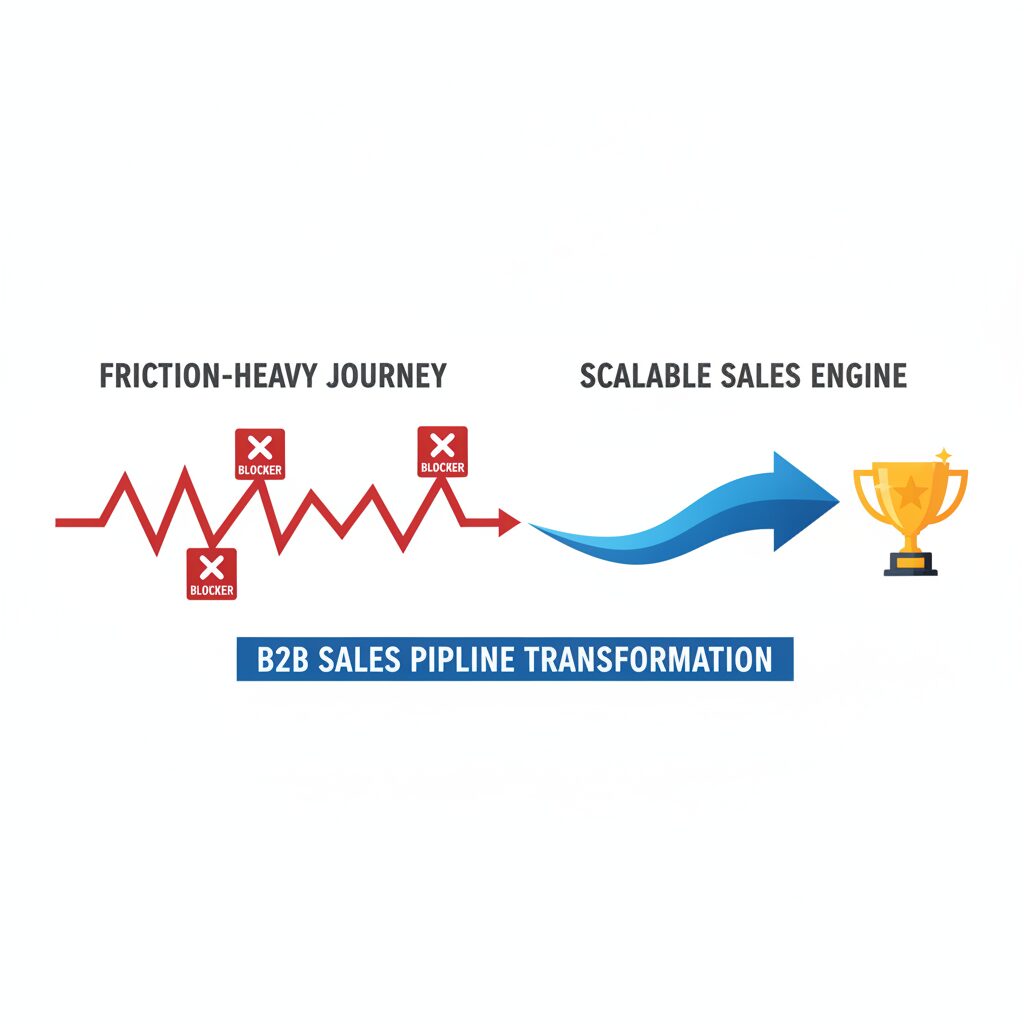
The Vighnaharta approach to revenue transformation
Just as Ganesh Chaturthi celebrates the removal of hurdles to start something new, your business needs a seasonal reset of its sales operations. Most startups rely on “real deals” that happen by chance or through the founder’s personal network. This is not a process; it is luck. A predictable revenue model requires a repeatable engine where blockers are identified and removed systematically.
One overlooked blocker is the lack of internal alignment. When the CEO promises a feature that the product team cannot deliver, you create a friction point that emerges during the final stages of the buyer’s journey. This creates a trust deficit. To solve this, implement a “Deal Review Board” where sales, product, and finance align on the feasibility of a deal before it reaches the final proposal stage.
If you find that your team lacks the skill to navigate these complexities, generic training will not work. You need corporate sales training that focuses on real-world pipeline shifts. The goal is to move your team from being “order takers” to “deal architects.” This shift ensures that the buyer’s journey is a smooth glide toward a closed-won status.
Building a friction-less future
The difference between a company that grows linearly and one that scales exponentially is the amount of friction in their sales process. When you remove the blockers, you don’t just increase your win rate; you increase your Customer Lifetime Value (CLV) because the relationship starts with a positive, effortless experience. You can explore more about this in our guide on the CLV factor.
Stop guessing why your deals are stalling. Audit your buyer’s journey today. Look for the gaps where communication drops or where the buyer is asked to do too much work. Once you identify these friction points, eliminate them with a structured approach to pipeline architecture.
Frequently Asked Questions
What is the most common friction point in B2B sales?
The most common point is the gap between the demo and the proposal. Buyers often feel a loss of momentum when the salesperson takes too long to provide a tailored solution.
How do I know if my sales process has too much friction?
Check your lead-to-close velocity. If deals stay in the “negotiation” or “review” stage for longer than your average sales cycle, you have friction blockers.
Can a Fractional CSO help remove these blockers?
Yes, a Fractional CSO analyzes your current pipeline architecture and implements the structural changes needed to ensure predictable revenue.
Does removing friction mean lowering prices?
No, friction is about the effort of buying, not the cost. Removing process blockers actually allows you to maintain higher prices by increasing the perceived value.
How does an ICP help reduce buyer’s journey friction?
A clear ICP ensures you only target prospects who have the problem you solve. This removes the friction of trying to convince an unfit lead to buy.
What is a ‘shared success plan’ in B2B sales?
It is a document co-created with the buyer that lists the goals, milestones, and deadlines required to achieve their desired outcome.
Why do B2B deals stall after a successful demo?
Usually, this happens because the demo focused on features rather than business outcomes, leaving the buyer unsure of the actual ROI.
How often should I audit my buyer’s journey?
Audit your journey every quarter. Market conditions and buyer expectations in the B2B sector shift rapidly, especially in the current 2026 climate.
This Ganesh Chaturthi, remove the blockers stalling your growth and build a scalable B2B sales engine with Sales Fundas. Book a strategy call for a free pipeline audit today.
Sales Fundas operates as an embedded leadership partner for ambitious B2B founders and CEOs, specializing in pipeline architecture and predictable revenue growth. By combining rigorous sales consulting frameworks with advanced digital advertising and performance marketing, we build sustainable, high-performing sales engines that complement and scale the founder's strategic vision.
- B2B Sales Consulting & Pipeline Architecture Frameworks
- Advanced Performance Marketing & Conversion Rate Optimization
- Search & Generative Engine Optimization (SEO/GEO) Specialists
- B2B Digital Advertising & Lead Generation Experts
This content was drafted using AI-assisted research and meticulously reviewed by the Sales Fundas consulting team to ensure strategic accuracy and alignment with our B2B sales frameworks.