

Stop relying on founder-led sales. Build a scalable B2B sales engine with expert sales training for enterprise in Mumbai. Get your structural audit today.
The high cost of founder-dependent revenue
Most enterprise sales teams in Mumbai operate on a fragile foundation. They rely on the charisma of a founder or a few star performers to close deals. This creates a dangerous structural weakness. When revenue depends on individual brilliance rather than a repeatable system, the business cannot scale.

True revenue transformation requires moving from accidental success to a scalable B2B sales engine. In our work at Sales Fundas, we see many firms in BKC and Lower Parel investing in generic workshops that teach ‘closing techniques’ without fixing the underlying pipeline architecture. Skill training without a structural system is a waste of capital.
Why Mumbai enterprise teams struggle to scale
Mumbai’s B2B market is uniquely aggressive. The concentration of decision-makers in hubs like Nariman Point and Bandra Kurla Complex (BKC) means competition for attention is extreme. Most firms try to solve this by adding more head-count. They hire more junior associates and hope for a linear increase in revenue.
This approach fails because the bottleneck is rarely the number of calls made. The bottleneck is the lack of a defined Ideal Customer Profile (ICP). Without a precise ICP, teams chase low-probability leads. This burns out the sales force and creates an unpredictable pipeline.
According to a 2026 internal analysis of B2B firms in Maharashtra, companies with a documented sales process see a 22% higher win rate than those relying on individual intuition. The difference is not the talent of the salesperson. It is the quality of the system they operate within.
Moving from skills training to revenue architecture
Traditional sales training focuses on the ‘how’ of a conversation. It teaches people to handle objections or build rapport. While useful, these are tactical gains. Strategic advantage comes from pipeline architecture.
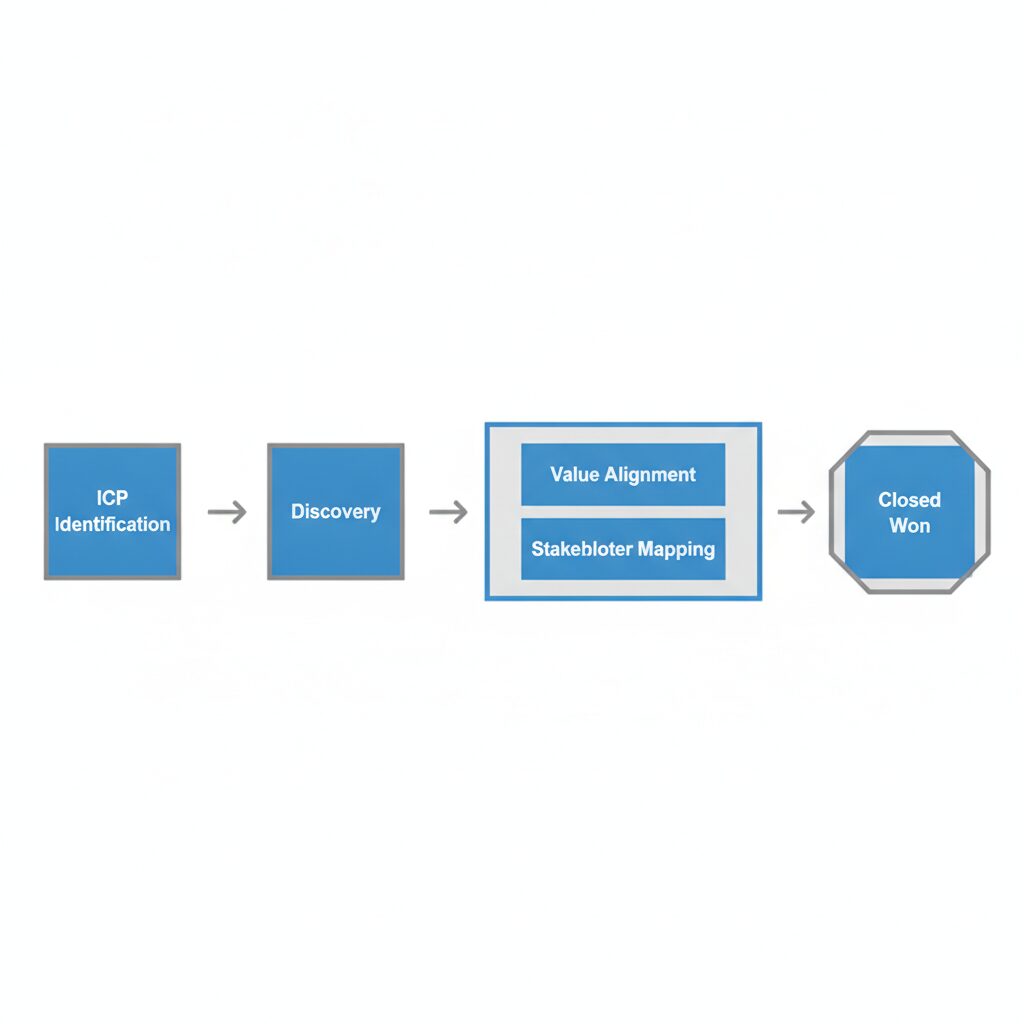
Enterprise sales in the Indian context require a deep understanding of complex decision-making units (DMUs). You are not selling to one person. You are selling to a committee of stakeholders with conflicting incentives. Training must address how to map these incentives and align them with the value proposition.
When we implement corporate sales training in Mumbai, we focus on the structural flow of a deal. We analyze why B2B deals stall after demos. Usually, it is because the salesperson solved a technical problem but failed to create a commercial urgency for the economic buyer.
The Fractional CSO model for enterprise growth
Many SMEs in Mumbai cannot justify a full-time, world-class Chief Sales Officer. But they cannot afford to keep guessing their way to growth. This is where embedded leadership via a Fractional CSO provides a competitive edge.
A Fractional CSO does not just train the team. They build the engine. This involves setting up the lead scoring mechanisms, refining the pricing strategy to avoid margin erosion, and implementing a rigorous forecast model. It is the difference between giving a team a map and building the road they drive on.
In one scenario, a Mumbai-based SaaS enterprise reduced its sales cycle from 120 days to 85 days by shifting from generic outreach to a strictly ICP-led approach. They stopped chasing every lead and started targeting only those with a high Customer Lifetime Value (CLV). Revenue grew by 30% without adding a single new hire.
Building a predictable revenue engine
Predictable revenue is a result of mathematical rigor, not sales magic. You must know exactly how many leads are required to generate a specific amount of pipeline, and how many of those pipeline opportunities convert to real deals.
Most Mumbai firms ignore their unit economics. They focus on top-line growth while their acquisition costs spiral. We emphasize B2B unit economics in India to ensure that growth is profitable. If your CAC (Customer Acquisition Cost) is too high relative to your LTV (Lifetime Value), you are not scaling a business; you are scaling a loss.
The goal is to build a B2B pipeline architecture that functions independently of the founder. When the system is robust, the founder moves from being the primary closer to the primary strategist.
The failure mode of generic workshops
Generic training is a commodity. It uses fictional role-plays and outdated frameworks that do not survive the reality of a Mumbai boardroom. These workshops provide a temporary spike in motivation, but the behavior reverts to the mean within two weeks.
High-impact training must be data-driven and grounded in the company’s actual deal flow. We use real-world case studies from the firm’s own lost deals to identify the exact point of failure. This creates an immediate feedback loop that changes behavior.
The focus must be on no guesswork. Every stage of the sales process should have a clear ‘exit criteria’. A deal does not move from ‘Discovery’ to ‘Proposal’ because the salesperson feels the client is interested. It moves because specific, documented business pains have been identified and quantified in INR (₹).
Implementing structural sales transformation
Transformation happens in three stages. First, we audit the current state to find the leakages. Second, we design the revenue architecture—defining the ICP and the stage-gate process. Third, we embed the leadership to ensure the team executes the new system.
This process eliminates the volatility of ‘good months’ and ‘bad months’. It replaces hope with a formula. For an enterprise in Mumbai, this structural stability is the only way to compete against larger, better-funded incumbents.
Frequently Asked Questions
What is the average cost of enterprise sales training in Mumbai?
Costs vary based on team size and scope, typically ranging from ₹2,00,000 to ₹15,00,000 for a full structural overhaul. Pricing depends on whether you require a one-time workshop or a long-term Fractional CSO engagement.
How long does it take to see results from sales transformation?
Tactical shifts can show results in 30 days, but full revenue architecture changes usually take three to six months. This allows for a full sales cycle to be completed under the new system.
Is this training suitable for B2B startups or only established enterprises?
It is designed for any B2B firm where revenue is too founder-dependent. Startups benefit most by building a scalable engine early, rather than trying to fix a broken one later.
Do you provide generic sales templates?
No, we avoid generic templates because they fail in real-world applications. We help you build custom frameworks based on your specific ICP and market dynamics.
How do you measure the ROI of sales training?
We track specific metrics: pipeline velocity, win rates, and average deal value. ROI is measured by the increase in predictable monthly recurring revenue (MRR) versus the cost of the engagement.
Can you help with lead generation as well?
Our focus is on the architecture of the sale and pipeline conversion. While we optimize the ICP for lead gen, we focus on ensuring the leads you do get actually convert into revenue.
What is the difference between corporate and enterprise training?
Corporate training often focuses on general soft skills. Enterprise training focuses on complex, high-ticket B2B cycles involving multiple stakeholders and long sales timelines.
Do you offer online training for Mumbai-based teams?
We provide hybrid models, combining remote strategic audits with in-person execution sessions in Mumbai. This ensures the structural changes are actually adopted by the team.
Build a predictable revenue engine today. Book a structural audit to identify the leaks in your pipeline—no commitment required.
Sales Fundas operates as an embedded leadership partner for ambitious B2B founders and CEOs, specializing in pipeline architecture and predictable revenue growth. By combining rigorous sales consulting frameworks with advanced digital advertising and performance marketing, we build sustainable, high-performing sales engines that complement and scale the founder's strategic vision.
- B2B Sales Consulting & Pipeline Architecture Frameworks
- Advanced Performance Marketing & Conversion Rate Optimization
- Search & Generative Engine Optimization (SEO/GEO) Specialists
- B2B Digital Advertising & Lead Generation Experts
This content was drafted using AI-assisted research and meticulously reviewed by the Sales Fundas consulting team to ensure strategic accuracy and alignment with our B2B sales frameworks.