

Generic workshops don't fix a founder-dependent pipeline. How pipeline architecture, ICP discipline, and a Fractional CSO change B2B sales in Mumbai.
The failure of generic sales training in Mumbai
Most B2B founders in Mumbai mistake activity for progress. They hire an experienced sales trainer, pay for a three-day workshop on closing techniques, and then wonder why the pipeline is still unpredictable six months later. The problem usually isn’t effort. It’s that the training targets individual skill while leaving the actual pipeline architecture untouched.

Corporate sales training often defaults to role-play scenarios and generic closing frameworks, and we see the same pattern in our Bangalore engagements as much as in Mumbai. It rarely works for SMEs or startups where the founder is still the primary rainmaker. Moving away from founder-dependent revenue takes a system that holds the sales knowledge, not a sharper pitch.
The structural trap of founder-led growth
In Mumbai’s B2B ecosystem, plenty of companies hit a ceiling somewhere between ₹10 crore and ₹50 crore in annual revenue, and the reason is almost always the same: the sales process only exists in the founder’s head. A new hire gets told to “be like the founder,” which isn’t a strategy, it’s a bet on finding a clone of someone irreplaceable.
That bet usually loses. New hires without a repeatable process end up chasing leads that don’t fit the Ideal Customer Profile (ICP), which stretches out sales cycles and drags down conversion rates. The pattern shows up often enough in Mumbai and Pune’s startup scene that it’s become something of a cliché among operators: sales here tends to get treated as an art form when it should be run as a science, and that gap is usually what caps growth well below where the underlying product could actually support it.
Breaking that cycle means shifting from individual brilliance to systemic excellence, which is really what building a predictable sales practice means in practice: a process that works regardless of who’s making the call.
Competitive advantage through pipeline architecture
Michael Porter’s classic framework says competitive advantage comes down to cost leadership, differentiation, or focus, going deep on a specific niche rather than trying to serve everyone. In B2B sales, the differentiation that actually matters isn’t product features. It’s the efficiency of your customer acquisition. If a competitor can close a high-value client in 30 days while you take 90, that’s a structural advantage no amount of product polish fixes on its own.
Real revenue transformation happens when you treat the pipeline as a piece of engineering rather than a collection of individual efforts. That means mapping every touchpoint from the first signal of intent through to the signed contract, which is what removes the “hope” factor from a quarterly forecast.
The principle plays out consistently: teams that tighten their entry criteria and target leads by fit rather than volume see shorter sales cycles and larger average deal sizes, because they’ve stopped spending cycles on prospects who were never going to convert in the first place. The goal isn’t more leads. It’s fewer, better ones, chosen against a real Customer Lifetime Value (CLV) lens instead of a gut feeling.
Why Mumbai’s B2B market requires a different approach
Mumbai is a high-friction environment. Decision-makers here get pitched constantly and have very little patience for fluff. A sales call that opens with a generic script gets tuned out within the first thirty seconds. Hustle without a map is just noise, however much energy goes into it.
Effective corporate sales training in Mumbai has to account for local procurement psychology. Indian B2B buyers tend to be risk-averse and respond to embedded expertise more than a polished pitch. They’re not buying from a vendor. They’re buying from someone who clearly understands their specific operational constraints, which is the whole logic behind our Fractional CSO approach: senior strategic leadership guiding the team in real time, instead of a lecture delivered once in a hotel conference room.
The failure mode we see most often in this market is over-promising and under-delivering. The fix is leading with a strategic diagnosis, identifying the client’s actual pain point before presenting anything resembling a solution. That’s the line between being treated as a commodity vendor and being treated as a strategic partner.
Moving from role-play to real deals
Most training programs lean on role-plays that feel obviously scripted. In the real world, a CEO won’t follow anyone’s script. They’ll interrupt, challenge the pricing, and pivot the conversation somewhere the training never covered. Reps need practice on real deals, not rehearsed ones.
Our approach starts with an audit of the live pipeline: exactly where deals are stalling, whether that’s the discovery call, the proposal stage, or the final negotiation. Working from the actual shape of the B2B sales cycle a client is running, rather than a generic template, is what makes the corrections land as immediately useful instead of theoretical.
Deals stall at the proposal stage more often than founders expect, and price is rarely the real reason. Usually it’s a value proposition that never got made concretely enough for the buyer to defend the purchase internally. Restructuring the offer around outcome-based pricing, rather than a feature list, is often what unsticks exactly this kind of deal.
Building a scalable B2B sales engine
Scaling a sales team isn’t about adding more people. It’s about increasing revenue per head. Bolt more reps onto a broken process and you don’t get more revenue, you get more expensive chaos.
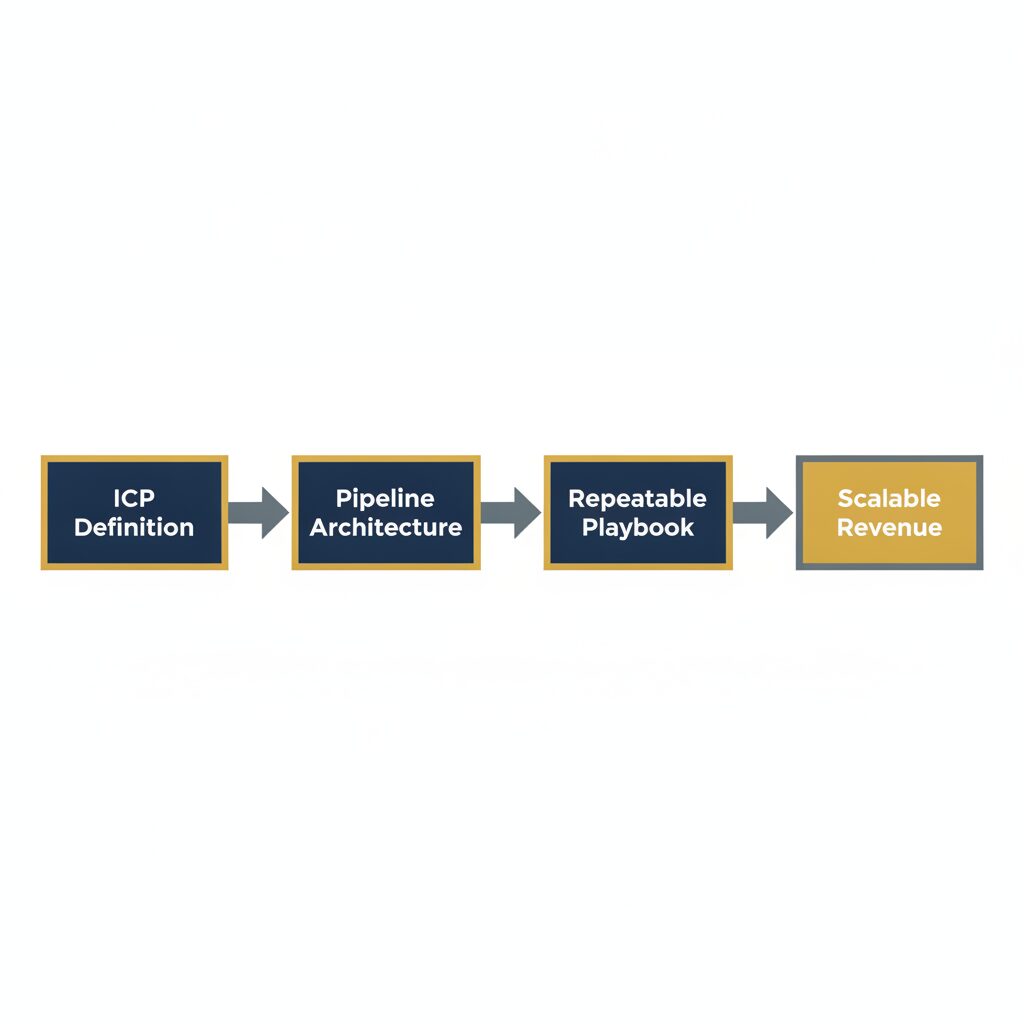
A scalable engine needs three things in place. First, a rigid definition of the ICP: if you can’t describe your ideal customer in three sentences, what you have is a wish list, not an ICP, and defining it properly is usually the fastest way to stop wasting time on leads that were never going to close.
Second, a documented sales playbook that functions as the organization’s source of truth: objection handling, follow-up sequencing, all of it written down rather than living in one person’s head. That’s what lets a new hire ramp in weeks instead of months.
Third, a shift in how sales leadership actually works. Most sales managers are promoted top performers, people who know how to close but were never taught how to coach. Applying real leadership frameworks turns a manager who happens to be good at selling into someone who can actually replicate that success across a whole team.
The cost of inaction in a competitive market
Every month a team operates without a repeatable process, revenue leaks out quietly. It isn’t theoretical. It’s the deals that went cold, the leads nobody followed up on, and the discounts a rep gave away because they didn’t know how to defend the value in the room.
Watch the LTV to CAC ratio closely here. If the cost to acquire a customer keeps climbing while the sales cycle keeps stretching, unit economics are quietly collapsing underneath what still looks like a healthy top line, and for a lot of Mumbai startups that’s the hidden threat to runway nobody catches until it’s already a problem. Burn doesn’t fix a broken engine. Only fixing the engine does.
The real risk of staying with the status quo isn’t standing still, it’s that competitors are actively investing in this kind of transformation right now. A team that depends on a few star players stays fragile. A team built on a system that makes every player closer to a star compounds instead.
Measuring the impact of professional sales transformation
We don’t measure success with a satisfaction survey after a training session. We measure it in the CRM, against a small set of numbers that actually predict revenue.
Pipeline Velocity. How fast does a lead move from discovery to closed-won? Even a modest improvement here compounds into meaningfully more annual recurring revenue without a single additional lead entering the funnel.
Win Rate. What share of qualified opportunities actually close? A win rate sitting well below industry norms usually points to a problem with the value proposition or the targeting, not the reps themselves.
Average Deal Value. Is the team discounting to win? A rep trained in value-based selling can generally hold margin even in a price-sensitive market like India, because the conversation has shifted from what the product does to what the outcome is worth.
Frequently Asked Questions
How is this different from standard sales workshops?
We replace generic theory with pipeline architecture and audits of real, live deals. The focus is building a repeatable system, not teaching temporary tricks that fade within a month.
Do you provide training for newly hired sales teams?
Yes, through documented playbooks built for rapid onboarding. That’s what shortens the time it takes a new hire to hit their first quota.
Can you help with founder-led sales transitions?
This is core to what we do. We help founders extract the sales process from their own head and turn it into something the rest of the team can actually run.
Is this training applicable to B2B SaaS and services?
Yes. The frameworks apply to any high-ticket B2B offering, adapted to the specific sales cycle of the industry involved.
Do you offer on-site training in Mumbai?
Yes, including sessions in hubs like BKC and Powai, plus embedded leadership through our Fractional CSO service. We run the same programs for teams in Pune and other nearby markets.
How long does it take to see a change in revenue?
Cultural shifts take longer, but pipeline optimizations often show up within a single sales cycle. Most clients notice a change in lead quality within the first month.
Do you help with defining the ICP?
Yes, it’s the first step in the process. A sales team can’t scale while targeting the wrong people, no matter how good the training on top of that is.
What is the typical cost of corporate sales training in Mumbai?
It depends on the depth of the transformation involved. Pricing is custom, based on team size and the complexity of the revenue goals.
A better process beats a better pitch, every time a competitor with one shows up in the same deal. Book a strategic revenue audit and find out where your pipeline is actually leaking, at no cost.
Sales Fundas operates as an embedded leadership partner for ambitious B2B founders and CEOs, specializing in pipeline architecture and predictable revenue growth. By combining rigorous sales consulting frameworks with advanced digital advertising and performance marketing, we build sustainable, high-performing sales engines that complement and scale the founder's strategic vision.
- B2B Sales Consulting & Pipeline Architecture Frameworks
- Advanced Performance Marketing & Conversion Rate Optimization
- Search & Generative Engine Optimization (SEO/GEO) Specialists
- B2B Digital Advertising & Lead Generation Experts
This content was drafted using AI-assisted research and meticulously reviewed by the Sales Fundas consulting team to ensure strategic accuracy and alignment with our B2B sales frameworks.