
Stop losing B2B deals to ghosting and pricing wars. Learn how to fix B2B sales not converting in India by bridging the trust gap. Book a free call.
The reason your deals are stalling
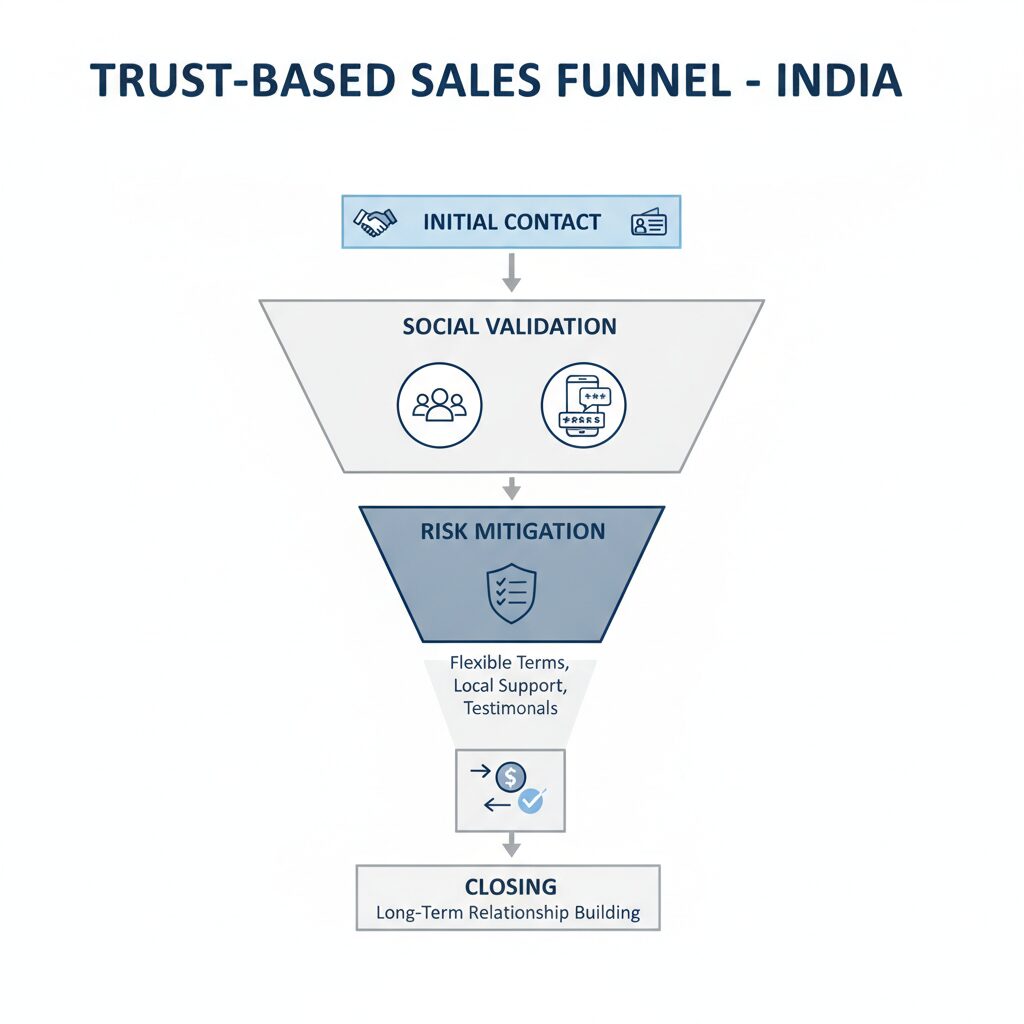
B2B sales in India fail not because the product lacks features, but because of a mismatch between global sales scripts and local trust patterns. Most founders try to push a value proposition based on efficiency or ROI, but the Indian buyer operates on a different frequency: risk mitigation and social validation.

If your pipeline is full of “interested” leads who stop responding after the second demo, you don’t have a lead quality problem. You have a trust gap. In the Indian market, the decision to buy is rarely about the best tool; it is about the safest bet. To fix this, you must shift from relationship-based selling to a systematic revenue transformation.
The consensus-based buying cycle
The Indian B2B buying cycle is rarely a straight line. It is a web of stakeholders. While you might be talking to a Manager or a VP, the actual decision often rests with a committee or a single dominant figure who may not even be in your Zoom calls. This is where many startups fail by treating the primary contact as the sole decision-maker.
In practice, the failure mode is ignoring the internal champion. Your contact might love the product, but they lack the political capital to push it through the finance or procurement department. When sales are not converting, it is often because you haven’t given your champion the specific ammunition they need to sell your solution internally.
We have seen this repeatedly at Sales Fundas. Founders often confuse a “positive reaction” with a “commitment to buy.” A positive reaction is a social courtesy; a commitment is a signed contract. To bridge this, you need a mastery of the sales cycle that accounts for hidden stakeholders.
The trust gap and the obsession with references
Indian B2B buyers are among the most risk-averse in the world. The fear of making a wrong choice that leads to professional embarrassment outweighs the desire for a 20% increase in efficiency. This creates a dependency on social proof that goes beyond a few logos on a website.
The common phrase “Who else in my industry is using this?” is not a request for a list of clients. It is a request for a safety net. If you cannot provide a reference from a company that looks exactly like theirs, the perceived risk spikes. This is why your Ideal Customer Profile (ICP) must be narrow. Trying to sell to everyone in India means you have no deep authority anywhere.
According to internal analysis of SME sales patterns in 2026, deals with a direct industry reference close 42% faster than those without. To solve this, stop chasing broad markets. Build a beachhead in one specific vertical, dominate it, and use those specific wins to lower the risk for the next buyer.
Indian pricing psychology and the discount trap
In the Indian market, the price is rarely the problem; the perceived value of the price is. There is a deeply ingrained culture of negotiation. Many B2B founders make the mistake of offering a discount too early to “close the deal.” This is a fatal error. When you discount early, you signal that your initial price was arbitrary or that your product is not actually worth the asking price.
The anchoring effect is powerful here. If you start at ₹10,00,000 and drop to ₹7,00,000 without a change in scope, you haven’t saved the deal; you have eroded your authority. The buyer now wonders what else they can squeeze out of you during the implementation phase.
Instead of discounting, trade value. If a client asks for a lower price, remove a feature or shorten the support window. This maintains the integrity of your pricing while giving the buyer the “win” of a negotiation. This shift is central to building a predictable sales practice that protects your margins.
Solving follow-up fatigue
“Just checking in” is the most ignored phrase in Indian B2B email. Most sales teams default to a sequence of polite nudges. In a high-noise environment, these emails are viewed as digital clutter. When a buyer ghosts you, it is usually because the perceived value of the conversation has dropped below the effort required to reply.
The fix is value-led follow-ups. Instead of asking for an update, send a piece of insight that helps them do their job. For example, instead of “Any update on the proposal?”, try “I saw this shift in [Competitor’s] pricing strategy and thought it might impact your Q4 planning. Here is how our tool handles that specific scenario.”
When you provide a insight, you transition from a vendor to a trusted advisor. This is exactly why customers stop picking up calls—they feel the call is for the salesperson’s benefit, not theirs. Shift the focus to their problem, and the response rate climbs.
The PoC trap: Proof of Concept as a stalling tactic
Many Indian B2B buyers will ask for a free Proof of Concept (PoC) or a pilot. While this seems like a path to conversion, it is often a stalling tactic used to avoid making a firm decision. A PoC without a defined success metric is just a free trial that leads nowhere.
To avoid this, implement a paid pilot. If a client is not willing to pay a nominal fee for a PoC, they are not a serious buyer; they are a window shopper. A paid pilot filters out the noise and ensures the client has skin in the game. It changes the dynamic from “Let’s see if this works” to “Let’s prove the value so we can scale.”
Define the success criteria in writing before the PoC starts. If the metric is “Reduce lead leakage by 15% in 30 days,” and you hit it, the transition to a full contract is a logical next step, not a new negotiation. This is how you build a scalable B2B sales engine that doesn’t leak revenue in the final mile.
Pipeline architecture vs. relationship selling
The biggest hurdle for B2B founders in India is the reliance on “relationships.” While relationships open doors, they do not close deals at scale. Relationship selling is unpredictable. If your top salesperson leaves, your revenue vanishes because the trust was in the person, not the process.
You need a pipeline architecture that systematizes trust. This means having a repeatable process for discovery, qualification, and closing that works regardless of who is making the call. It involves moving the buyer through a series of small commitments rather than one giant leap of faith.
Focus on the B2B pipeline architecture to ensure your revenue is not founder-dependent. When you move from “I know the CEO” to “We have a proven system for solving this problem for CEOs,” you stop guessing and start growing.
The role of embedded leadership
For many SMEs and startups, the gap in conversion is a leadership gap. The sales team often lacks the strategic depth to handle complex objections or navigate the political landscape of a large corporate client. They are following a script instead of diagnosing a business problem.
This is where a Fractional CSO provides the most value. By embedding strategic leadership into the sales process, you can coach your team in real-time on how to handle the “Indian nuance.” Instead of just reviewing numbers in a weekly meeting, a Fractional CSO helps restructure the actual conversations being had with clients.
Moving from junior-level execution to strategic sales leadership allows you to target high-value accounts without feeling out of your depth. If your team is struggling to convert, you may need fractional leadership to build the engine while you focus on the product.
Frequently Asked Questions
Why are my B2B leads ghosting me after the first demo?
Most ghosting happens because the demo focused on features rather than solving a specific, high-stakes business pain. You likely failed to establish a clear, urgent next step that provides value to the buyer.
How do I handle clients who demand heavy discounts in India?
Never discount without removing a part of the service or product scope. This preserves your value perception and teaches the buyer that your pricing is tied to actual deliverables.
Is a free PoC a good idea for Indian B2B startups?
Generally, no. Free PoCs often attract non-serious buyers and lead to endless stalling. Switch to a paid pilot with written success metrics to ensure commitment.
How many follow-ups are too many for an Indian B2B lead?
There is no fixed number, but the type of follow-up matters more than the frequency. Stop “checking in” and start sending industry insights or competitor data to maintain relevance.
How do I find the real decision-maker in a large Indian company?
Ask your current contact who else would be affected by the failure of this project. This reveals the stakeholders who are risk-averse and need to be convinced.
What is the best way to get references for a new B2B product?
Offer a deeply discounted “founder’s rate” to three ideal clients in exchange for a detailed, public case study. Use these early wins to build trust for the rest of the market.
Should I use WhatsApp for B2B sales in India?
Yes, but only after a formal relationship is established. Use it for quick updates and coordination, but keep all official proposals and contracts in email for audit trails.
How can I tell if a lead is actually interested or just being polite?
Ask for a specific commitment, such as a meeting with their finance head or a signed letter of intent. Politeness avoids commitment; genuine interest seeks it.
Build a predictable revenue engine today
Stop guessing why your deals are stalling and start implementing a system that converts. If your revenue is too founder-dependent or your pipeline is unpredictable, we can help you architect a scalable B2B sales engine. Book a strategic diagnosis call to identify your trust gaps for free.
Sales Fundas operates as an embedded leadership partner for ambitious B2B founders and CEOs, specializing in pipeline architecture and predictable revenue growth. By combining rigorous sales consulting frameworks with advanced digital advertising and performance marketing, we build sustainable, high-performing sales engines that complement and scale the founder's strategic vision.
- B2B Sales Consulting & Pipeline Architecture Frameworks
- Advanced Performance Marketing & Conversion Rate Optimization
- Search & Generative Engine Optimization (SEO/GEO) Specialists
- B2B Digital Advertising & Lead Generation Experts
This content was drafted using AI-assisted research and meticulously reviewed by the Sales Fundas consulting team to ensure strategic accuracy and alignment with our B2B sales frameworks.