
Stop B2B deal ghosting in India. Learn how to shift from feature-led to outcome-led demos and use Mutual Action Plans to drive predictable revenue. Book a free audit.
The reason your B2B deals stall after a demo is rarely the product.
In the Indian enterprise market, ghosting happens when a prospect confuses interest with commitment. Your demo might have been a technical success, but it failed as a commercial catalyst. If the decision-maker leaves the call saying, ‘This looks great, we will get back to you,’ you have already lost the momentum.

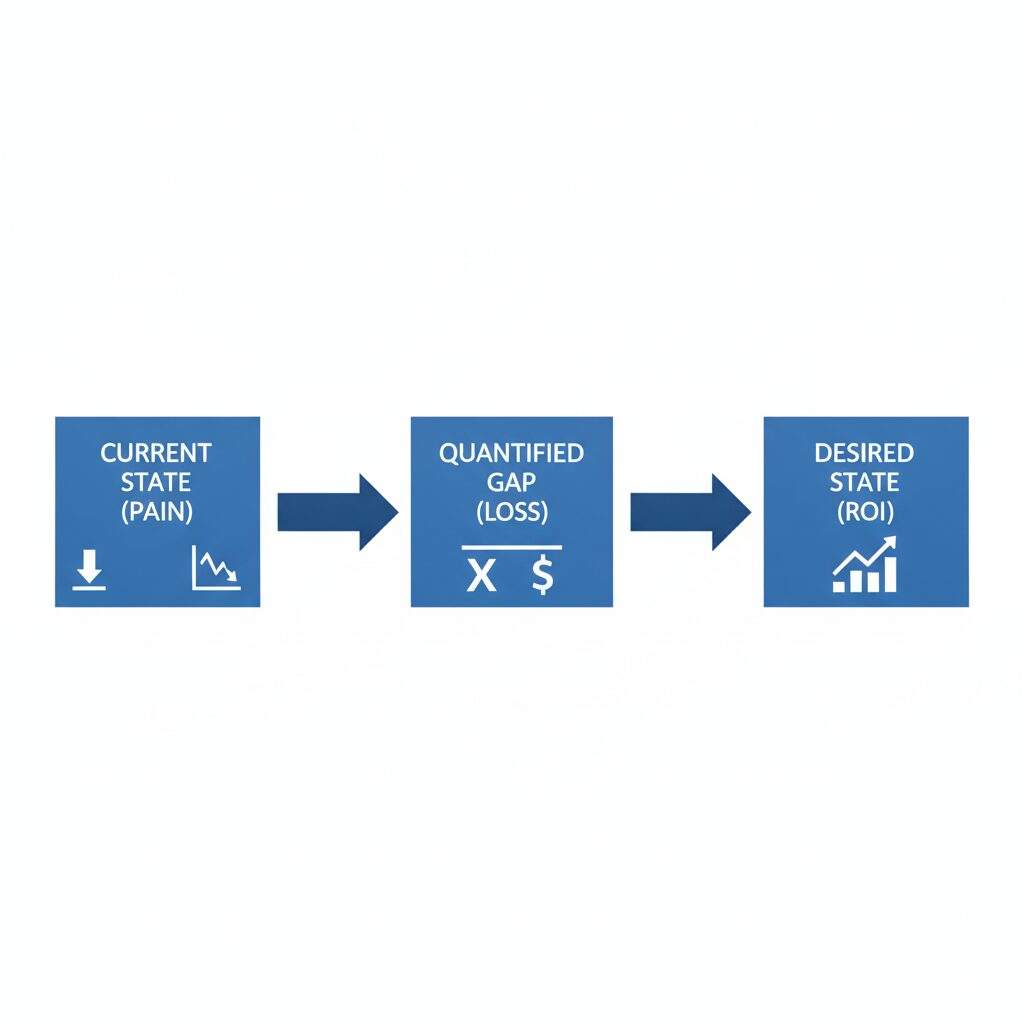
To move a deal forward, you must transition from a feature-led demonstration to an outcome-led diagnostic. The goal is not to show what the software can do, but to prove the cost of the prospect continuing with their current, broken process. When the cost of inaction exceeds the cost of your solution, the deal moves.
The polite ghosting phenomenon in Indian enterprises
Indian B2B buyers are culturally predisposed to be polite. This creates a dangerous signal for sales teams. A founder or MD will often nod and agree during a demo to maintain social harmony, even if they have no intention of buying. They avoid the hard ‘no’ because it feels confrontational.
In our work at Sales Fundas, we see this happen most often when the salesperson mistakes a ‘positive reaction’ for a ‘buying signal.’ The prospect is happy with the presentation, but they are not feeling the pain of their problem. They are essentially treating your demo as a free consulting session on how their industry is evolving.
The failure mode here is a lack of tension. Without tension, there is no urgency. If the prospect feels that their current situation is ‘manageable,’ your solution becomes a luxury rather than a necessity. To fix this, you must stop selling the ‘gain’ and start selling the ‘avoidance of loss.’
Feature-led demos vs. outcome-led demos
Most sales teams in India run feature-led demos. They spend forty minutes clicking through a dashboard, showing a reporting tool, and explaining a set of integrations. This is a mistake. Features are a commodity. Your competitors have similar features. When you lead with features, you invite the prospect to compare you on a checklist, which leads to price wars and stalling.
An outcome-led demo focuses on the gap between the current state and the desired state. Instead of showing a ‘lead tracking module,’ you show exactly where ₹15 Lakhs of potential revenue is leaking from their current pipeline every month. You connect the feature directly to a financial bleed.
Consider a scenario where a B2B SaaS company is selling a CRM to an Indian manufacturing firm. A feature-led demo shows the ‘automated follow-up’ tool. An outcome-led demo shows that the firm is losing 22% of its leads because follow-ups happen after 48 hours instead of four. The demo becomes a mirror reflecting their inefficiency. This creates the internal pressure needed to avoid the ‘I’ll get back to you’ trap.
The post-demo urgency framework for Indian decision-makers
Momentum dies in the silence between the demo and the follow-up email. You cannot rely on a ‘checking in’ email. That is the fastest way to be ignored. You need a formal mechanism that creates mutual accountability.
The most effective tool for this is a Mutual Action Plan (MAP). This is a shared document that outlines the exact steps required to reach the goal, including the internal approvals the prospect needs to secure. It shifts the conversation from ‘Do you want to buy this?’ to ‘How do we get this implemented by October?’
A MAP for an Indian SME might look like this:
- Agreement on the quantified gap in revenue (current state vs. future state)
- Technical validation by the IT head
- Commercial approval from the CFO/MD
- Pilot phase launch date
When you present this, you are not asking for a sale; you are coordinating a project. This professionalizes the interaction and makes it harder for the prospect to ghost you without feeling they are failing a project commitment. This approach is a key part of a predictable B2B pipeline architecture.
Dealing with the ‘I will get back to you’ objection
When a prospect says they will get back to you, they are usually trying to end the conversation politely. If you accept this, the deal is effectively dead. You must pivot the conversation back to the cost of delay.
In practice, the most effective response is to ask about the timeline of the pain. For example: ‘Usually, when a CEO tells me they will get back to me, it means the problem we discussed isn’t a priority right now. If we wait another three months to solve this lead leakage, how much more revenue will be lost?’
By framing the delay as a financial loss, you force the decision-maker to quantify the cost of their hesitation. If they still hesitate, you have successfully qualified them as a ‘non-buyer’ and can stop wasting resources. This prevents your pipeline from being cluttered with ‘zombie deals’ that look healthy but will never close.
Building a scalable B2B sales engine
Stopping deals from stalling requires more than a few scripts; it requires a fundamental shift in how you view the sales cycle. You must move away from the ‘vendor’ mindset and adopt the ’embedded leadership’ mindset. A vendor asks for a sale. A leader helps the client solve a business crisis.
Many founders find that their revenue is too founder-dependent because they are the only ones who can create this level of urgency. To scale, you need to institutionalize this process. This is why Fractional CSO services are becoming common for Indian startups; they provide the architecture for this high-impact selling without the cost of a full-time executive.
If your team is still relying on generic frameworks or ‘following up’ as a strategy, you are leaving money on the table. The goal is to build a predictable sales practice where every demo has a mandatory next step and a quantified cost of inaction.
The role of the Ideal Customer Profile (ICP) in demo success
Often, deals stall after the demo because you demoed to the wrong person. In Indian enterprises, there is a massive gap between the ‘user’ (who loves the features) and the ‘economic buyer’ (who cares about the ROI). If you only convince the user, the deal will stall at the CFO’s desk.
You must ensure the economic buyer is present for the ‘value’ portion of the demo. If they cannot attend, the user cannot be your champion. A true champion is someone who can articulate the financial cost of inaction to their boss in your absence. If your prospect cannot do that, you haven’t sold the outcome; you’ve only sold the tool.
Refining your ICP definition ensures you are only spending time on prospects who have a problem urgent enough to warrant a change in behavior. If the pain is not acute, no amount of demo polish will close the deal.
Frequently Asked Questions
Why do Indian B2B clients ghost after a successful demo?
They often confuse politeness with agreement. They avoid saying ‘no’ directly, leading the salesperson to believe the deal is moving when it is actually stagnant.
How do I tell if a demo was actually successful?
A successful demo ends with a scheduled next step and a signed-off Mutual Action Plan. Interest in features is a vanity metric; commitment to a timeline is the only real success signal.
Should I offer a discount to restart a stalled deal?
No. Offering a discount to a stalled deal signals that your value is negotiable and that you are desperate. Instead, re-introduce the cost of inaction.
What is the best follow-up cadence for B2B deals in India?
Avoid ‘checking in.’ Every follow-up must provide new value or reference a specific milestone in the Mutual Action Plan agreed upon during the demo.
How do I handle a prospect who loves the product but says they have no budget?
Budget is rarely the issue for high-impact solutions. The real issue is that the perceived value of solving the problem is lower than the cost of the software.
Is a free trial the best way to prevent ghosting?
Trials often increase ghosting because they remove the urgency to buy. Use a paid pilot with specific success criteria instead.
How long should a B2B demo last in the Indian market?
Keep the presentation to 20 minutes and the discovery/diagnostic to 40 minutes. The more the client talks about their pain, the more likely they are to buy.
What is a Mutual Action Plan (MAP)?
A MAP is a shared document outlining the technical, commercial, and legal steps required to reach a goal. It creates shared accountability between the buyer and seller.
Stop losing deals to silence
If your pipeline is full of ‘interested’ prospects who won’t commit, you don’t have a product problem—you have a pipeline architecture problem. Stop guessing why your deals are stalling and start implementing a system that forces urgency.
Build a scalable B2B sales engine today by booking a diagnostic call with our experts. We help you move from founder-led chaos to predictable revenue with no guesswork. Book your free sales audit now.
Sales Fundas operates as an embedded leadership partner for ambitious B2B founders and CEOs, specializing in pipeline architecture and predictable revenue growth. By combining rigorous sales consulting frameworks with advanced digital advertising and performance marketing, we build sustainable, high-performing sales engines that complement and scale the founder's strategic vision.
- B2B Sales Consulting & Pipeline Architecture Frameworks
- Advanced Performance Marketing & Conversion Rate Optimization
- Search & Generative Engine Optimization (SEO/GEO) Specialists
- B2B Digital Advertising & Lead Generation Experts
This content was drafted using AI-assisted research and meticulously reviewed by the Sales Fundas consulting team to ensure strategic accuracy and alignment with our B2B sales frameworks.