

A practical framework for growing B2B SaaS customer lifetime value through ICP fit, NRR, and time-to-value, without hiring more account managers.
The math of scale is simple
Doubling customer lifetime value does not require a bigger payroll. The common mistake is throwing more account managers at a churn problem, which only inflates overhead and thins your margins. The real lever is shifting from providing a service to building something closer to infrastructure: a system that keeps delivering value whether or not a specific person is on the account that week.

The fastest-scaling companies stop treating customer success as a support function and start treating it as a second sales motion. You do not need more people. You need a pipeline that gets the client to a real result faster, because once the value is obvious, expansion tends to follow on its own.
The account manager trap
Many small and mid-sized firms believe high-touch management prevents churn, so they hire junior associates to check in every two weeks. That is a strategy failure dressed up as diligence. A check-in with no attached value milestone is just noise, and the client did not sign up for noise. They signed up for a result.
Relying on a person to hold the relationship together creates a single point of failure. If that account manager leaves, the relationship often leaves with them, which is the real risk inside any founder-dependent or employee-dependent revenue model. Doubling CLV means moving the relationship from the person to the process.
Churn math works against you quietly here. A 25 percent reduction in churn typically produces roughly a 33 percent improvement in lifetime value, and cutting churn in half can double it outright. Churn isn’t one lever among several. It’s usually the highest-leverage one available, which is exactly why a process that survives staff turnover matters more than a friendlier check-in call.
Refining the ICP for high-velocity value
You cannot double the value of a client who was the wrong fit to begin with. Churn is often a symptom of a leaky ideal customer profile, not a service failure. A client without the internal infrastructure to use your solution will eventually leave no matter how much account management you throw at them, because they never got the result.
Look at your top ten percent of clients by profit, not revenue. What they have in common is rarely industry or headcount. It’s usually a specific internal trigger, a new CEO, a failed internal project, a compliance deadline, that made them genuinely motivated to solve the problem you solve. Target that trigger and the client arrives already primed to succeed.
This isn’t a theoretical exercise. Lavu, a restaurant point-of-sale company, spent years selling to “all restaurants” before narrowing its ICP to a specific restaurant segment where its features delivered outsized value. That single change, not a new feature or a bigger sales team, was a major part of what took the company from around $10 million to over $40 million in ARR. The lesson generalizes well past restaurant software: saying no to the wrong-fit prospects frees your existing team to go deeper with the right ones, which is how you raise lifetime value without adding a single headcount. For more on this, see 4 ICP profitability shifts that stop revenue leakage.
Building a pipeline architecture for expansion
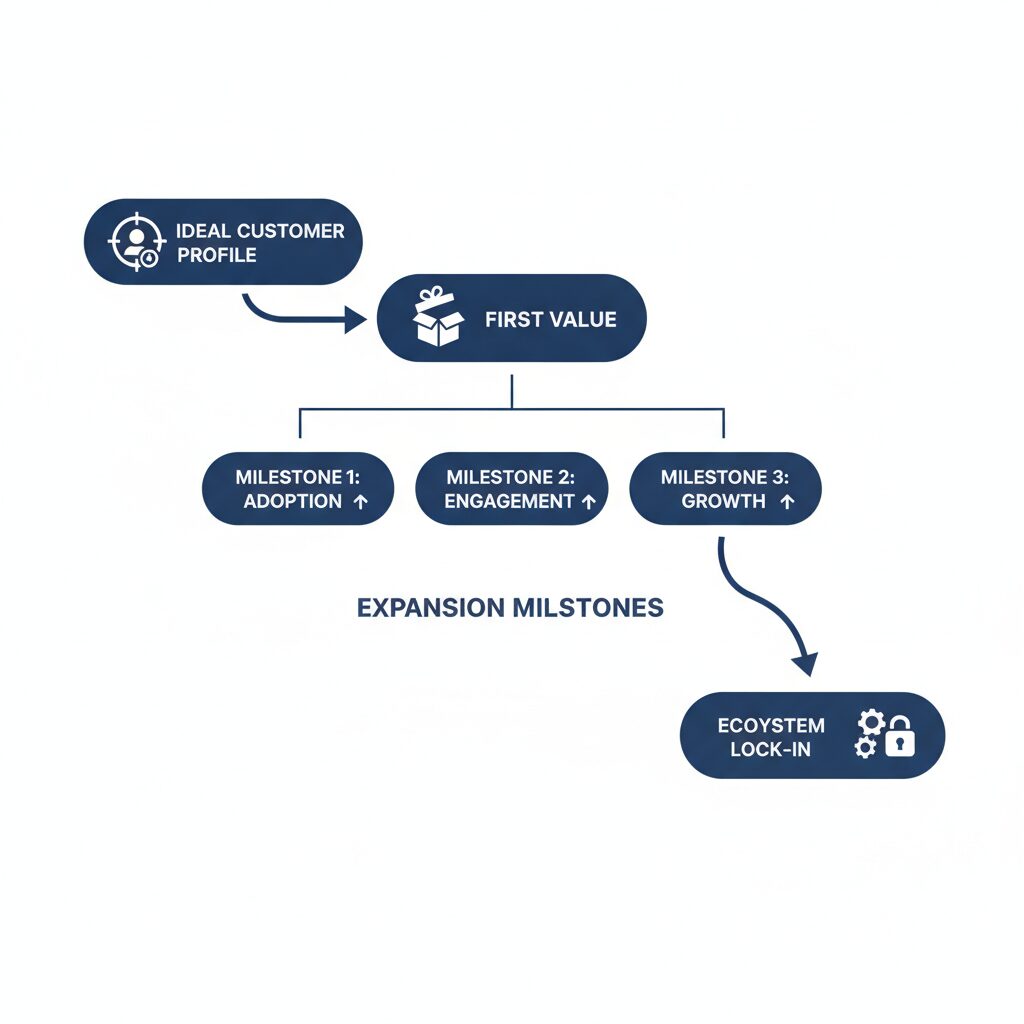
Most companies treat the first sale as the finish line. In a scalable B2B engine, the first sale is the entry point, and the real profit sits in the expansion that follows, what the wider SaaS world calls land-and-expand. That requires a pipeline architecture that maps the client’s growth journey before the contract is even signed.
Instead of waiting for the client to ask for more, define the milestones in advance. For a B2B sales consulting engagement, the first milestone might be a repeatable lead generation process, the second a predictable closing rate, the third a sales team that can run without the founder on every call. Each milestone becomes a natural, pre-agreed trigger for the next phase of the engagement.
When the move to the next phase is simply the logical next step in the client’s own growth, it stops feeling like a pitch and starts feeling like guidance. You are not upselling more services. You are walking them toward a larger version of the outcome they already hired you for, which is what turns a one-time project into a multi-year relationship.
Moving from service to ecosystem
To actually double CLV, the offering has to move from being a tool to being infrastructure. A tool is replaceable. Infrastructure isn’t. In the Indian B2B context, this often means shifting from a pure service model toward a hybrid that includes proprietary frameworks, audits, or a software layer alongside the human work.
Take a company selling sales training. If it only sells a three-day workshop, CLV is capped at the price of that workshop. But if it wraps the training in a CRM setup and a recurring performance audit, the client is now inside an ecosystem, and the cost of switching providers rises sharply because the provider holds both the data and the process.
The mistake is trying to build the ecosystem after the fact. It has to be designed at the start of the relationship, which is exactly the kind of architecture a Fractional CSO is built to put in place, so the business keeps growing without the founder sitting in every client meeting.
The role of asynchronous value delivery
Frequent live meetings are the enemy of scale. If value delivery requires a call every week, headcount eventually has to grow in lockstep with the client base. The alternative is asynchronous delivery: recorded walkthroughs, structured dashboards, and playbooks the client can move through at their own pace, with live calls reserved for genuinely strategic conversations rather than status updates.
Teams that make this shift tend to see the same pattern: fewer calendar meetings, faster onboarding, and a customer success team that can carry meaningfully more accounts without adding headcount, because the client is no longer waiting on someone’s calendar to get their next answer. The tradeoff is that the async materials have to be good enough to stand on their own. A confusing dashboard with no live explanation is worse than no dashboard at all.
This shift demands real clarity in how you communicate the offer. If the client can’t interpret what they’re looking at, the dashboard becomes clutter rather than value. Your value proposition has to be sharp enough that the results speak without a person translating them in real time.
Measuring what actually matters
Stop tracking client happiness and start tracking value realization. Happiness is a lagging indicator, and sometimes a misleading one. A client can like you personally and still churn, because liking you was never what they were paying for.
Four numbers matter more than a CSAT score.
Time to First Value. How many days pass from signature to the client’s first tangible win? This is the single highest-leverage number in the whole framework. Data across SaaS onboarding consistently shows customers who reach real value inside 14 days retain at roughly 80 percent or higher a year later, while those who take longer than 30 days retain at only 35 to 50 percent. Somewhere around 60 to 70 percent of annual churn happens inside the first 90 days, and the largest single chunk of that sits in the first 30. If you fix one number, fix this one.
Feature or service adoption rate. What share of the value you promised is the client actually using? A client paying for a full engagement but touching a third of it isn’t stable revenue. It’s revenue that hasn’t churned yet.
Net revenue retention, or NRR. The percentage of recurring revenue kept and grown from existing clients over a period, expansion included. Above 100 percent means your base is worth more this year than last year before you sign a single new client. Private B2B SaaS medians have recently sat around 101 to 105 percent, with enterprise accounts running closer to 115 to 120 percent.
Gross revenue retention, or GRR. The same calculation with expansion stripped out, so it can never exceed 100 percent. This is the number that matters most when NRR looks healthy. A business can show 110 percent NRR while quietly running an 85 percent GRR, which means a handful of expanding accounts are masking real churn everywhere else. Track both, and read the gap between them rather than just the headline NRR figure.
When a client reaches value inside two weeks, adopts most of what they paid for, and keeps growing with you while rarely leaving, you have a value-delivery engine rather than a service. That combination, not a satisfaction score, is what a rising CLV actually looks like on a spreadsheet.
Frequently asked questions
How do I identify which clients will have the highest lifetime value?
Look at your existing base and isolate the top clients by profit, then find what they had in common before they signed, usually a specific trigger or internal condition rather than industry or size. Target new prospects who match that pattern, not a generic buyer persona.
Can I increase CLV without raising my prices?
Yes. Extending how long a client stays and how often they expand usually moves CLV further than a one-time price increase, and it compounds in a way a price hike doesn’t.
What’s the biggest mistake founders make when trying to scale CLV?
Hiring more people to manage clients instead of fixing the underlying value-delivery process. That adds cost without adding anything the client actually notices.
How often should I review my ICP to prevent churn?
Quarterly is a reasonable cadence. Markets shift and your own product changes, and an ICP that was accurate two quarters ago can quietly stop matching who you’re actually signing.
Is a Fractional CSO better than a full-time sales director for growing CLV?
For most SMEs, yes, at least early on. A Fractional CSO gives you the strategic architecture and systems without the fixed cost of a full-time executive salary, and you can graduate to a full-time hire once the system justifies the headcount.
How do I handle clients who demand high-touch attention?
Redirect the demand toward the value-delivery process itself rather than matching it call for call. Show them the system produces a better result than a weekly check-in would, and let the result make the case.
What’s a healthy LTV:CAC ratio for a B2B company in India?
The global benchmark holds up reasonably well here: 3:1 is the baseline for sustainability, and top-quartile companies run 4:1 to 6:1. Capital-constrained teams should treat anything below 3:1 as an active problem, not a number to just watch.
What’s the difference between NRR and GRR, and why track both?
GRR counts only churn and contraction, so it can never exceed 100 percent, it’s a pure measure of how leaky the base is. NRR adds expansion revenue on top and can exceed 100 percent. A wide gap between a strong NRR and a weak GRR usually means a few growing accounts are covering for a churn problem everywhere else.
How does pipeline architecture affect retention?
It gives the client a visible roadmap of what’s next. When they already know the next milestone, they have far less reason to go shopping for another provider in the meantime.
Most B2B service businesses already have the ingredients for a higher CLV sitting inside client data they don’t look at often: time to first value, adoption rate, the gap between NRR and GRR. What’s usually missing is the architecture that turns those numbers into an actual growth engine instead of a spreadsheet nobody revisits. Book a free strategy audit with Sales Fundas and we’ll map out where your current model is leaking value and what a process-driven version of it would look like.
Sales Fundas operates as an embedded leadership partner for ambitious B2B founders and CEOs, specializing in pipeline architecture and predictable revenue growth. By combining rigorous sales consulting frameworks with advanced digital advertising and performance marketing, we build sustainable, high-performing sales engines that complement and scale the founder's strategic vision.
- Embedded Leadership for B2B Growth
- Sales Pipeline & Revenue Architects
- B2B Sales Engine Development
- Strategic Sales Scaling Experts