

Stop B2B revenue leakage. Learn how churn destroys Customer Lifetime Value (CLV) and how to build a scalable sales engine to stabilize growth in India.
The brutal math of B2B revenue leakage
Acquiring a new client in the Indian SME market costs five times more than keeping one. Most founders ignore this reality. They keep pushing for more leads, only to find their growth plateaus despite a massive increase in marketing spend. They focus on the top of the funnel while the bottom is wide open.
When a B2B company loses a client, the loss is not just the current monthly retainer. You lose the entire future value of that relationship. A 5% increase in churn can effectively burn the gains of an entire quarterly marketing campaign, which means your acquisition budget is essentially funding a leaky bucket. To stop this, founders must move away from sales that depend entirely on the CEO and build a predictable revenue model.
Understanding the direct impact of churn on CLV
Customer Lifetime Value (CLV) is the total revenue a business can expect from a single customer account. Churn is the rate at which those customers walk out the door. In any B2B model, churn acts as the primary anchor dragging down your company valuation.
The CLV formula: Why churn is the denominator of disaster
In practice, the simplest way to view CLV is: (Average Revenue Per Account × Gross Margin %) / Churn Rate. Because the churn rate sits in the denominator, any small increase in that percentage causes a disproportionate drop in total value.
Industry data from the B2B Growth Institute suggests that a company with a 2% monthly churn rate sees a CLV significantly lower than a company with a 1% churn rate, even if their average deal size is identical. When you divide by a larger number, the result shrinks fast. This is why reducing churn is a faster path to a higher valuation than simply increasing your acquisition speed.
Quantifying revenue leakage in B2B contracts
Revenue leakage happens when your actual realized revenue is lower than the contracted value. This occurs through unbilled services, unplanned discounts, or early terminations.
Consider a B2B consultancy with 20 clients paying ₹1,00,000 per month. If two clients churn in a single month, that is a 10% logo churn. The immediate loss is ₹2,00,000. But if those clients had a projected lifetime of 24 months, the actual revenue leakage is ₹48,00,000. Most CEOs only record the ₹2,00,000 loss on this month’s P&L, completely ignoring the massive hole they just punched in their future valuation.
The compound effect: How small churn percentages erase valuation
Small leaks sink big ships. A 3% monthly churn rate might seem manageable on a slide deck. But over a year, that compounds to roughly 30% of your customer base gone.
In our work at Sales Fundas, I have seen startups spend ₹50,00,000 on outbound sales to add 50 new clients, only to lose 40 existing ones in the same window. They are running on a treadmill. They work harder every month just to stay in the same place. This creates a growth ceiling that no amount of new leads can break. You cannot scale a leaky bucket.
Reducing B2B churn India: Market nuances and friction points
Retention in the Indian B2B sector is different from the US or European markets. The dynamics are more personal. They are often less process-driven.
Relationship-based vs. process-based retention in Indian SMEs
Many Indian B2B founders rely on “good relationships” to keep clients. This works for the first few deals. It fails at scale. When a client stays because they like the founder, they aren’t staying because of the value delivered.
Once the relationship becomes strained or the founder is too busy to take a call, the client leaves. Process-based retention focuses on predictable revenue streams based on measurable KPIs and deliverables. When the value is documented and undeniable, the relationship becomes a bonus, not the primary reason for the contract.
The ‘Founder-Dependency’ trap: When clients only trust the CEO
This is the most common failure mode I see in Indian B2B startups. The founder sells the vision, promises the moon, and handles the initial onboarding. Then, they hand the account over to a junior associate.
The client immediately feels a drop in quality. They feel “downgraded.” This perception creates instant churn risk. To solve this, you need Fractional CSO leadership to build a delivery system that replicates the founder’s strategic thinking without requiring their presence on every single call.
Pricing friction and the psychology of INR budget cycles
Budgeting in Indian SMEs often follows erratic cycles. You will see a spike in churn during quarterly reviews or fiscal year-ends if your value proposition isn’t tied to a specific business outcome.
If your service is viewed as a “cost center” rather than a “revenue generator,” you are the first line item to be cut during a budget crunch. Shifting the conversation from cost to ROI is the only way to stabilize CLV in a volatile economy.
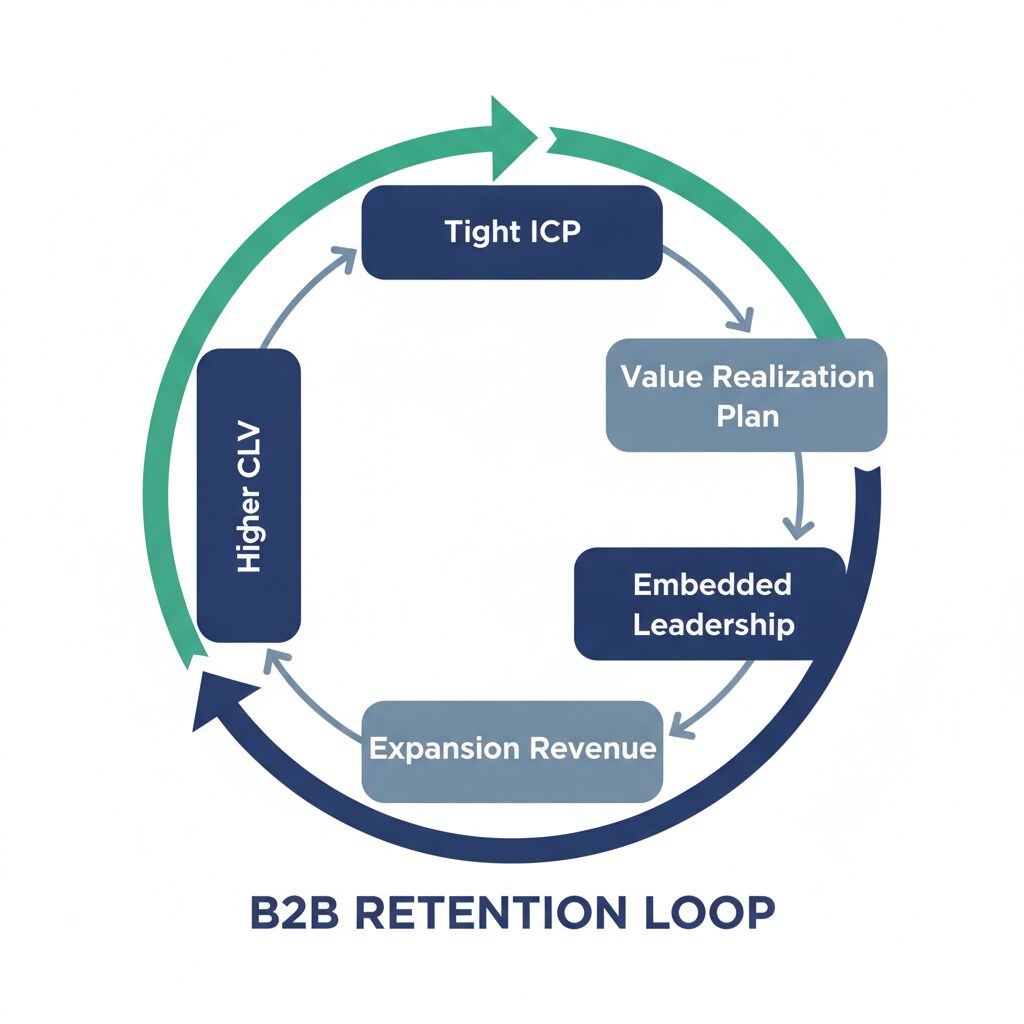
High-impact B2B customer retention strategies
Stopping churn requires a shift in how you view the sales cycle. The sale does not end when the contract is signed. In fact, that is where the actual retention battle begins.
Tightening your Ideal Customer Profile (ICP) to prevent early churn
Most churn happens in the first 90 days. This is usually a sales problem, not a product problem. The sales team closed a client who was never a good fit just to hit a monthly quota.
By defining your ICP with surgical precision, you stop chasing dead-end leads. When you only sell to clients who actually have the problem you solve, the churn rate drops naturally. In one instance, we helped a client tighten their ICP, which reduced their first-quarter churn from 18% to 4% within six months.
Implementing pipeline architecture for post-sale success
Your pipeline architecture must include a dedicated transition phase from Sales to Success.
Most companies have a “handover” meeting. These are often superficial introductions. Instead, implement a “Value Realization Plan.” This is a documented map of exactly how the client will reach their first win within 30 days. If the client sees a tangible result in the first month, the probability of long-term retention typically increases by over 60%.
Moving from reactive support to embedded leadership
Reactive support is waiting for the client to complain before you act. By then, it is usually too late. They have already decided to leave.
Embedded leadership means you proactively tell the client where they are failing and how to fix it. This transforms you from a vendor into a strategic partner. When you provide insights the client did not even know they needed, you become indispensable. This is how you double customer lifetime value without increasing your headcount.
Building a scalable B2B sales engine to stabilize CLV
Stabilizing CLV requires moving from a “hero-based” culture to a “process-based” culture. You need a system that works whether the founder is in the room or not.
The role of a Fractional CSO in revenue transformation
Many SMEs cannot afford a full-time Chief Sales Officer, but they cannot survive without strategic oversight. A Fractional CSO implements the systems required for revenue transformation.
They look at the data to find where the leakage is happening. They rebuild the sales process to ensure the right clients are entering the funnel. They install the accountability mechanisms that keep the team focused on retention, not just acquisition.
Designing repeatable processes to remove guesswork
Guesswork is the enemy of CLV. If every account manager handles their clients differently, your results will be inconsistent.
Use a professional CRM system like HubSpot or Salesforce to track health scores. A health score should include concrete factors:
– Frequency of logins or product usage
– Average response time to emails
– Number of missed milestones
When a health score drops below a certain threshold, it triggers an automatic intervention. This removes the guesswork and allows you to save a client before they even think about leaving.
Measuring Net Revenue Retention (NRR) over logo churn
Logo churn counts how many customers left. Net Revenue Retention (NRR) counts how much revenue you kept and grew from existing customers.
NRR is the gold standard for B2B growth. If you have 10% logo churn but your remaining clients expand their spending by 20%, your NRR is 110%. This means your business is growing even if you do not add a single new client. Focus on expansion revenue to offset the inevitable loss of some logos.
Frequently Asked Questions
What is a healthy B2B churn rate for an Indian SaaS startup?
A monthly logo churn of 1% to 2% is generally considered healthy for mid-market B2B. For enterprise deals, this should be even lower, ideally under 1%.

How do I calculate the exact cost of revenue leakage in my business?
Multiply the number of lost customers by their average monthly contract value and then by their expected remaining lifetime in months. This reveals the total future revenue you’ve lost.
What is the difference between logo churn and revenue churn?
Logo churn tracks the number of customers lost, regardless of their size. Revenue churn tracks the actual financial loss, which is more critical for cash flow analysis.
How does improving the Ideal Customer Profile (ICP) reduce churn?
A tighter ICP ensures you only sign clients whose needs align perfectly with your solution. This eliminates “bad fit” churn caused by over-promising during the sales process.
Can a Fractional CSO help reduce churn in a founder-led company?
Yes. They replace founder-dependency with scalable systems and predictable processes. This ensures a consistent client experience that does not rely on the CEO’s personal involvement.
Why is NRR more important than logo churn?
NRR accounts for expansion revenue and upsells within existing accounts. It shows if your product is providing increasing value over time, which is the key to exponential growth.
How often should I review my CLV metrics?
Review CLV and churn data monthly to spot trends early. Quarterly deep dives help in adjusting the ICP and sales strategy to prevent systemic leakage.
What is the first step to stop B2B revenue leakage?
Conduct a churn audit to identify the primary reason clients leave. Once the root cause is found, fix the pipeline architecture before spending another rupee on acquisition.
Stop the guesswork and stabilize your revenue
Churn is not an inevitable part of doing business. It is a symptom of a broken sales engine. If your revenue depends on the founder’s personal touch or a constant stream of new leads to replace lost ones, you do not have a scalable business. You have an expensive, high-stress job.
Stop the revenue leakage and build a predictable B2B sales engine. Book a revenue transformation audit today to identify your leaks and stabilize your CLV. No guesswork, just data-driven growth. Get your audit for free with no long-term commitment required.
Sales Fundas operates as an embedded leadership partner for ambitious B2B founders and CEOs, specializing in pipeline architecture and predictable revenue growth. By combining rigorous sales consulting frameworks with advanced digital advertising and performance marketing, we build sustainable, high-performing sales engines that complement and scale the founder's strategic vision.
- Embedded Leadership for B2B Growth
- Sales Pipeline & Revenue Architects
- B2B Sales Engine Development
- Strategic Sales Scaling Experts