
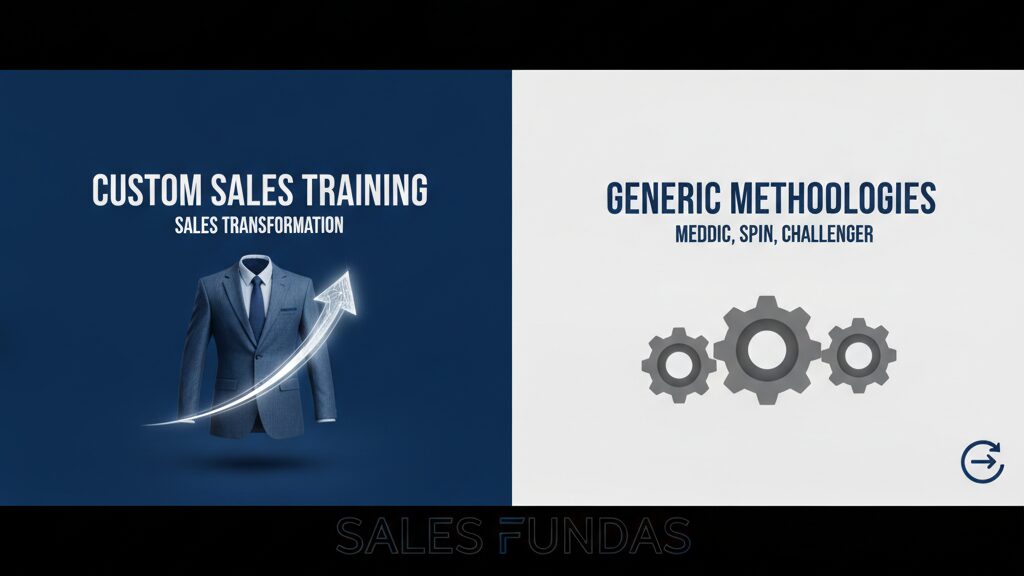
- Custom sales training builds playbooks around specific customer profiles, unit economics, and live pipeline deals rather than standardized qualification models.
- Generic methodologies work best within mature sales operations infrastructures, but fail when used as a substitute for basic sales strategy.
- Research indicates 72% of surveyed B2B sellers felt overwhelmed by required skills, making them 45% less likely to achieve quota.
- Standard frameworks struggle in Indian enterprise sales because local buying centers operate through consensus, informal internal alliances, and heavy risk aversion.
B2B founders and commercial leaders should invest in custom sales training when their revenue relies on bespoke deal structures, multi-stakeholder enterpri
B2B founders and commercial leaders should invest in custom sales training when their revenue relies on bespoke deal structures, multi-stakeholder enterprise committees, or founder intuition. Off-the-shelf methodologies provide helpful qualification vocabulary, but bespoke training embeds those concepts directly into your actual deal stages, buyer personas, and pipeline architecture to generate predictable revenue.

Choosing between custom sales training vs generic frameworks means deciding between an operational playbook built around your economics and an abstract set of classroom principles. While packaged programs offer immediate structure, they rarely address why your specific buyers stall during commercial negotiations or procurement reviews.
Early-stage companies frequently encounter a predictable revenue plateau when moving beyond founder-led sales. When new account executives fail to close deals, executive leadership often purchases an off-the-shelf methodology. The assumption is that teaching reps a famous acronym will solve pipeline unpredictability. In practice, generic methodologies address seller behavior in a vacuum, ignoring the realities of your market.
What is the difference between custom sales training and off-the-shelf sales training?
Off-the-shelf sales training teaches standardized qualification models and question flows designed for universal enterprise transactions. In contrast, custom sales training builds playbooks around your unit economics, specific Ideal Customer Profile (ICP), actual buying committee dynamics, and verifiable sales stages using live pipeline deals.
Generic training relies on hypothetical role-plays and external case studies from Fortune 500 technology firms. Your sales team spends hours debating how an enterprise software company sold an infrastructure deal a decade ago. That context does not help a mid-market rep navigate a ₹25,00,000 annual contract with a conservative Indian manufacturing conglomerate.
Custom programs examine your closed-won and closed-lost CRM data before delivering instruction. The curriculum reflects your deal velocity, your typical champion profile, and your pricing mechanics. According to research on SalesGuru, high-performing sales organizations are 56% more likely to systematically measure training effectiveness and quantify direct performance improvements.
When do off-the-shelf sales methodologies work and fail?
Off-the-shelf methodologies work best when an organization already possesses a mature sales operations infrastructure, clear stage gates, and dedicated enablement managers. In that environment, a framework like MEDDIC supplies a unified vocabulary for pipeline inspection across hundreds of enterprise reps.
These frameworks fail when startups use them as a substitute for basic sales strategy. If your team cannot articulate product value or lacks clarity on target accounts, an acronym will not save the quarter. Sellers get burdened with administrative overhead rather than conducting sharper commercial discovery.
Research published by SalesGuru notes that 72% of 1,026 surveyed B2B sellers felt overwhelmed by required role skills, and overwhelmed sellers were 45% less likely to achieve quota. Imposing heavy enterprise frameworks on lean sales teams compounds this cognitive strain without improving win rates.
The methodology deconstruction matrix: MEDDIC, SPIN, and Challenger
Every legacy sales framework was designed to address a distinct transaction dynamic. Selecting the right approach requires evaluating your average contract value (ACV), sales cycle duration, and buyer risk tolerance. The table below outlines how standard frameworks compare to tailored enablement across operational dimensions.
| Methodology | Primary Focus | Best Suited ACV & Cycle | Common Failure Mode | Custom Adaptation Requirement |
|---|---|---|---|---|
| SPIN Selling | Uncovering latent pain through investigative questioning | ₹5,00,000–₹25,00,000; 30–60 days | Interrogation fatigue; reps ask questions without providing commercial insight | Map questions directly to verified trigger events and technical pain profiles |
| The Challenger Sale | Reframing mental models and teaching commercial insights | ₹20,00,000–₹1,00,00,000; 60–120 days | Reps act abrasive with senior executives without earning authority | Build validated local industry benchmarks to anchor the teaching pitch |
| MEDDPICC | Strict deal qualification and process verification | ₹75,00,000+; 90–270 days | Reps treat CRM fields as a compliance exercise rather than an inspection guide | Prune criteria to match actual multi-threaded committee access |
| Custom Sales Engine | Contextual discovery, qualification, and consensus building | Calibrated to your exact business model and customer segments | Requires active leadership reinforcement to prevent procedural drift | Embedded coaching running on live pipeline inspection and real deals |
Why off-the-shelf frameworks struggle in the Indian B2B market
Most commercial sales frameworks originated in North American corporate environments where direct confrontation and top-down decision rights are standard. Applying those rules uncritically to Indian enterprise sales produces friction. Indian corporate buying centers operate through consensus, informal internal alliances, and heavy risk aversion.
When an Indian mid-market rep attempts a classic Challenger reframing on a Chief Financial Officer, the interaction frequently stalls. Indian enterprise leaders place high value on vendor reliability, long-term commitment, and operational deference. Pushing provocative assertions without an established relationship creates defensive resistance rather than commercial urgency.
A custom enablement model adapts these techniques to local realities. It retains the rigorous discovery of SPIN and the qualification discipline of MEDDPICC, while framing commercial conversations around risk mitigation and internal sponsor enablement. For guidance on navigating multi-stakeholder approvals, review our analysis on B2B buying committee strategy.
The founder extraction blueprint: Building a custom sales playbook
Startups often struggle to scale because the founder possesses undocumented institutional knowledge. The founder knows instinctively which technical trade-offs appease a cautious buyer and how to price contracts dynamically. Custom sales training codifies that intuition into a repeatable system for incoming account executives.
- Extract core narrative drivers: Interview the founder to document the specific customer pain points, macro shifts, and unit economics that drove the initial 20 enterprise deals.
- Map the customer decision journey: Define verifiable customer commitments required to move a deal from discovery to commercial review, replacing vague seller opinions.
- Isolate primary commercial objections: Document the exact financial, security, and integration pushbacks encountered over the prior four quarters, along with validated response tracks.
- Establish live deal coaching cadences: Implement weekly pipeline reviews focused on deal mechanics and multi-threading rather than inspecting cosmetic CRM update fields.
When organizations systematically document this workflow, new hires reach quota readiness significantly faster. To complement internal playbook development with outbound volume, align your discovery stages with our cold outbound strategy for startups.
How do you adapt a framework to your deal size and buyer type?
Adapting an enterprise framework requires pruning administrative elements that do not match your contract size and buyer velocity. For an annual contract value under ₹15,00,000, enforcing a full nine-part MEDDPICC scorecard creates unnecessary friction. Lean commercial cycles require lightweight qualification focused on budget reality and implementation timelines.
Consider an enterprise SaaS vendor selling compliance software at an average price of ₹40,00,000 per year. In this scenario, combining SPIN discovery questions with MEDDPICC qualification criteria produces strong results. The rep uses diagnostic questions to quantify the hard financial cost of compliance breaches during early meetings.
Once technical urgency exists, the rep transitions to MEDDPICC mechanics: identifying the true Economic Buyer and verifying the legal approval timeline. The methodology serves the deal velocity, not the other way around. Embedding an experienced Fractional CSO ensures that these operational guardrails remain active across every pipeline review.
The logo-swap audit: How to spot generic training vendors
Many corporate training providers advertise bespoke enablement while delivering generic content. They take standard presentation slides, replace the header with your corporate logo, and conduct high-energy workshops that produce zero lasting behavioral change. Founders can spot these generic offerings by reviewing potential engagements against seven critical warning signs.
- Vendor requests your pitch deck but refuses to inspect closed-lost CRM opportunities or interview your actual buyers.
- Curriculum focuses on abstract communication styles rather than pipeline stage conversions and negotiation parameters.
- Exercises rely on imaginary buyer role-plays rather than preparing strategies for live deals currently stuck in your pipeline.
- Trainer cannot explain the specific margin structures, sales velocity, or regulatory constraints of your vertical market.
- Program concludes with an inspirational keynote instead of structured managerial inspection checklists.
- No operational integration is planned for your existing customer relationship management platform.
- Engagement is delivered as a two-day workshop without ongoing deal coaching or performance measurement.
True enablement requires sustainable reinforcement. Rather than settling for classroom lectures, leaders choose High Impact Sales Training to install structured discovery mechanisms that reps apply directly to live accounts.
Selection checklist: Evaluating sales training approaches
Use this evaluation matrix during your commercial planning cycles. Score each item to determine whether your sales organization requires an off-the-shelf framework license or a bespoke sales engine build.
- Target deal complexity: If your ACV exceeds ₹20,00,000 and involves four or more stakeholders, prioritize custom playbooks over rigid commercial scripts.
- Current revenue dependency: If over 40% of pipeline revenue still requires founder closing intervention, bespoke extraction is necessary before standardizing rep training.
- Frontline managerial capacity: If your sales managers lack bandwidth for daily coaching, avoid standalone generic licenses that lack reinforcement mechanisms.
- Market maturity: If selling in specialized or consensus-heavy sectors, ensure your training incorporates tailored risk-mitigation messaging.
Frequently Asked Questions
What is the difference between custom sales training and generic sales training?
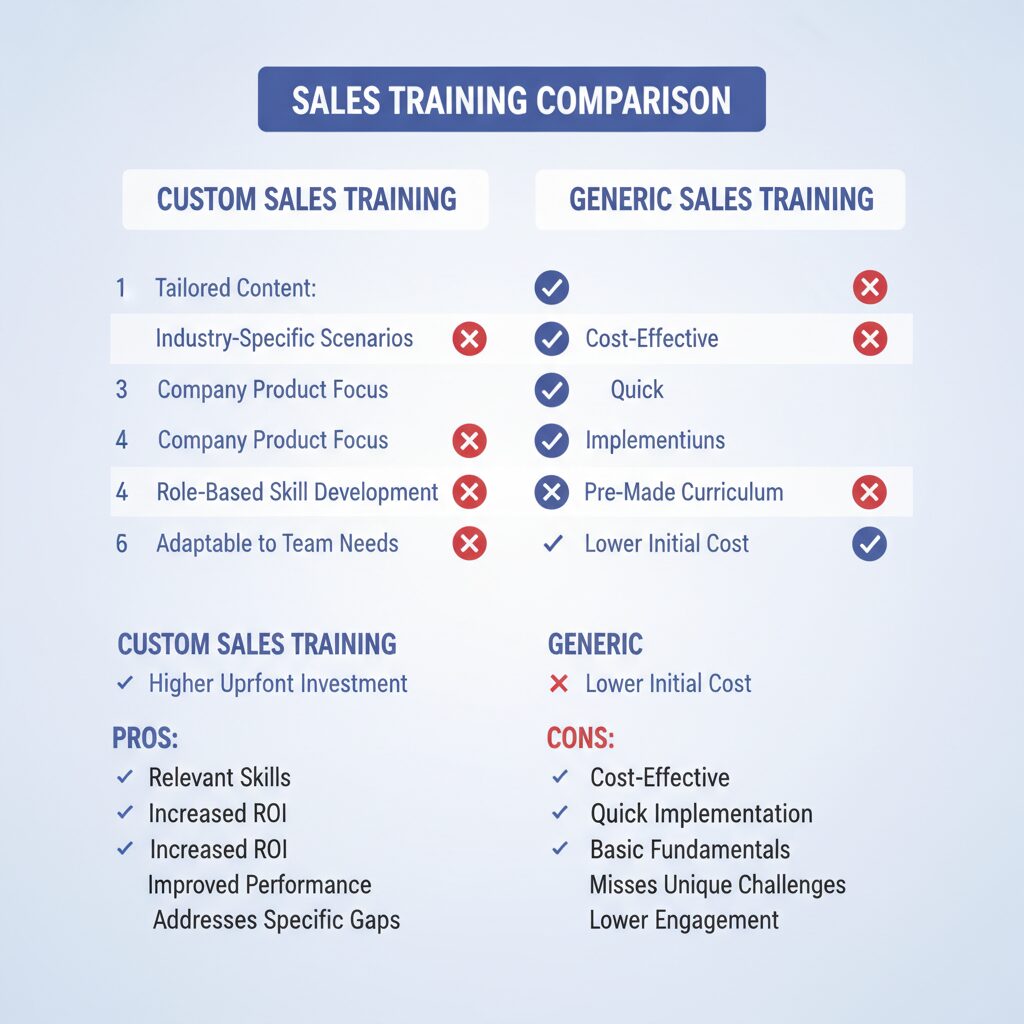
Generic sales training teaches universal frameworks through abstract role-plays and standard slides. Custom sales training builds playbooks around your specific buyer journeys, unit economics, and live pipeline deals.
Is MEDDIC or Challenger better for B2B startups and SMEs?
Challenger works well for opening conversations in low-awareness categories where buyers require education on latent problems. MEDDIC is better suited for complex multi-stakeholder enterprise deals requiring rigorous procurement qualification.
Why does generic sales training fail to change rep behavior?
Generic training fails because reps struggle to translate abstract theory into their daily buyer conversations. Without ongoing pipeline inspection and manager coaching, sellers revert to comfortable, ineffective habits within weeks.
How much does custom B2B sales training cost compared to generic programs?
Generic programs charge standard per-seat licensing fees that seem economical upfront but deliver low behavioral retention. Custom programs require higher upfront architecture investment, yet generate higher return through measurable win rate improvements.
Can you combine SPIN Selling and MEDDPICC in a custom sales process?
Yes, teams routinely combine early-stage SPIN investigative questioning with late-stage MEDDPICC deal qualification criteria. A tailored playbook connects both frameworks into a single sequence matching your pipeline stages.
How do founders transition out of founder-led sales using sales training?
Founders transition by codifying their intuitive objections, commercial trade-offs, and value narratives into documented playbooks. Embedded sales leadership then trains and coaches new account executives using those real deal scenarios.
What is the average ROI of custom sales enablement programs?
Custom enablement programs typically deliver returns through shortened sales cycles, higher average deal sizes, and improved quota attainment. Measuring success requires tracking pipeline velocity before and after playbook rollout.
How long does it take to implement a custom sales training playbook?
A thorough custom sales playbook implementation takes between four and eight weeks to audit, build, and deploy. Ongoing reinforcement and live deal coaching continue over several quarters to ensure behavioral adoption.
Build your predictable revenue engine
Sustainable enterprise growth requires moving beyond disconnected training workshops. If your sales pipeline feels unpredictable or your revenue remains heavily dependent on founder intervention, generic methodologies will not solve the structural breakdown. Schedule an operational pipeline diagnostic with Sales Fundas to identify where your deals stall and establish a custom sales engine built for measurable growth.
Sales Fundas operates as an embedded leadership partner for ambitious B2B founders and CEOs, specializing in pipeline architecture and predictable revenue growth. By combining rigorous sales consulting frameworks with advanced digital advertising and performance marketing, we build sustainable, high-performing sales engines that complement and scale the founder's strategic vision.
- Embedded Leadership for B2B Growth
- Sales Pipeline & Revenue Architects
- B2B Sales Engine Development
- Strategic Sales Scaling Experts