

Analyze verified benchmarks from 1.16M enterprise emails. Discover why account intent signals outperform high-volume cold lists in enterprise B2B sales.
Cold email performance has reached an inflection point. According to data published on 2026-09-24 by Danish Lead Co., analyzing 1.16 million emails sent across 520,000 corporate prospects between June and September 2026, generic broadcast outreach collapsed below a 1.2% reply rate. In contrast, tightly curated campaigns segmented by verified firmographic signals achieved a 4.8% reply rate and generated three times more sales meetings.

The release of the State of B2B Outbound 2026: Benchmark Analysis of 1.16 Million Sends confirms what high-performing revenue teams already suspected. High-volume list blasting wastes capital and burns corporate domains. Building a predictable revenue stream requires shifting outbound resources away from sheer contact volume and toward structured account intent signals.
What the 1.16 million outbound send analysis reveals about enterprise reply rates
The numbers from the Danish Lead Co. study settle the debate between scale and precision. Broad sequences sent to scraping-tool lists yielded a bleak return: 1.18% average reply rate, with positive response rates hovering at 0.31%. That means an enterprise SDR sending 1,000 cold emails per week generates roughly three conversations that actually want to speak with sales.
The benchmark shifts dramatically when teams apply strict account filters. Sequences built around specific operational triggers achieved a 4.8% aggregate reply rate. More importantly, their qualified meeting conversion rate rose to 2.1% of all contacted accounts. In practice, sending 200 precisely targeted emails produced more booked pipeline than 1,000 broadcast messages.
This data highlights a breakdown in classic top-of-funnel thinking. When founders hire junior business development reps and instruct them to blast 5,000 contacts a month, they treat corporate inboxes like advertising impressions. Enterprise buyers do not treat their inboxes like ad channels. They filter aggressively, report spam liberally, and ignore messaging that shows zero awareness of their operational reality.
Why list volume destroys outbound economics in enterprise sales
Relying on list size creates hidden balance-sheet damage. When your team burns through 50,000 generic contacts, you do not just miss sales quotas; you ruin your secondary domain health and exhaust your total addressable market. In India, a typical B2B mid-market software or consulting contract sits between ₹15,00,000 and ₹60,00,000 annually. Burning your reputation with the top 500 accounts in your sector removes those opportunities for quarters to come.
Consider the math behind outbound overhead. A typical sales development rep costs ₹80,000 to ₹1,50,000 per month in base salary, plus ₹35,000 monthly for data aggregators, sequencer licenses, and secondary Google Workspace inboxes. If that rep relies on mass scraping to send 3,000 emails per month at a 1.1% reply rate, the cost per qualified conversation routinely exceeds ₹45,000. That model creates an unsustainable customer acquisition cost before the founder even joins the product demo.
Fixing this dynamic requires redesigning your pipeline architecture. When you cut volume by 70% and raise relevance, your reps spend their hours investigating accounts rather than managing bounce reports. The Danish Lead Co. dataset proves that efficiency comes from rigorous account curation, real deals, no guesswork.
Account intent signals versus static contact lists
Static contact databases degrade within weeks. Executives switch jobs, companies freeze budgets, and vendor priorities pivot quarterly. If your outreach relies strictly on title filters like “VP of Supply Chain” pulled from generic directories, you reach people who match a title description but experience zero urgency.
Account intent signals flip the prospecting logic. Instead of finding names first, you identify conditions that make buying inevitable:
- Active hiring sprints for specific technical or revenue roles that indicate internal bottlenecks
- Regulatory compliance deadlines forcing mid-market companies to replace manual tracking systems
- Leadership changes within the first ninety days of executive onboarding
- Technology stack displacements identifiable through public job postings and API changes
When an outreach email references a documented change inside the prospect’s operation, the message reads like business correspondence rather than commercial solicitation. In our client engagements at Sales Fundas, moving SDRs from broad database downloads to trigger-based targeting lifts connect rates within forty-five days. Clean account selection outperforms clever copywriting every single time.
Technical deliverability hurdles that benchmark analysis exposed
The Danish Lead Co. benchmark documented a severe drop in email deliverability across accounts that ignored domain governance. Between June and September 2026, corporate spam engines updated automated filtering algorithms. Inboxes hosted on Microsoft 365 and Google Workspace now silently route untargeted cold emails into Quarantine and Junk folders based on recipient interaction patterns.
Sending 200 emails a day from an unverified inbox guarantees sender reputation collapse. Modern delivery requires strict technical hygiene:
- Complete SPF, DKIM, and DMARC alignment enforced at the DNS level
- Custom tracking domains with open-tracking disabled to avoid security scanner triggers
- Strict send caps limited to 30 to 40 outbound messages per inbox per business day
- Spreading volume across multiple auxiliary domains to protect primary brand reputation
Email infrastructure failure frequently masquerades as a messaging problem. Founders frequently rewrite value propositions because “nobody is answering,” completely unaware that 78% of their sequences went directly into enterprise spam quarantine. Bad data feeding into modern sales sequences ruins pipeline before campaigns ever launch, a dynamic examined in our analysis of CRM data for automated sales engines.
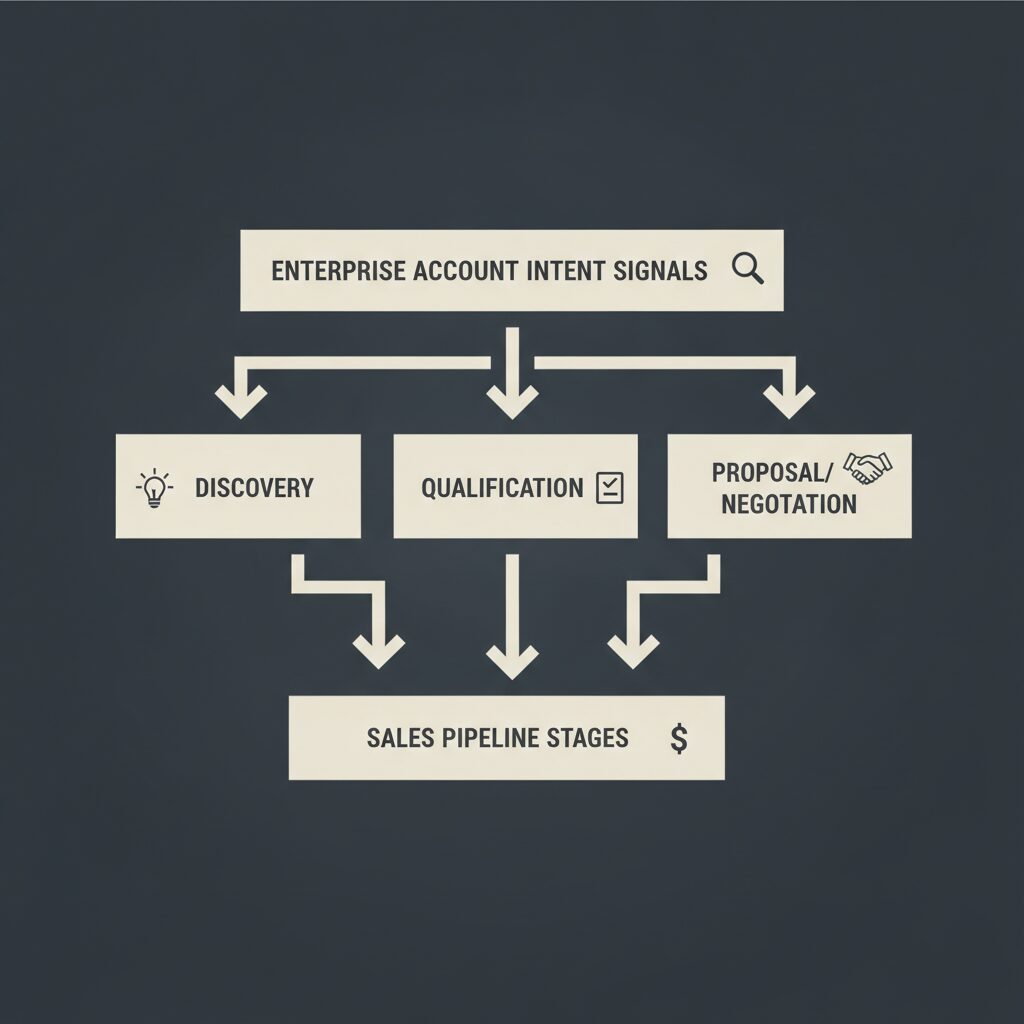
Engineering a signal-driven pipeline architecture
Transitioning from spray-and-pray outbound to a targeted motion requires discipline across four distinct stages. This workflow removes random prospecting and gives your revenue team a repeatable, predictable cadence.
First, define your sharp Ideal Customer Profile (ICP) based on accounts where you have proven unit economics. If your average deal size in Mumbai or Bengaluru is ₹25,00,000, do not let reps prospect companies with fewer than 50 employees who will choke on the contract value. Filter ruthlessly for industry vertical, revenue band, and existing software infrastructure.
Second, establish weekly signal monitoring routines. Reps should build weekly target lists of 30 to 50 accounts based exclusively on observable triggers. If an account has not triggered a buying signal, it stays out of the active outbound queue.
Third, map the multi-stakeholder dynamic before writing a single word. Enterprise sales rarely close through a solo buyer. As outlined in our guide to B2B buying committee strategy, your outbound messaging must speak to financial officers, operational leads, and end users simultaneously with distinct value angles.
Fourth, enforce strict outreach thresholds. Sequence lengths should run four to six touchpoints across email, phone, and professional networks over three weeks. If there is no engagement, rest the account for ninety days rather than spamming contacts until they block your domain.
Shifting from founder-led guesswork to predictable revenue
Early-stage B2B companies often grow through founder networks and referral relationships. This creates an illusion of sales momentum. The moment the founder tries to hand off prospecting to an internal team, deal flow dries up because the business lacks a scalable B2B sales engine. The founder assumes outbound does not work for their category, when the root problem is an absence of operational structure.
Building sustainable outbound demands embedded leadership. It requires inspecting rep activities, listening to call recordings, monitoring inbox bounce rates, and aligning compensation with qualified meetings rather than vanity send metrics. When leadership tracks metrics that matter—reply-to-meeting conversion, positive response sentiment, and account progression rates—reps stop cutting corners with mass lists.
A seasoned Fractional CSO installs this discipline directly into your commercial team. Instead of watching your SDRs burn through ₹10,00,000 of monthly overhead with negligible pipeline generation, senior sales leadership builds a repeatable sales process grounded in rigorous data analysis.
Frequently Asked Questions
What is a good cold email reply rate in B2B enterprise sales?
A standard reply rate for signal-based enterprise outreach sits between 4% and 7%, with top performers reaching higher. Generic cold outreach without intent signals typically struggles below 1.2%.
Why did broadcast cold email reply rates drop in 2026?
Major corporate email providers introduced stricter security filtering and user-engagement algorithms that route bulk cold sequences into junk folders. At the same time, enterprise decision-makers actively ignore generic messaging that lacks verifiable account context.
How many cold emails should an enterprise SDR send per day?
An enterprise SDR should target 30 to 50 highly researched, trigger-based accounts daily across properly warmed inboxes. Exceeding these numbers usually indicates automated list blasting that damages domain deliverability.
What are the strongest buying signals for B2B outbound prospecting?
The strongest signals include rapid departmental hiring sprints, executive leadership changes within 90 days, and regulatory compliance updates. Technology migrations identified through public job descriptions also indicate immediate vendor need.
How many secondary domains do B2B companies need for cold outreach?
High-performing outbound teams maintain two to four secondary domains dedicated specifically to outbound prospecting. This structure protects the primary corporate website domain from spam penalties and preserves day-to-day email communications.
Should SDRs track email opens using tracking pixels?
Disabling open-tracking pixels is now recommended for enterprise cold outbound campaigns. Enterprise email security gateways frequently flag tracking pixels as spam markers, directly degrading inbox placement.
How long should a cold email sequence run before stopping?
An effective enterprise sequence should consist of four to six touches spanning email, phone, and social channels over 18 to 21 days. Continuing past six unanswered touchpoints damages sender reputation without improving conversion.
Can high-volume outbound still work for low ACV products?
High-volume outbound remains viable only for low-touch products with broad horizontal appeal where CAC must stay minimal. For high-ticket enterprise contracts, custom account-level targeting remains the only financially sustainable route.
Building your predictable outbound engine
Now that State of B2B Outbound 2026: Benchmark Analysis of 1.16 Million Sends confirms that list volume cannot substitute for verified buyer intent, audit your prospecting architecture and build a predictable outbound engine with Sales Fundas. Schedule an introductory pipeline assessment to identify targeting bottlenecks across your sales operations, completely free with no contractual commitment required.
Sales Fundas operates as an embedded leadership partner for ambitious B2B founders and CEOs, specializing in pipeline architecture and predictable revenue growth. By combining rigorous sales consulting frameworks with advanced digital advertising and performance marketing, we build sustainable, high-performing sales engines that complement and scale the founder's strategic vision.
- Embedded Leadership for B2B Growth
- Sales Pipeline & Revenue Architects
- B2B Sales Engine Development
- Strategic Sales Scaling Experts