

B2B deals stalling? Learn to distinguish deal complexity from process inefficiency and use Mutual Action Plans to reduce your sales cycle. Book a consult.
The cost of a slow sales cycle is more than just delayed revenue
A deal that lingers in the pipeline for six months instead of three is not just a timing issue. It is a capital efficiency problem. When B2B deals stretch beyond their natural lifespan, you are burning resources on hope rather than data. This friction usually stems from a failure to distinguish between deal complexity and process inefficiency.

Complexity is inherent to the purchase. A ₹50,00,000 software implementation requires security audits and legal reviews. That is a feature of the sale, not a bug. Inefficiency, however, is the artificial friction you create through poor pipeline architecture. In our work at Sales Fundas, we find that most founders mistake inefficiency for complexity, leading them to push harder when they should be structuring better.
Complexity vs. inefficiency: knowing where the friction lives
Complexity is a structural reality. If you are selling to a mid-sized enterprise in Mumbai, the number of stakeholders involved in a decision is likely to be five or more. According to Gartner (2025), the average B2B buying group now involves six to ten decision-makers. This is a known variable. You account for it by building a scalable B2B sales engine that manages multiple personas.
Inefficiency is a behavioral failure. This is when a deal stalls for two weeks because the prospect forgot to send a document, or your team failed to define the next concrete step. The failure mode here is the ‘checking in’ email. When you send a message saying, ‘Just checking in to see where we stand,’ you have admitted you are no longer leading the sale. You are now a passenger in your own deal.
To fix this, you must audit your deals. If a deal is slow because the client is debating the ROI with their board, that is complexity. If it is slow because you are waiting for a calendar invite, that is inefficiency. One requires more value-building; the other requires a mastery of the sales cycle.
Identifying the shadow stakeholders
Most B2B deals do not die because the champion said no. They die because a shadow stakeholder—someone you have never spoken to—decided it was not a priority. This is often the Head of Procurement, the CFO, or a security officer who appears in the eleventh hour to veto the project.
In practice, the champion is your internal guide, but they are rarely the sole decision-maker. The risk is assuming the champion has the political capital to push the deal through alone. When a deal takes too long, it is usually because the champion is fighting a battle they cannot win because you have not armed them with the right data for the shadow stakeholders.
You identify these hidden players by asking direct, high-friction questions. Instead of asking, ‘Who else needs to be involved?’ ask, ‘When this goes to the CFO for final approval, what is the one question they will ask that we haven’t answered yet?’ This forces the champion to reveal the internal politics. If you find the process is still opaque, it might be time to look at why B2B sales aren’t converting in India due to these cultural nuances of hierarchy.
Implementing a Mutual Action Plan (MAP)
A Mutual Action Plan is not a proposal. It is a project management document shared between you and the prospect. It shifts the relationship from ‘vendor and buyer’ to ‘partners solving a problem.’ The goal is to move from a vague timeline to a series of agreed-upon milestones.
A professional MAP includes four specific columns: the milestone, the owner, the deadline, and the definition of success. For example, instead of ‘Legal Review,’ the milestone is ‘Signed MSA.’ The owner is the prospect’s legal counsel. The deadline is October 12. The definition of success is a document with zero redlines on the liability clause.
When you introduce a MAP, you are providing embedded leadership. You are telling the prospect, ‘I have done this a hundred times, and this is the fastest path to your desired outcome.’ This reduces the cognitive load on the buyer. Most B2B buyers are overwhelmed. When you provide the map, they stop worrying about the process and start focusing on the result. This approach is a core part of how a Fractional CSO stabilizes a volatile pipeline.
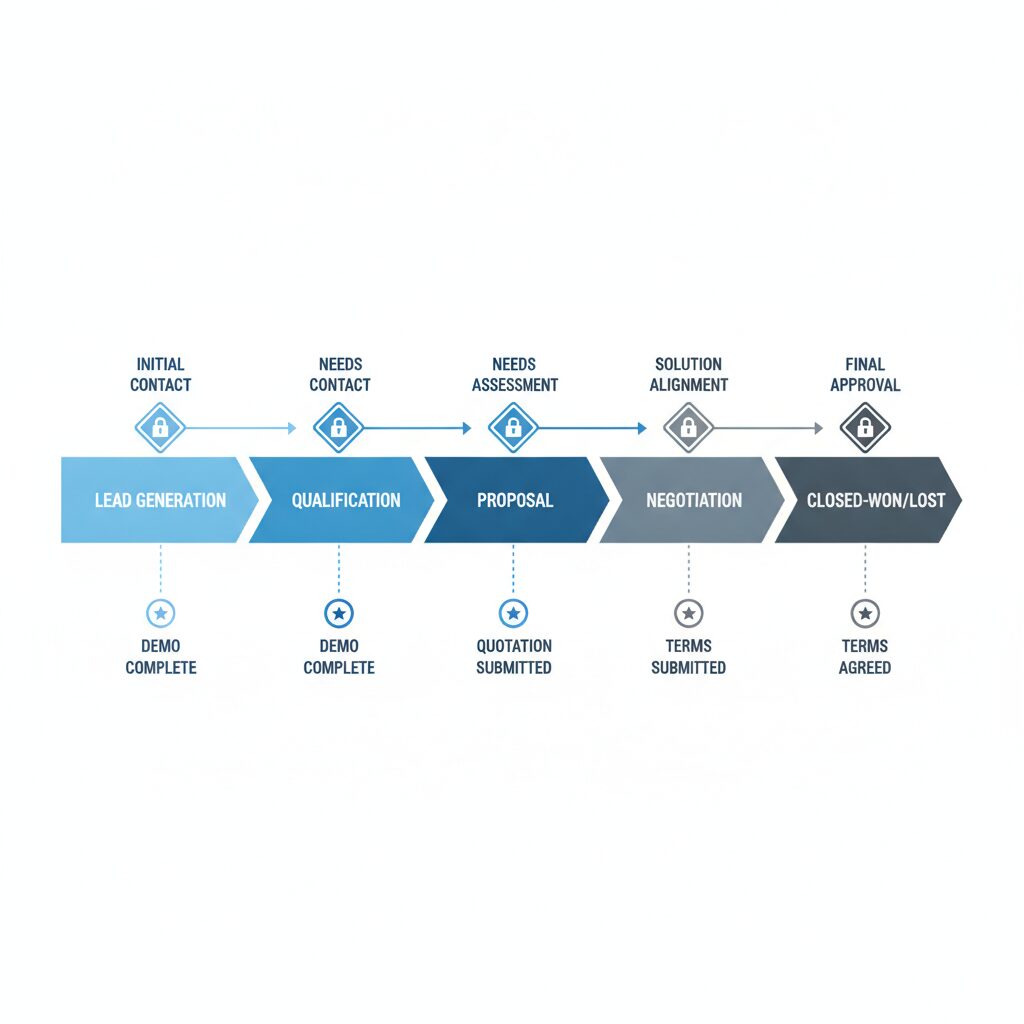
Structural shifts for predictable revenue
If your deals are consistently stalling, the problem is likely your pipeline architecture. Many teams treat the pipeline as a list of leads rather than a series of gates. A gate is a qualification requirement that must be met before a deal can move forward. If the ‘Technical Validation’ gate is not closed, the deal should not move to ‘Contracting.’
One common error is the ‘Demo Trap.’ Teams believe a successful demo means the deal is moving. In reality, a demo is just a presentation. The actual progress happens when the prospect agrees to a specific change in their current workflow. If you see B2B deals stalling after demos in India, it is usually because the demo proved the product works, but it did not prove why the company must change *now*.
To build predictable revenue, shift your focus from the ‘close’ to the ‘gap.’ The gap is the distance between where the client is today and where they want to be. If the gap is small, the deal will take forever because there is no urgency. If the gap is large and the cost of inaction is clear, the deal moves fast. Your job is not to sell the product, but to widen the perceived gap.
The role of the Ideal Customer Profile (ICP) in deal speed
Slow deals are often a symptom of a diluted Ideal Customer Profile (ICP). When you sell to companies that are ‘almost’ a fit, you spend half the sales cycle educating them on why they need the solution in the first place. This adds weeks or months of friction that has nothing to do with your sales process.
High-velocity deals happen when the prospect already recognizes the pain. If you are spending too much time justifying the category of your software, you are fishing in the wrong pond. By narrowing your ICP to only those experiencing a specific, acute trigger event, you remove the education phase of the sale. This is how you transition from a founder-dependent sales model to a scalable B2B sales engine.
For those managing larger teams, the failure is often in the training. Standard sales training focuses on closing techniques. High-impact training focuses on revenue transformation. If your team is using generic frameworks, they will produce generic results. We often see this in corporate sales training in Mumbai, where the focus is on volume rather than the precision of the pipeline architecture.
Dealing with the ‘No Decision’ outcome
The most dangerous competitor is not another company; it is the status quo. ‘No decision’ is the primary reason B2B deals take too long. The prospect likes the product, but the internal pain of changing their process is greater than the pain of staying the same.
To combat this, you must quantify the cost of inaction. If a company is losing ₹2,00,000 per month due to inefficiency, a six-month delay costs them ₹12,00,000. When you frame the delay in terms of lost capital, the slow pace of the deal becomes a business risk for the prospect. This transforms the conversation from ‘Do we want this?’ to ‘Can we afford to wait?’
This level of strategic framing is what separates junior associates from embedded leadership. It requires a deep understanding of the client’s P&L and a willingness to challenge the prospect’s timeline. When you stop being a vendor and start acting as a consultant for their revenue transformation, the deal speed naturally increases.
Frequently Asked Questions
Why are my B2B deals stalling after the final presentation?
Usually, this happens because you solved the technical problem but didn’t address the business risk or internal politics. The ‘hidden stakeholders’ have stepped in and found a reason to hesitate.
How do I introduce a Mutual Action Plan without sounding too pushy?
Frame it as a tool for their convenience, not your control. Tell them, ‘To ensure we don’t waste your team’s time with unnecessary meetings, I’ve drafted a simple roadmap to get us to the finish line.’
What is the difference between a sales pipeline and a sales process?
The pipeline is the visual representation of where deals are. The process is the set of mandatory actions and gates required to move a deal from one stage to the next.
How many stakeholders should I expect in a typical B2B deal?
For SMEs and startups, expect three to five. For larger enterprises, this often grows to six to ten, including finance, legal, and IT security.
What is a ‘Shadow Stakeholder’?
A shadow stakeholder is someone who has the power to veto or delay a deal but has not been formally introduced to the sales process.
Is a long sales cycle always a bad sign?
No, if the deal size is large and the complexity is high, a longer cycle is normal. It only becomes a problem when the cycle is longer than similar deals in your historical data.
How can I speed up the legal and procurement phase?
Send your standard MSA (Master Service Agreement) early and ask for their redlines immediately. Using a Mutual Action Plan helps keep the legal teams accountable to a date.
Why is my ICP causing my deals to slow down?
If your ICP is too broad, you are selling to people who don’t feel an urgent need. This forces you to spend time ‘creating’ a problem rather than ‘solving’ one.
Build a predictable revenue engine
Stop guessing why your deals are stalling and start engineering your pipeline for speed. If your revenue is still too dependent on the founder or your pipeline is unpredictable, you need a structural shift. Start building a scalable B2B sales engine today. Book a consultation for a Fractional CSO to audit your pipeline architecture—no long-term commitment required.
Sales Fundas operates as an embedded leadership partner for ambitious B2B founders and CEOs, specializing in pipeline architecture and predictable revenue growth. By combining rigorous sales consulting frameworks with advanced digital advertising and performance marketing, we build sustainable, high-performing sales engines that complement and scale the founder's strategic vision.
- B2B Sales Consulting & Pipeline Architecture Frameworks
- Advanced Performance Marketing & Conversion Rate Optimization
- Search & Generative Engine Optimization (SEO/GEO) Specialists
- B2B Digital Advertising & Lead Generation Experts
This content was drafted using AI-assisted research and meticulously reviewed by the Sales Fundas consulting team to ensure strategic accuracy and alignment with our B2B sales frameworks.