

Inbound vs outbound sales: stop guessing your pipeline. Learn how to build a predictable B2B revenue engine for your startup. Get a free assessment today.
The bottom line on lead generation
Inbound and outbound sales are not competing philosophies. They are different mechanisms for filling the same pipeline. The choice between them depends entirely on your Ideal Customer Profile (ICP) and whether your market already recognizes the problem you solve.

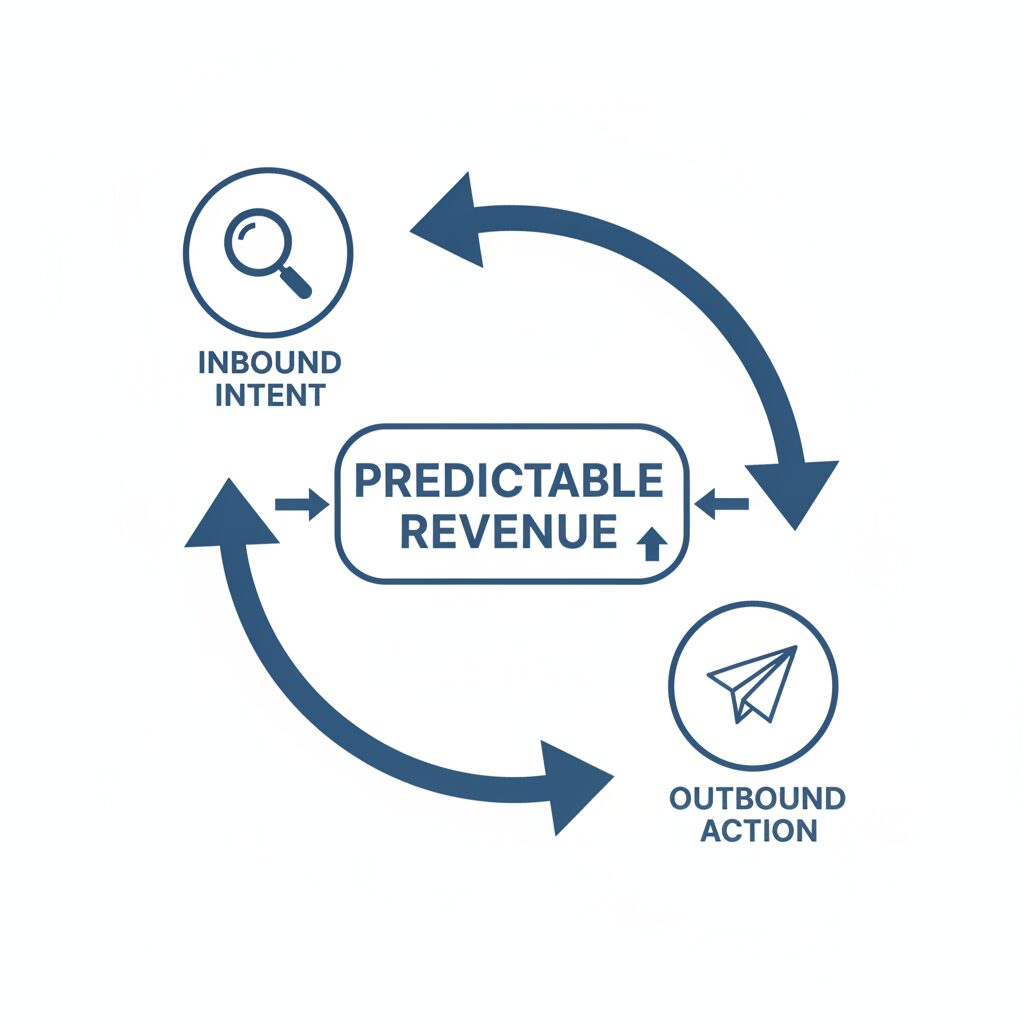
For most B2B startups in India, the mistake is choosing one and ignoring the other. Relying solely on inbound leaves you at the mercy of algorithms. Relying solely on outbound leads to burnout and high churn. A predictable revenue engine requires a balanced pipeline architecture that uses both to target different stages of the buyer’s journey.
The mechanics of inbound sales
Inbound sales happen when a prospect finds you. This is a game of attention. You create value—through technical guides, research, or tools—and the prospect raises their hand. In practice, inbound is less about selling and more about qualifying.
The failure mode for inbound in 2026 is treating it as a volume game. Many founders chase ‘leads’ that are actually just curious observers. According to 2026 B2B buyer behavior data, 72% of buyers prefer self-service research before ever talking to a salesperson. If your inbound process requires a discovery call too early, you lose the lead.
When we build a pipeline architecture for predictable revenue, we treat inbound as a filter. The goal is not more leads, but higher intent. A lead that downloads a pricing sheet is worth ten leads that read a blog post.
The reality of outbound sales
Outbound is the act of initiating the conversation. You identify a specific company that fits your ICP and you reach out. It is a proactive strike. Outbound is essential when you are entering a new market or selling a product that solves a problem the customer doesn’t realize they have yet.
The noise floor in B2B outreach has never been higher. In 2026, automated AI sequences have made the average CEO’s inbox a graveyard of generic pitches. Most customers are not picking up calls because the outreach lacks a strategic diagnosis. They see a template, not a solution.
Effective outbound today requires embedded leadership. You cannot outsource this to a junior associate with a list of 1,000 emails. You need a focused approach where the outreach is based on a specific trigger—like a recent funding round or a leadership change—and offers a concrete insight. In one 2026 test, personalized outbound based on ‘trigger events’ saw a 14% meeting rate, compared to 0.8% for generic sequences.
Strategic diagnosis: which one to prioritize?
The decision isn’t about which method is ‘better.’ It is about the state of your market. Strategy is the art of focusing resources on a single pivot point to achieve a result.
If you are selling a ‘vitamin’—something that makes a good process better—inbound is your best bet. People search for vitamins when they feel the need for improvement. If you are selling a ‘painkiller’ for a problem the founder doesn’t know they have, you must use outbound. You cannot wait for a prospect to search for a solution to a problem they haven’t named yet.
Consider a B2B SaaS startup selling AI-driven tax compliance for Indian SMEs. If SMEs are already searching for ‘automated GST filing,’ that is an inbound opportunity. But if the real value is preventing revenue transformation leaks that the founder hasn’t noticed, you must go outbound and show them the leak.
The unit economics of the pipeline
The cost structure of these two methods differs wildly. Inbound has high upfront costs (content creation, SEO, brand building) but low marginal costs per lead over time. Outbound has linear costs; more leads usually require more headcount or more expensive data tools.
When analyzing B2B unit economics in India, founders often overlook the ‘time to value.’ Inbound takes months to prime. Outbound can generate a meeting in 24 hours. For a Series A startup with a tight runway, waiting for SEO to kick in is a strategic error.
The most successful teams we advise at Sales Fundas use a 70/30 split. They use outbound to test messaging and find the ICP quickly, then they feed those insights into their inbound content to capture the broader market. This prevents the common trap of burning venture capital on a lead gen strategy that doesn’t convert to real deals.
Avoiding the ‘Relationship Trap’
In the Indian B2B context, there is a dangerous tendency to conflate outbound sales with ‘relationship building.’ Many founders believe that having a strong network is a substitute for a scalable B2B sales engine. It is not.
Relationships can get you the first five clients, but they cannot scale to five hundred. If your revenue is too founder-dependent, you don’t have a sales process; you have a network. You need to move toward a structured B2B sales process in India where the value proposition is the hero, not the personal connection.
The convergence: Warm Outbound
The most potent strategy in 2026 is the hybrid model. This is where you use inbound signals to trigger outbound actions. This is called ‘Warm Outbound.’
Instead of cold calling a random list, your sales team monitors who is visiting your pricing page or engaging with a specific high-intent LinkedIn post. The outreach then becomes: ‘I noticed you were looking at our X feature; usually, companies in your position are struggling with Y. Is that the case for you?’
This removes the friction of the ‘cold’ start. It turns the salesperson into a consultant. When you stop guessing and start reacting to intent data, your pipeline becomes predictable.
Frequently Asked Questions
Is inbound sales better than outbound for B2B?
Neither is objectively better. Inbound is superior for capturing existing demand, while outbound is necessary for creating new demand.
How long does it take for inbound sales to work?
Typically, it takes three to six months to see significant lead flow from content and SEO. Outbound provides immediate feedback and leads.
Do I need a huge budget for outbound sales?
No. Effective outbound relies more on ICP precision and personalized research than on expensive software or massive lists.
Can a founder handle both inbound and outbound?
Early on, yes. However, to remove founder dependency, you must eventually implement a repeatable system managed by a Fractional CSO or sales lead.
What is the best CRM for tracking these leads?
It depends on your scale. For many Indian startups, the choice often comes down to Zoho vs HubSpot depending on budget and automation needs.
How do I know if my ICP is wrong?
If your outbound responses are consistently ‘not a fit’ or your inbound leads never convert to paid deals, your ICP needs a strategic diagnosis.
Should I hire a full-time VP of Sales for this?
Not necessarily. Many startups find more value in a Fractional Sales Director to build the engine before committing to a full-time executive salary.
What is the most common mistake in B2B lead gen?
The most common mistake is optimizing for lead volume instead of lead quality, which wastes sales team time on low-intent prospects.
Build your revenue engine
Stop guessing which lead gen method will work and start building a system based on your actual market data. Book a startup B2B sales consultation to architect a predictable pipeline with no long-term commitment.
Sales Fundas operates as an embedded leadership partner for ambitious B2B founders and CEOs, specializing in pipeline architecture and predictable revenue growth. By combining rigorous sales consulting frameworks with advanced digital advertising and performance marketing, we build sustainable, high-performing sales engines that complement and scale the founder's strategic vision.
- B2B Sales Consulting & Pipeline Architecture Frameworks
- Advanced Performance Marketing & Conversion Rate Optimization
- Search & Generative Engine Optimization (SEO/GEO) Specialists
- B2B Digital Advertising & Lead Generation Experts
This content was drafted using AI-assisted research and meticulously reviewed by the Sales Fundas consulting team to ensure strategic accuracy and alignment with our B2B sales frameworks.