

Stop losing H2 momentum. Learn how to run a virtual sales kickoff for Q3 2026 that re-energizes remote teams and builds predictable B2B revenue. Plan now.
The stakes for your H2 revenue targets
Most B2B founders wait until January to reset their sales strategy. By then, they have already lost six months of momentum. A mid-year reset in May or June is the only way to ensure your H2 push is based on real deals rather than optimistic projections.

For remote teams, the challenge is energy. Virtual meetings often drain a team instead of fueling them. This high-impact virtual sales kickoff Q3 planning is about moving past the ‘Zoom fatigue’ to build a scalable B2B sales engine that does not rely on the founder’s constant intervention.
Audit your pipeline architecture before the call
A kickoff without data is just a pep talk. Before you invite your team to a call, you must perform a cold-eyed audit of your H1 performance. In our work at Sales Fundas, we find that most startups inflate their pipeline by 30% by keeping ‘zombie leads’ active.
Analyze your Ideal Customer Profile (ICP) hit rate. If 70% of your closed-won deals in H1 came from a specific sub-sector you didn’t prioritize, your Q3 plan must shift to reflect this. This is where you move from guesswork to predictable revenue.
Check your current B2B sales process. If the cycle length in India has crept up from 60 to 90 days, your H2 targets are already at risk. You can find specific ways to shorten this cycle in our guide on B2B sales cycle fixes for 2026.
Structuring the virtual event for maximum energy
Remote teams do not need another four-hour slide presentation. They need ownership. Split your virtual kickoff into three distinct phases: the retrospective, the strategic pivot, and the tactical commitment.
Start with the retrospective. Instead of a manager presenting the numbers, let the top performer explain exactly how they closed their largest deal in H1. This provides peer-led social proof that the process works. Use a digital whiteboard for a ‘Stop-Start-Continue’ exercise to identify friction in the current B2B sales process.
The strategic pivot should focus on the H2 North Star. Be direct about the gap between current pipeline and the year-end goal. Use actual numbers. For example, if you need ₹5 Crore in new ARR to hit your target and your average deal size is ₹10 Lakh, you need 50 closed deals. State this clearly so the team understands the math of their success.
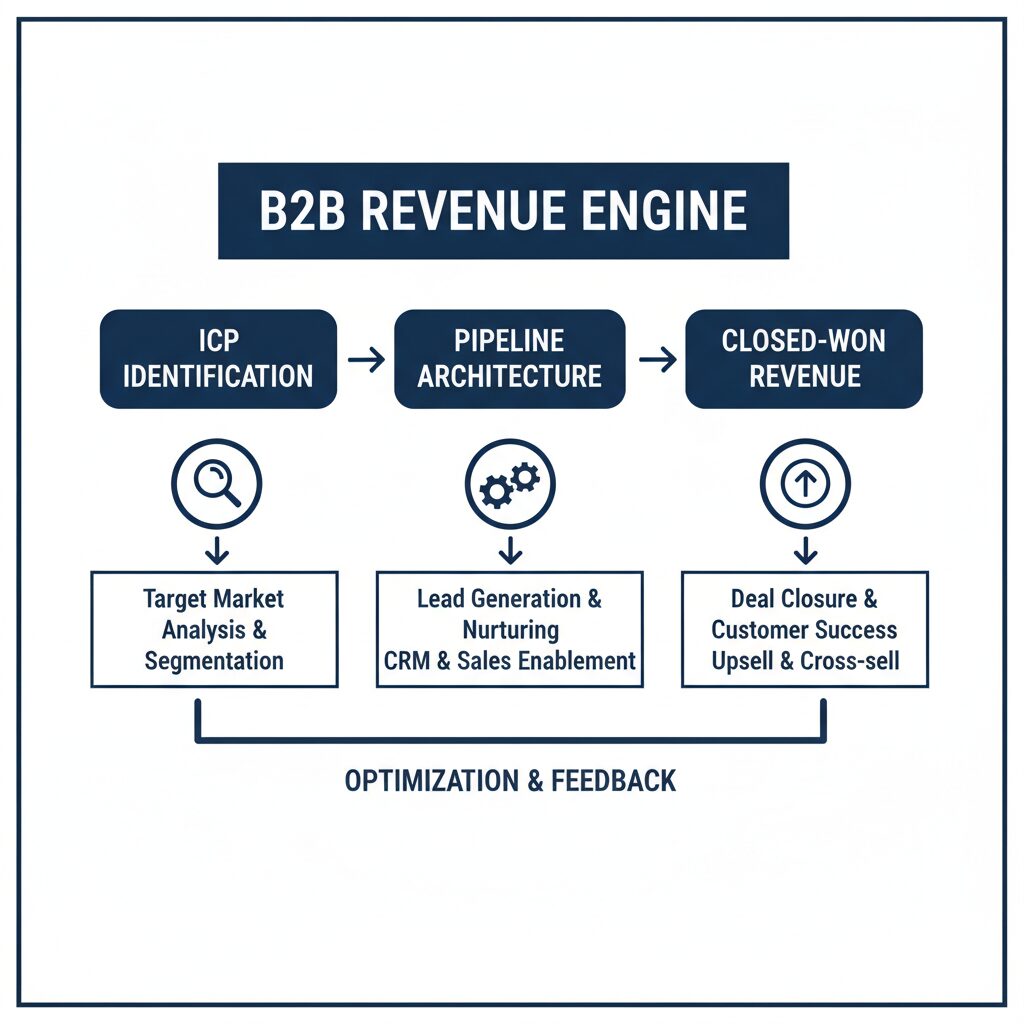
Designing the Q3 tactical roadmap
Avoid generic frameworks. Your team needs a playbook they can execute on Monday morning. Define the specific lead generation channels that will drive H2. If you are scaling a SaaS product, decide whether to double down on vertical lead gen or stay generalist. You can compare these strategies in our analysis of vertical vs generalist lead gen for 2026.
Assign ownership for specific ‘revenue blocks.’ One rep might own the expansion of existing accounts (upselling), while another focuses on new logo acquisition. This prevents the ‘everybody is responsible, so nobody is responsible’ trap common in remote teams.
Include a section on embedded leadership. If the team is still waiting for the founder to approve every discount or contract tweak, your revenue transformation will stall. Set clear delegation boundaries for Q3 to remove the founder as the primary bottleneck.
Post-kickoff accountability and tracking
The energy of a kickoff dies the moment the Zoom call ends unless you have a tracking mechanism. Move the commitments made during the session into your CRM immediately. Whether you use Zoho or HubSpot, the Q3 goals must be visible in a real-time dashboard.
Schedule ‘sprint reviews’ every two weeks. These are not status updates; they are tactical adjustments. If the team is struggling with a specific objection in the mid-funnel, spend the session role-playing that exact scenario with real-world data from recent lost deals.
For companies where the founder is still the primary salesperson, this is the moment to transition. Transitioning to a Fractional Sales Director can provide the professional oversight needed to turn a chaotic H1 into a disciplined H2.
Frequently Asked Questions
How long should a mid-year virtual sales kickoff last?
Limit the synchronous sessions to four hours spread over two days. Use asynchronous videos for the data prep to keep the live time focused on strategy and alignment.
What is the main goal of a Q3 sales reset?
The goal is to align the team on a corrected ICP and a realistic path to the year-end revenue target. It transforms H1 failures into H2 tactical advantages.
How do I stop remote reps from tuning out during virtual meetings?
Use interactive polling and peer-led case studies. Shift from a ‘presentation’ format to a ‘workshop’ format where reps must contribute to the roadmap.
Should we change our sales targets mid-year?
Adjust targets only if the market data has fundamentally shifted. Instead of changing the goal, change the tactics used to achieve it.
How do we handle underperforming reps during a kickoff?
Keep the kickoff focused on the collective engine. Handle individual performance issues in private 1:1s before or after the group event.
What metrics are most important for Q3 planning?
Focus on pipeline velocity, lead-to-close conversion rates, and average deal size. These reveal where the engine is leaking revenue.
Can a mid-year kickoff replace a full annual strategy?
No, but it corrects the errors of the annual strategy. It is a course correction that prevents a total year-end failure.
How do I ensure the team actually follows the new Q3 plan?
Tie the new tactics to a specific incentive or bonus structure for H2. Publicly track the adoption of the new process in your CRM.
This High-impact virtual sales kickoff Q3 planning, build a predictable revenue engine with Sales Fundas. Start your free revenue assessment today to identify your H2 gaps with no credit card required.
Sales Fundas operates as an embedded leadership partner for ambitious B2B founders and CEOs, specializing in pipeline architecture and predictable revenue growth. By combining rigorous sales consulting frameworks with advanced digital advertising and performance marketing, we build sustainable, high-performing sales engines that complement and scale the founder's strategic vision.
- B2B Sales Consulting & Pipeline Architecture Frameworks
- Advanced Performance Marketing & Conversion Rate Optimization
- Search & Generative Engine Optimization (SEO/GEO) Specialists
- B2B Digital Advertising & Lead Generation Experts
This content was drafted using AI-assisted research and meticulously reviewed by the Sales Fundas consulting team to ensure strategic accuracy and alignment with our B2B sales frameworks.