

Stop losing B2B deals to L1 procurement. Learn how to pitch outcome-based pricing in India to close deals 40% faster. Update your sales engine for 2026.
The end of the L1 procurement era
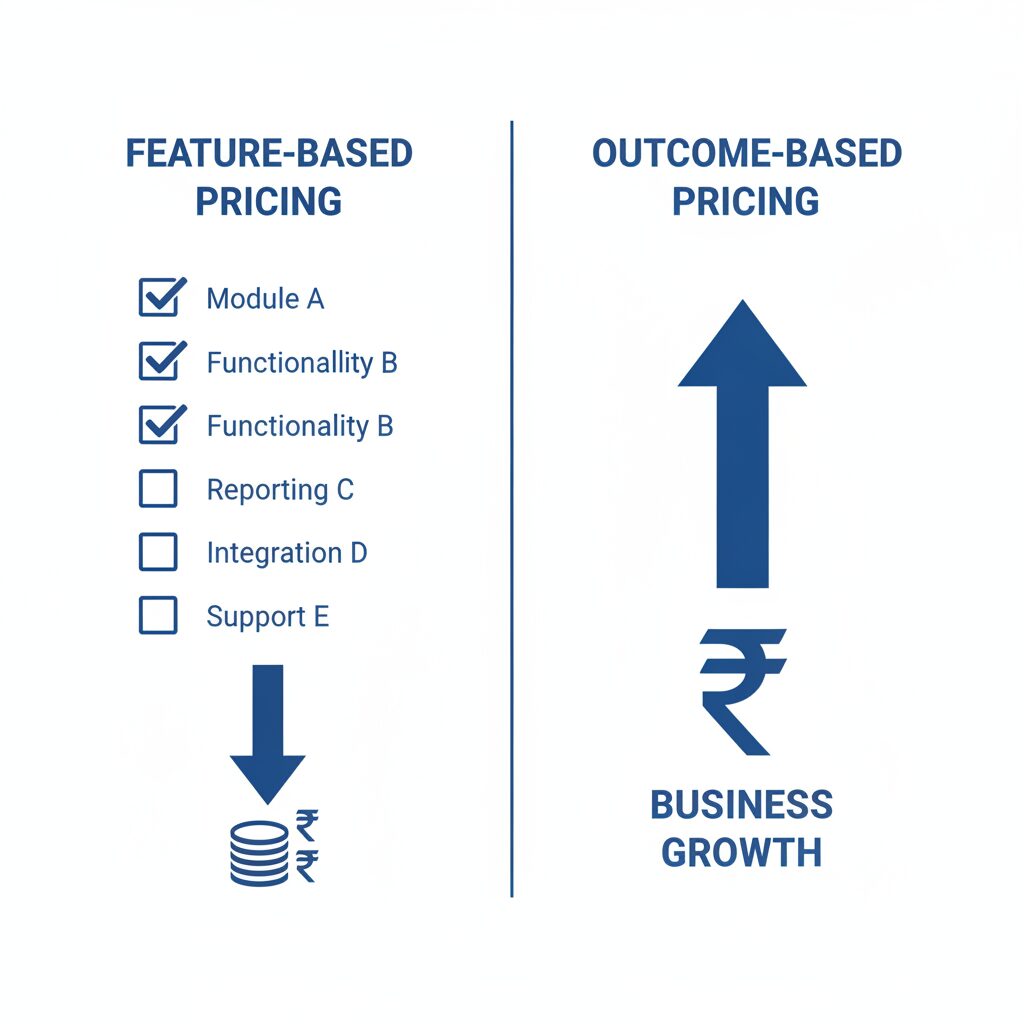
Most B2B founders in India still pitch their services as a list of features and a cost-plus price tag. This approach forces you into the L1 procurement trap, where the buyer only cares about who is the lowest bidder. When you sell features, you are a commodity. When you are a commodity, your only lever for winning is to drop your price.

The market has shifted. According to Forrester Research (2024-08-15), cost-plus pricing is losing ground to outcomes-linked pricing in large-scale B2B contracts across India. MDs and CEOs are no longer buying software or consulting hours; they are buying a specific financial result. If you cannot tie your price to a measurable business outcome, you will continue to see your deals stall in the final procurement round.
Why feature-based pitching kills your margins
In our work at Sales Fundas, we see the same failure mode repeatedly. A founder spends an hour demoing a platform, listing every single module and integration. They then present a quote of ₹15,00,000 based on a perceived market rate. The client looks at the list, decides they only need three of the ten features, and asks for a 40% discount.
This happens because the buyer sees your price as a cost to be minimized rather than an investment to be captured. Feature-based pricing anchors the conversation to your effort—how many hours you work or how many tools you provide. This is a losing game. To escape this, you must shift the anchor from what you do to what the client gains. This is the core of high value customer acquisition B2B.
The cost of inaction (COI) anchor
The most effective way to bypass price objections is to anchor the deal to the cost of inaction. According to Forrester Research (2024-08-15), founders can close deals 40% faster by anchoring their price to the cost of inaction rather than a feature-list breakdown.
The cost of inaction is the quantifiable financial loss a company suffers every month they do not solve the problem. In practice, if a B2B startup is losing ₹5,00,000 in leaked pipeline every month due to a lack of a repeatable process, the cost of inaction over a year is ₹60,00,000. When you present a solution for ₹12,00,000, you are not asking for a payment; you are offering to save them ₹48,00,000.
When the gap between the price and the COI is wide, the L1 procurement mindset disappears. The conversation shifts from “Why is this expensive?” to “How fast can we start?” This is how you build a predictable revenue engine without sacrificing your margins.
How to restructure your proposal for outcome-based pricing
To move away from the L1 trap, you must rewrite your proposals. Stop using a table of features and a final price. Instead, use a financial outcome framework.
First, define the current state. Use the client’s own data to show the leak. For example, “Current lead-to-close rate is 12%, resulting in ₹2,00,000 of lost revenue per lead.” This establishes the baseline of the problem.
Second, define the target state. State the specific outcome you will deliver. Instead of “We will provide sales training,” write “We will increase lead-to-close rate from 12% to 20%.” This transforms your service into a financial asset.
Third, present the pricing as a fraction of the gain. If the increase in conversion adds ₹1,00,00,000 to their annual top line, a fee of ₹20,00,000 is a 5% investment for a 100% return. This is pipeline architecture that actually works.
If you find your deals are still stalling after the demo, you may need to look at why B2B deals stall after demos in India to identify where the value gap is opening.
Handling the procurement pushback
Even with an outcome-based pitch, procurement officers will try to pull you back into the L1 conversation. They will ask for a line-item breakdown of your costs. This is a trap designed to find “fluff” they can cut to lower the price.
The failure mode here is to comply. If you provide a line-item breakdown, you have just admitted that you are selling hours and features. Instead, refuse the breakdown and refocus on the outcome. A professional response looks like this: “We don’t price by the hour because you aren’t buying hours. You are buying a 20% increase in pipeline velocity. If we spent fewer hours but achieved the same result, would you want to pay us less?”
This forces the procurement officer to acknowledge the value. Most will back down because they cannot argue against a quantified financial gain. This approach is a key part of mastering the sales cycle for B2B founders.
The role of embedded leadership in pricing
Pitching outcomes requires more than a new slide deck; it requires a shift in how you lead the sales process. You cannot be a vendor; you must be a partner. This is where the concept of embedded leadership comes in. You must act as a Fractional CSO who cares more about the client’s P&L than your own contract.
When you operate as a partner, you can suggest pricing models that align your success with theirs. This could be a base fee plus a performance kicker tied to the actual outcomes achieved. This removes the risk for the buyer and increases the upside for you. It is the fastest way to build trust with a skeptical MD.
For startups that lack the internal expertise to execute this shift, bringing in a Fractional CSO service can bridge the gap between having a great product and having a scalable B2B sales engine.
Avoiding the value-based pricing pitfalls
The biggest mistake founders make is guessing the value. If you claim you will save a company ₹1 Crore without having the data to back it up, you lose all credibility. Your outcome must be grounded in the client’s own numbers.
In practice, run a “Value Discovery” phase before the final proposal. Ask questions like: “If this problem persists for another six months, what is the exact hit to your quarterly revenue?” and “How much has it cost you in terms of employee churn or lost market share?”
Let the client name the number. When they define the cost of inaction, they are selling themselves on your price. You are simply providing the solution to a pain they have already quantified. If you struggle with this, you might find that your B2B sales are not converting in India because you are talking to the wrong person or using the wrong anchor.
Frequently Asked Questions
What is the difference between value-based and cost-plus pricing?
Cost-plus pricing adds a margin to the cost of delivery. Value-based pricing sets the price based on the financial outcome delivered to the client.
How do I calculate the cost of inaction for a client?
Multiply the monthly financial loss caused by the problem by the number of months it takes to implement a solution. This creates a concrete number for the client to consider.
Will procurement still try to force an L1 comparison?
Yes, procurement is trained to find the lowest price. You defeat this by refusing line-item breakdowns and refocusing the conversation on the total financial gain.
Does outcome-based pricing work for small contracts?
It works for any contract where the problem being solved has a measurable financial impact. The larger the impact, the easier the pitch.
What if the client refuses to share their financial data?
Use industry benchmarks to create a plausible scenario. Ask them if the benchmark is accurate for their business to get them to reveal their actual numbers.
Can I combine a base fee with a performance bonus?
Yes, this hybrid model is highly effective in India. It reduces the perceived risk for the buyer while rewarding you for over-delivering on outcomes.
How does outcome-based pricing speed up the sales cycle?
It removes the need for endless price negotiations. When the value is clear and quantified, the decision becomes a simple math problem rather than a negotiation.
Is this approach applicable to SaaS products?
Absolutely. Instead of pricing by seat or module, price based on the value metric the customer actually cares about, such as revenue generated or costs saved.
Now that the ‘Value-Based Pricing’ shift for Indian enterprise deals is the new standard, it is time to stop selling features and start pitching outcomes. Build a scalable B2B sales engine with Sales Fundas. Book a strategy call today to restructure your pipeline for maximum margin, no guesswork required.
Sales Fundas operates as an embedded leadership partner for ambitious B2B founders and CEOs, specializing in pipeline architecture and predictable revenue growth. By combining rigorous sales consulting frameworks with advanced digital advertising and performance marketing, we build sustainable, high-performing sales engines that complement and scale the founder's strategic vision.
- B2B Sales Consulting & Pipeline Architecture Frameworks
- Advanced Performance Marketing & Conversion Rate Optimization
- Search & Generative Engine Optimization (SEO/GEO) Specialists
- B2B Digital Advertising & Lead Generation Experts
This content was drafted using AI-assisted research and meticulously reviewed by the Sales Fundas consulting team to ensure strategic accuracy and alignment with our B2B sales frameworks.