

Stop wasting your sales budget on low-intent leads. Learn how to build a high-yield ICP in sales to drive predictable B2B revenue. Book a consultation.
The strategic filter for predictable revenue
An Ideal Customer Profile (ICP) is a strategic definition of the company that derives the most value from your product and provides the most value back to your business. It is a filter, not a wish list. When B2B founders treat their ICP as a broad set of industries, they create a pipeline of low-intent leads that drain sales resources and kill margins.

In our work at Sales Fundas, we see a recurring failure mode: companies confuse a buyer persona with an ICP. A persona describes a person; an ICP describes the organization. If you target the wrong organization, the most polished sales pitch in the world will fail because the economic incentive for the customer to buy does not exist. A precise ICP ensures your revenue transformation starts with the right targets.
The diagnosis of the founder’s trap
Most early-stage B2B startups suffer from the founder’s trap. They sell to anyone who says yes. This creates an illusion of product-market fit while building a fragile foundation of mismatched customers. This approach leads to high churn and a sales process that depends on the founder’s intuition rather than a repeatable system.
The problem is a lack of strategic diagnosis. When you accept any deal to hit a quarterly target, you introduce noise into your data. You cannot build a scalable B2B sales engine if your successful deals are anomalies. To move toward predictable revenue, you must identify the common denominator among your most profitable, lowest-churn clients.
Consider a SaaS firm in Bangalore that sells warehouse management software. They initially targeted any company with a warehouse. They found that while small firms signed up quickly, they churned in three months due to a lack of internal technical staff. The high-value clients were mid-sized logistics firms with a dedicated IT head and a minimum turnover of ₹50 Crore. The ‘industry’ was not the signal; the internal organizational structure was.
Architecture of a high-yield ICP
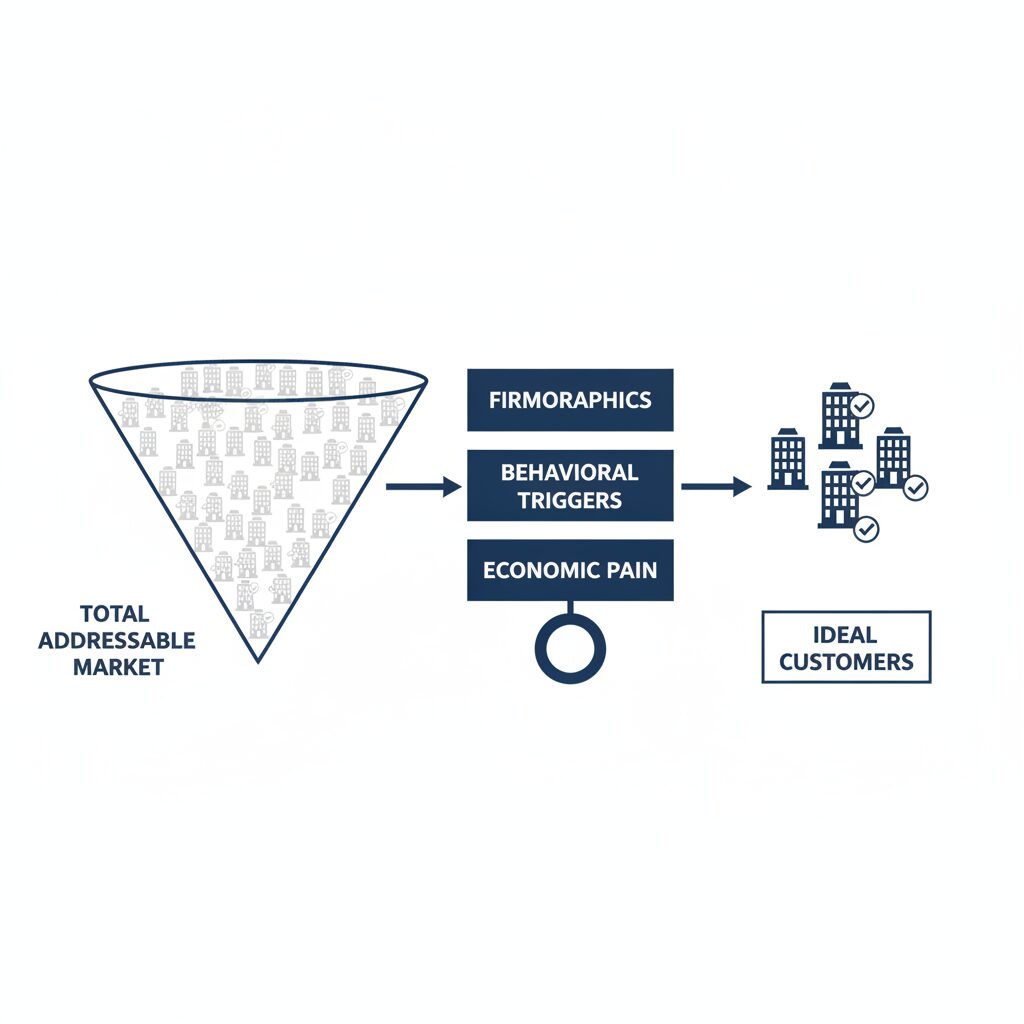
A professional ICP avoids generic descriptors. Knowing your customer is in ‘Healthcare’ or ‘Finance’ is useless. Those are categories, not profiles. A high-yield ICP focuses on operational triggers and economic pain points.
Start with firmographics, but keep them tight. Define the exact revenue brackets, employee counts, and geographic clusters where your solution wins. But firmographics are only the baseline. The real signal lies in the Ideal Customer Profile (ICP) profitability shifts that separate a lead from a high-value partner. You must document the specific tech stack they use, the regulatory pressures they face, and the internal reporting structures that trigger a purchase.
In practice, we look for the ‘Critical Event.’ This is a specific change in the customer’s business that makes your solution an immediate necessity. For a Fractional CSO, a critical event might be the departure of a VP of Sales or a failed Series B funding round due to unpredictable revenue. When you align your ICP with these events, your outreach stops feeling like a cold call and starts feeling like a solution to an urgent problem.
You can refine this by analyzing your current win-loss data. Identify the top 20% of your clients who provide 80% of your profit. Map their common traits: Who was the internal champion? What was the exact cost of their problem before you arrived? How long was the sales cycle? This data allows you to build a B2B pipeline architecture that prioritizes quality over volume.
Validating the profile with real deals
An ICP is a hypothesis until it is tested against the market. The failure mode here is spending months in a boardroom drafting a document that doesn’t survive a single discovery call. You validate an ICP through aggressive experimentation and data feedback loops.
Run a ‘sprint’ targeting a narrow slice of your hypothesized ICP. If you are targeting CEOs of SMEs with ₹100 Crore to ₹500 Crore revenue in the manufacturing sector, dedicate two weeks of outbound effort exclusively to that group. Measure the response rate and, more importantly, the qualification rate. If the conversion from discovery call to demo is low, your ICP is wrong.
Often, the gap is in the value proposition. If you target the right company but the wrong pain, you will fail. This is why you must build a value proposition in sales that speaks directly to the organizational pain identified in your ICP. For example, a CEO does not care about ‘feature sets’; they care about reducing founder-dependency and increasing the valuation of the firm.
Moving from ICP to scalable execution
Once the ICP is validated, it becomes the law of the land for your sales team. Every lead that does not fit the ICP is rejected immediately. This discipline is what prevents revenue leakage and keeps the sales team focused on real deals.
This focus allows you to implement Product-Led Sales more effectively. When you know exactly who the ideal user is, you can identify Product Qualified Leads (PQLs) with precision. You stop guessing who to call and start calling people who have already demonstrated the behavior of your high-value ICP.
The transition from founder-led sales to a professional team requires this clarity. A new sales hire cannot ‘feel’ the market the way a founder does. They need a concrete profile to hunt. Without it, they will either freeze or chase low-probability leads, wasting your CAC (Customer Acquisition Cost) and demoralizing the team.
When you tighten your ICP, your sales cycle typically shortens. In one case, a B2B consulting firm reduced its sales cycle from 90 days to 45 days simply by removing ‘hope-based’ leads from their pipeline. They stopped pitching to companies that ‘might’ need them and started targeting those who ‘must’ have them.
Frequently Asked Questions
What is the difference between ICP and buyer persona?
An ICP defines the organization that is the best fit for your product. A buyer persona defines the individual roles within that organization who make the purchase decision.
How often should a B2B company update its ICP?
Review your ICP quarterly and perform a deep audit annually. Market shifts or product pivots make old profiles obsolete quickly.
Can a company have more than one ICP?
Yes, but only if the product serves distinct market segments with different value propositions. Too many ICPs dilute your focus and kill your operational efficiency.
How does a narrow ICP help with sales closing?
A narrow ICP ensures you only talk to people with a high urgency to solve the problem. This increases your win rate and allows for more direct sales CTAs.
What happens if my ICP is too narrow?
You risk a small total addressable market, but a narrow, high-converting pipeline is better than a large, low-converting one. You can always expand once you dominate a niche.
How do I identify the ‘Critical Event’ for my ICP?
Interview your best five customers and ask what happened in their business the month before they decided to look for a solution. Look for patterns in leadership changes or regulatory shifts.
Do I need a different ICP for inbound and outbound sales?
The core ICP remains the same, but the triggers differ. Inbound leads show intent through behavior, while outbound targets are identified by their fit to the profile.
How does ICP affect B2B unit economics?
A precise ICP lowers your Customer Acquisition Cost (CAC) and increases Lifetime Value (LTV) by reducing churn. This stabilizes your cash flow and improves overall profitability.
Scale your revenue with a predictable sales engine
Stop guessing who your best customers are and start using a data-driven filter to drive your growth. Book a Fractional CSO consultation today to build a scalable pipeline without the guesswork. No long-term contracts required to start.
Sales Fundas operates as an embedded leadership partner for ambitious B2B founders and CEOs, specializing in pipeline architecture and predictable revenue growth. By combining rigorous sales consulting frameworks with advanced digital advertising and performance marketing, we build sustainable, high-performing sales engines that complement and scale the founder's strategic vision.
- B2B Sales Consulting & Pipeline Architecture Frameworks
- Advanced Performance Marketing & Conversion Rate Optimization
- Search & Generative Engine Optimization (SEO/GEO) Specialists
- B2B Digital Advertising & Lead Generation Experts
This content was drafted using AI-assisted research and meticulously reviewed by the Sales Fundas consulting team to ensure strategic accuracy and alignment with our B2B sales frameworks.