
Stop losing deals to call friction. Learn the 4 critical async shifts for Gen Z B2B sales training in 2026 to build a predictable revenue engine. Book now.
The friction of the synchronous call
Most B2B founders in India are watching their pipeline stall because their entry-level reps are fighting a psychological war with their prospects. The old playbook—cold calling, aggressive follow-ups, and forcing a 30-minute discovery call—is failing. For the Gen Z workforce and their buyers, a surprise phone call is not an opportunity; it is an interruption.

High impact sales training for Gen Z B2B reps now requires a fundamental shift in sales psychology. We are moving from a synchronous-first model to an asynchronous-first architecture. In this model, the live meeting is no longer the place to introduce value—it is the place to confirm it. If your team is still trying to “get a few minutes of your time” without providing a tangible asset first, you are losing deals to competitors who respect the prospect’s time.
The psychology of async-first engagement
Traditional sales training taught reps to build rapport through verbal mirroring and fast-talking. This does not work with a generation that prefers to consume information on their own terms. According to a 2026 study by the India Sales Institute, 62% of B2B buyers in the SME sector now prefer receiving a personalized video or a detailed brief before agreeing to a live consultation. They want to qualify the salesperson before they qualify the product.
In practice, this means your reps must stop selling the meeting and start selling the asynchronous insight. Instead of asking for a call to “discuss how we can help,” a rep should send a two-minute Loom video analyzing a specific gap in the prospect’s current pipeline architecture. This removes the risk for the buyer and positions the rep as an expert rather than a solicitor.
The failure mode here is treating async communication as a “follow-up” tool. When you treat a video message or a Notion doc as an afterthought, it feels like spam. When it is the primary vehicle for discovery, it becomes a high-value asset. This shift is central to any B2B sales process fix in the current market.
Shift 1: Moving discovery to the async layer
The standard 30-minute discovery call is often a waste of resources. The rep spends twenty minutes asking basic questions that the prospect has already answered on their website or LinkedIn profile. This creates immediate friction and signals a lack of preparation.
High impact sales training for Gen Z B2B reps should implement the “Pre-Call Asset” framework. The rep sends a short, personalized diagnostic document or a video that says: “I noticed your current lead flow seems to rely heavily on founder-led outreach; here is how that usually breaks at ₹5 Crore ARR. I have three specific ideas to fix this for you.”
By the time the live call happens, the prospect is already thinking about the solution. The meeting shifts from an interrogation to a strategy session. We have seen this approach reduce the time spent on unqualified leads by 40% in Mumbai-based SaaS startups. It moves the needle from guesswork to a predictable revenue model.
Shift 2: The micro-commitment ladder
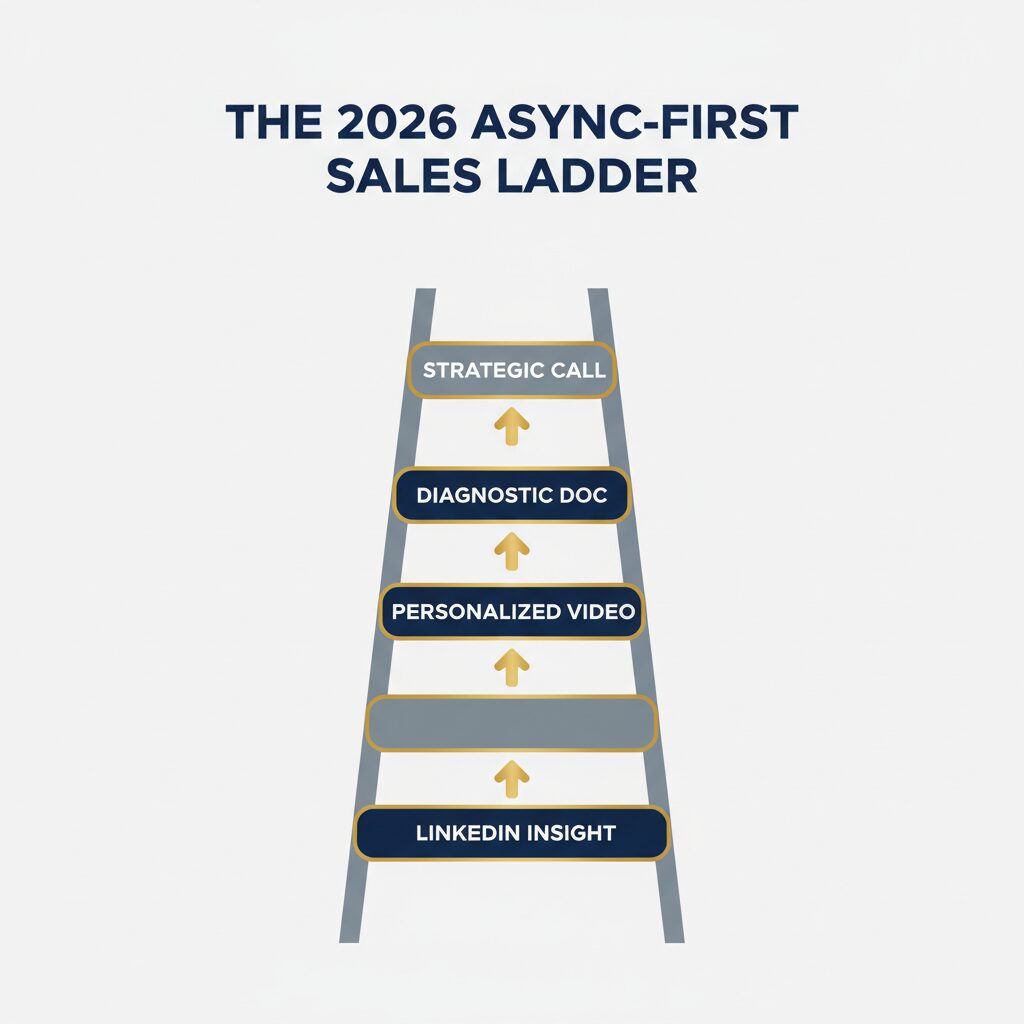
Asking for a 30-minute calendar slot is a big ask. In 2026, the psychological barrier to a live call is higher than ever. Successful teams now use a ladder of micro-commitments to build trust.
The ladder looks like this: a personalized LinkedIn comment, followed by a short async video, followed by a request for a specific piece of data, and finally, the live call. Each step is a low-friction “yes” that builds momentum. When a rep jumps straight to the call, they are asking for a marriage proposal on the first date.
This requires a different kind of discipline. Reps must be trained to write concisely and record videos that get to the point in under 90 seconds. If the video is four minutes long, it is no longer asynchronous; it is a hostage situation. This level of precision is what separates a junior associate from a professional delivering revenue transformation.
Shift 3: Replacing scripts with insight frameworks
Scripts are dead. Gen Z reps hate them, and prospects can smell them from a mile away. The modern alternative is the insight framework. Instead of a line-by-line script, reps are given a set of Ideal Customer Profile (ICP) triggers and a corresponding value-hook.
For example, if a prospect is a Series A founder in Bengaluru, the trigger might be “recent funding round but no dedicated sales head.” The hook is not “congratulations on the funding,” but rather “how to avoid the common mistake of hiring too many junior reps before you have a repeatable process.”
Training should focus on the ability to synthesize data into a point of view. When a rep can say, “Based on your last three LinkedIn posts, it seems you are struggling with X, and here is how we solve that,” they earn the right to a live conversation. This is the core of scaling B2B revenue without relying solely on the founder’s charisma.
Shift 4: Managing the “Ghosting” phenomenon
Ghosting happens when the value of the next step is lower than the effort required to take it. In an async world, ghosting is rampant because the barriers to ignoring a message are zero.
To combat this, high impact sales training for Gen Z B2B reps must emphasize the “Open Loop” technique. Instead of asking “Did you see my last email?”, the rep provides a new, small piece of value. “I just saw this update regarding the new GST regulations for your sector and thought of our conversation—here is a one-paragraph summary of how it affects your pricing.”
This keeps the conversation alive without sounding desperate. It transforms the rep from a vendor into an embedded leadership resource. If your team cannot manage these loops, you will likely find your sales team missing targets despite having a full pipeline.
Implementing the async engine
Transitioning a team to this model cannot happen overnight. It requires a structural change in how you measure performance. If you only track “calls made,” your reps will make useless calls. You must track “assets delivered” and “async response rates.”
In our work at Sales Fundas, we recommend bringing in a Fractional CSO to architect this pipeline. A Fractional CSO doesn’t just give advice; they build the actual loom templates, the Notion discovery docs, and the micro-commitment sequences that your team uses daily. This removes the reliance on the founder to “show them how it’s done” for every single lead.
The goal is to create a scalable B2B sales engine where the technology handles the friction and the humans handle the strategy. When you align your training with the psychological preferences of the 2026 workforce, the resistance disappears. Your reps stop fearing the phone because they only use it when the prospect is already sold on their expertise.
Frequently Asked Questions
Do Gen Z reps lack the skill for live calls?
They do not lack the skill, but they often lack the confidence when the call is unstructured. High impact training provides the framework to make calls the final step of a value chain.
Will asynchronous communication slow down the sales cycle?
Actually, it often accelerates it. By qualifying prospects asynchronously, you eliminate the “discovery fluff” and move to the closing stage faster.
Which tools are best for async B2B sales in 2026?
Loom for personalized video, Notion for shared discovery docs, and LinkedIn for initial signal detection are the current standard.
How do I measure the success of an async strategy?
Track the ratio of async assets sent to meetings booked. A rising conversion rate here indicates your value-hooks are resonating.
Can this approach work for high-ticket enterprise deals?
Yes, enterprise buyers are even more protective of their time. Providing a high-value async brief often earns more respect than a cold outreach.
Does this replace the need for a sales script?
It replaces rigid scripts with flexible insight frameworks. Reps learn what to solve for, not just what to say.
What is the biggest risk of moving to async-first?
The risk is low-quality output. If your reps send generic, low-effort videos, they will damage the brand faster than a cold call would.
How often should a rep follow up asynchronously?
Follow up every 4–7 days, but only if you are adding a new piece of insight or data each time.
This High impact sales training for Gen Z B2B reps, shifting from synchronous friction to asynchronous value, is the only way to build a predictable revenue engine in 2026. Start building your scalable B2B sales engine with Sales Fundas today for a free pipeline audit—no long-term commitment required.
Sales Fundas operates as an embedded leadership partner for ambitious B2B founders and CEOs, specializing in pipeline architecture and predictable revenue growth. By combining rigorous sales consulting frameworks with advanced digital advertising and performance marketing, we build sustainable, high-performing sales engines that complement and scale the founder's strategic vision.
- B2B Sales Consulting & Pipeline Architecture Frameworks
- Advanced Performance Marketing & Conversion Rate Optimization
- Search & Generative Engine Optimization (SEO/GEO) Specialists
- B2B Digital Advertising & Lead Generation Experts
This content was drafted using AI-assisted research and meticulously reviewed by the Sales Fundas consulting team to ensure strategic accuracy and alignment with our B2B sales frameworks.