
Technical founders: Learn to lead discovery calls and handle objections using a diagnostic approach. Stop sounding 'salesy' and start closing more deals in 2026.
The founder’s dilemma in deep-tech sales
Most technical founders treat sales like a product demo. They spend forty minutes explaining how the engine works and two minutes asking if the client wants to buy it. This approach fails because it positions the founder as a vendor, not a partner. In the current 2026 deep-tech climate, buyers are fatigued by polished pitches; they want a technical peer who can diagnose their business pain without a script.

High impact sales training for technical founders focuses on this shift. The goal is to move from “selling a solution” to “architecting a result.” When you stop trying to persuade and start trying to diagnose, the “salesy” feeling disappears. You are no longer a salesperson; you are an expert consultant conducting a technical feasibility audit.
The diagnostic-first discovery framework
A discovery call is not a pitch. It is a gap analysis. In practice, the failure mode for most non-sales founders is jumping to the solution before the client has fully articulated the cost of their problem. If you present a feature before the client admits a loss, you are just adding to the noise.
Start by anchoring the conversation in their current state. Use a diagnostic approach to map the existing pipeline architecture. Instead of asking “Do you have a problem with X?”, ask “How does the current inefficiency in X affect your monthly recurring revenue?” This forces the client to quantify the pain in ₹ terms.
According to a 2026 report by the B2B Growth Index, founders who spend at least 70% of the first call listening see a 22% increase in second-meeting conversion rates. The logic is simple: the person asking the questions controls the room.
Mapping the discovery sequence
To avoid sounding like a junior associate, follow a logical sequence that mirrors a technical troubleshooting process. This keeps the conversation grounded in reality and data.
First, establish the current baseline. Ask about their existing tech stack and the specific point where it breaks. For example, if you are selling a scalable B2B sales engine, ask how many leads currently drop off between the demo and the proposal stage.
Second, isolate the impact. If they say they lose 30% of leads, ask what that represents in lost annual contract value (ACV). In one case we managed, a Mumbai-based SaaS founder shifted from talking about “lead leakage” to talking about a ₹1.2 Crore revenue gap. The conversation changed instantly from a tool purchase to a revenue recovery mission.
Third, confirm the desire for change. Before you show a single slide, ask: “If we could close that ₹1.2 Crore gap by Q4, what does that do for your growth targets?” This creates an internal commitment to the solution before you even propose it. You can find more on optimizing this flow in our guide on the B2B sales process broken in India.
Handling objections through technical logic
Technical founders often fear objections because they feel like a personal attack on their product. In reality, an objection is just a request for more information. The mistake is trying to “overcome” the objection with a persuasive argument. That is where you start sounding salesy.
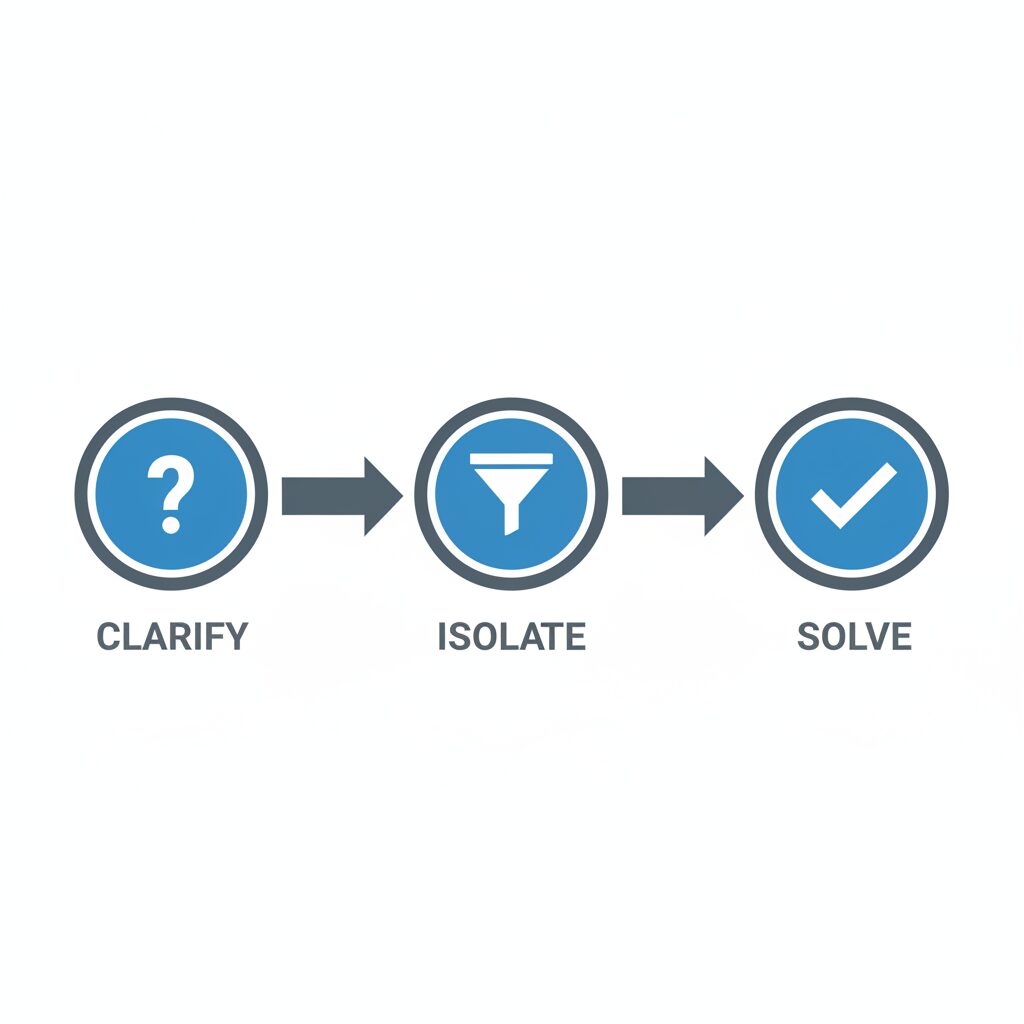
Use the Clarify-Isolate-Solve logic. This framework treats an objection like a bug in a piece of code.
When a prospect says, “It’s too expensive,” do not offer a discount. First, clarify: “When you say it’s too expensive, are you comparing this to a different solution or is it a budget constraint for this quarter?”
Next, isolate the issue: “If the price was not a factor, is this the exact solution you would use to solve the revenue gap we discussed?” If they say yes, you have isolated the price as the only remaining hurdle. You are no longer fighting the value of your product; you are solving a financial logistics problem.
Finally, solve the problem. Present the cost as an investment against the identified loss. If the solution costs ₹5 Lakhs but recovers ₹1.2 Crore, the price is no longer an expense—it is a high-yield asset. This is the core of founder led sales in India for 2026.
Phrasing shifts to remove the ‘sales’ smell
The difference between a consultant and a salesperson is often just a few words. To maintain an authoritative tone, replace persuasive language with investigative language.
Stop saying “I believe our product can help you.” Instead, say “Based on the gap we identified in your pipeline, the data suggests that X will happen if we implement Y.” The first is an opinion; the second is a projection based on evidence.
Avoid saying “Does that sound good?” This is a plea for validation. Use “Does that align with your internal goals for the year?” This keeps the focus on their business outcomes, not your approval.
When a lead goes cold, avoid the “just checking in” email. That provides zero value. Instead, send a specific insight: “I saw this shift in the 2026 B2B landscape and thought it might impact your Q3 targets.” This positions you as a source of intelligence, which is critical when you are the primary initial seller in a deep-tech startup.
Scaling beyond the founder’s effort
While these tactics work for the founder, the goal is eventually to remove founder dependency. You cannot scale a company if you are the only person who can conduct a discovery call. The process must be documented as a repeatable pipeline architecture.
Once you have mastered the diagnostic approach, record your best calls. Map the questions that led to the most successful closes. This becomes the playbook for your first sales hire. Without this, you are just hiring someone to guess how you sell.
Many founders struggle with this transition, often hiring too early or too late. For those navigating this, our guide on the first sales hire for startups in India provides the necessary salary data and hiring truths for 2026.
Frequently Asked Questions
How do I start a discovery call without sounding like a salesperson?
Start by stating the purpose of the call as a diagnostic session. Tell the prospect you want to understand if there is a technical fit before discussing any solutions.
What is the best way to handle the ‘send me more information’ objection?
Ask what specific information they need to make a decision. Then, suggest a brief call to ensure the information you send is tailored to their actual problem.
Should I demo my product during the first discovery call?
Only if the prospect asks and you have already identified a specific pain point. A demo without a diagnosed problem is just a feature list.
How do I handle a prospect who won’t tell me their budget?
Frame the budget as a way to ensure the solution is right-sized. Explain that you don’t want to propose a ₹20 Lakh solution if their problem only requires a ₹2 Lakh fix.
How long should a discovery call actually last?
Aim for 30–45 minutes. Use the first 20 minutes exclusively for diagnosis and the final 10 for aligning on next steps.
What if the prospect’s problem is too small for my product?
Be honest and disqualify them immediately. This builds immense trust and saves your team from chasing low-value leads that will churn.
How do I transition from discovery to the proposal stage?
Summarize the pain, the quantified loss, and the agreed-upon goal. Then ask if it makes sense to build a formal proposal to address those specific points.
Is a script helpful for technical founders?
Use a framework, not a script. A script sounds robotic; a framework of key questions ensures you hit the necessary data points while remaining natural.
This high impact sales training for technical founders is designed to turn your technical expertise into a predictable revenue engine. Stop guessing and start diagnosing with Sales Fundas to build a scalable B2B sales engine. Book a free sales architecture audit today with no obligation.
Sales Fundas operates as an embedded leadership partner for ambitious B2B founders and CEOs, specializing in pipeline architecture and predictable revenue growth. By combining rigorous sales consulting frameworks with advanced digital advertising and performance marketing, we build sustainable, high-performing sales engines that complement and scale the founder's strategic vision.
- B2B Sales Consulting & Pipeline Architecture Frameworks
- Advanced Performance Marketing & Conversion Rate Optimization
- Search & Generative Engine Optimization (SEO/GEO) Specialists
- B2B Digital Advertising & Lead Generation Experts
This content was drafted using AI-assisted research and meticulously reviewed by the Sales Fundas consulting team to ensure strategic accuracy and alignment with our B2B sales frameworks.