

Stop chasing low-margin leads. Learn to build a scalable B2B sales engine that targets high-value customers for predictable revenue growth.
The founder-led sales trap
Most B2B founders in India start by doing everything. You hunt the leads, run the demos, and close the deals. It works at first. But as you try to scale, you hit a wall. You realize your revenue depends entirely on your personal network and your own available hours. You haven’t built a company; you’ve built a high-paying job where you are the single point of failure.

The real burnout doesn’t come from the workload. It comes from chasing mid-tier leads that demand the same effort as a whale but pay a fraction of the price. I see this constantly. It isn’t a lead generation problem. It is a structural flaw in your sales architecture. You don’t need more leads. You need a scalable B2B sales engine that filters for high-value acquisition by default, which means your team spends time only on deals that actually move the needle.
Shifting from ‘getting leads’ to architecting a pipeline means you stop guessing. You move toward a system where the most profitable segments of the market are identified, targeted, and closed using a repeatable process. In practice, this is the difference between hoping for a big deal and engineering one.
The math of ICP profitability: Why most B2B lead gen fails
Most companies define their Ideal Customer Profile (ICP) by industry, company size, and geography. These are demographics, not drivers. Demographics tell you who a company is, but they don’t tell you if they are actually profitable to serve.
Beyond demographics: Identifying high-value behavioral triggers
High-value customers leave clues before they ever talk to a salesperson. In our audits at Sales Fundas, we’ve found that a company growing its engineering team by 20% in a quarter or one that just closed a Series B round is far more valuable than a company that simply fits a “mid-sized” bracket. These are behavioral triggers.
The real driver is the ‘cost of inaction.’ A high-value customer isn’t just someone with a big budget. It’s a client for whom the problem you solve is costing them ₹10 lakh or more per month in leaked revenue or wasted man-hours. When the pain is that acute, the sales cycle shrinks and the deal value spikes because the cost of doing nothing is too high to ignore.
Calculating LTV to CAC ratios for high-ticket B2B
For high-value acquisition, your Customer Acquisition Cost (CAC) will be higher. You cannot use a chatbot to close a ₹50 lakh contract. You need high-touch outreach and deep discovery. The danger is burning your seed capital on leads that never cross the finish line.
A healthy B2B engine generally targets an LTV:CAC ratio of 3:1. This means if you spend ₹1 lakh to acquire a customer, they should bring in at least ₹3 lakh in lifetime value. But here is where most founders slip up: they ignore the ‘service cost.’ If a high-revenue client requires 20 hours of manual hand-holding every week, your actual LTV plummets. You can see the common pitfalls in our guide on 4 LTV CAC Ratio B2B Errors That Kill Startup Runway.
The cost of a ‘bad fit’ customer in the SME ecosystem
A bad-fit customer is a revenue leak. They occupy your best people’s time, demand custom features that distract your product roadmap, and eventually churn because your product was never built for them. In the Indian SME market, these clients are notorious for pushing for 40% discounts while demanding 24/7 white-glove support.
Every hour your senior team spends managing a low-value, high-maintenance client is an hour stolen from acquiring a high-value account. This is why ICP profitability shifts are mandatory for any company moving past the seed stage.
Enterprise vs mid-market sales: Choosing your acquisition path
You cannot use the same playbook for a ₹5 lakh deal and a ₹50 lakh deal. The psychology, the stakeholders, and the risk profiles are completely different.
Navigating the enterprise buying committee: Complexity and cycles
Enterprise sales are rarely a one-on-one conversation. You are navigating a minefield called the buying committee. This usually includes the Economic Buyer (the one with the budget), the Champion (the one who loves your tool), and the Gatekeeper (IT or Procurement who can kill the deal over a single security clause).
The most common failure is focusing only on the Champion. You might have a CEO who loves your vision, but if the Head of IT views your implementation as a risk, the deal dies in the eleventh hour. High-value acquisition requires a map of this committee and a plan to influence each member simultaneously.
Mid-market velocity: Balancing volume with deal value
Mid-market deals move faster. The decision-maker is often the person actually using the product. Here, the goal is velocity. You need a qualification process that flags ‘lookers’ within the first ten minutes so your reps don’t waste a week on a lead with no intent to buy.
The secret is a tight feedback loop between marketing and sales. If your inbound leads are too small, your marketing is targeting the wrong pain points. If they are too big and move too slowly, your pricing might be alienating the mid-market appetite.
Strategic alignment: Matching your product stage to your target tier
Trying to sell an enterprise-grade solution with a seed-stage product is a shortcut to churn. Your product must be able to handle the complexity of a high-value client. If your onboarding takes four weeks of manual setup, you cannot scale a mid-market engine. Conversely, if your product is a simple plug-and-play tool, you’ll struggle to justify a ₹50 lakh price tag.
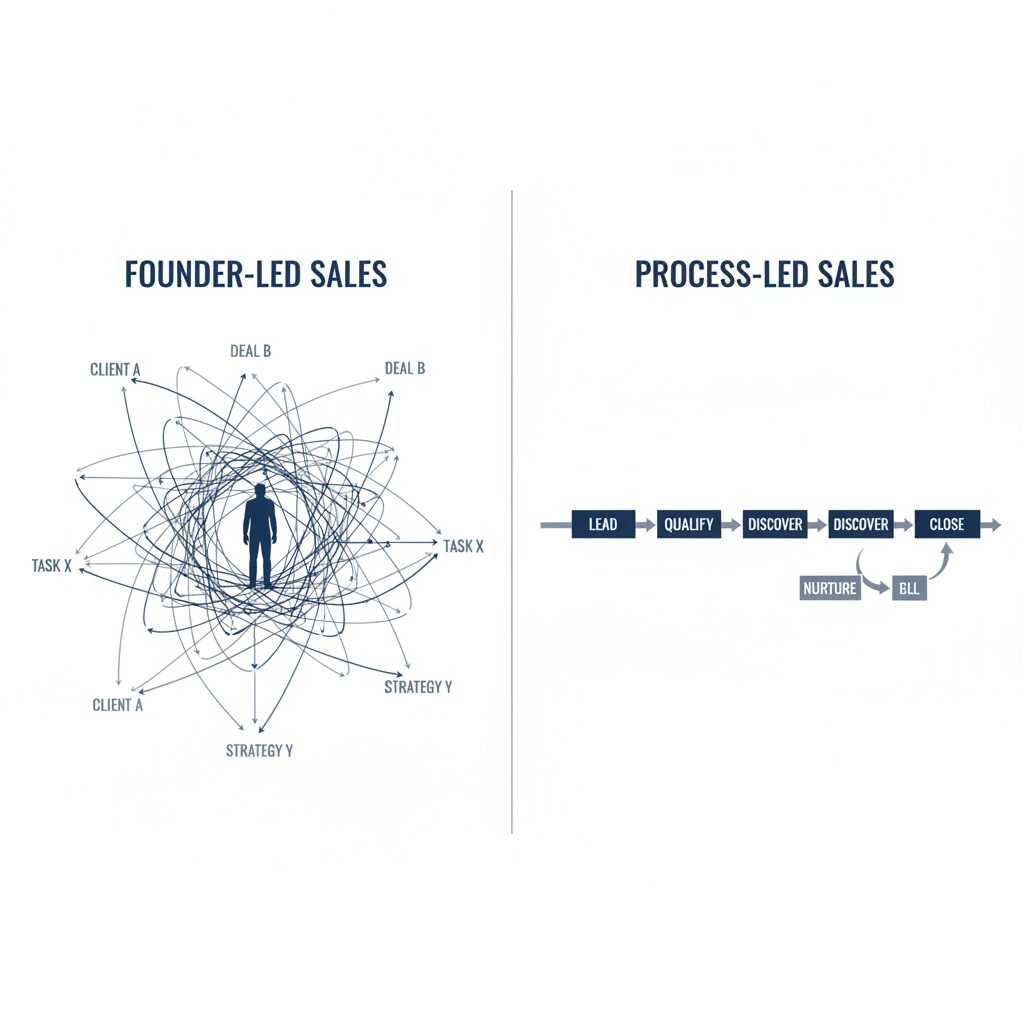
Architecting a scalable B2B sales engine
A revenue engine is a system where inputs (leads) are converted to outputs (revenue) with predictable efficiency. This requires moving away from the ‘hustle’ mentality and toward a structural approach.
Precision outbound: Replacing volume with research-led outreach
Mass emailing 1,000 people with a generic template is just expensive spam. High-value targets ignore “I hope this email finds you well.” They respond to specificity. Precision outbound means identifying 50 high-fit accounts and spending an hour researching each one before sending a single word.
In practice, this means mentioning a specific shift in their quarterly report or a move their direct competitor just made. This research-led approach increases response rates because it proves you’ve actually done the work. To do this without losing your mind, use sales intelligence tools like Apollo.io or ZoomInfo to map the right stakeholders.
Authority-based inbound: Positioning to attract the C-suite
CEOs don’t search for ‘B2B sales consulting.’ They search for ways to fix ‘unpredictable revenue’ or ‘founder-led sales bottlenecks.’ To attract high-value leads, your content must solve a specific, expensive problem.
Stop publishing ‘Top 5 Tips’ articles. They are noise. Instead, publish teardowns of industry failures, data-backed reports on market shifts, and frameworks for revenue transformation. When you position yourself as the expert who solves a ₹1 crore problem, you attract clients who have a ₹1 crore problem.
Embedded leadership: Transitioning from founder-led to process-led sales
The hardest jump for a founder is stepping out of the closing seat. You believe no one can sell the vision as well as you can. You’re probably right, but that’s exactly why you’re stuck. The goal is to bake your intuition into a process that a trained rep can execute.
This is where a Fractional CSO becomes a strategic asset. An embedded leader helps you build the pipeline architecture and trains the team to handle objections without needing you on every Zoom call. It moves the company from ‘founder-magic’ to ‘process-predictability.’
Converting high-value leads into real deals
Getting a meeting with a C-suite executive is the easy part. Closing a high-ticket contract is where most B2B companies stumble. The friction usually happens in discovery and pricing.
Pipeline architecture: The high-value discovery framework
Most sales reps use discovery as a checklist. ‘Do you have X problem? Do you use Y tool?’ This feels like an interrogation. High-value discovery is a strategic diagnosis.
Instead of asking what they want, ask what happens if they do nothing for another six months. Quantify the loss. If a client admits that a slow pipeline is costing them ₹20 lakh a month, your fee of ₹5 lakh for a transformation project is no longer a cost. It is a high-return investment. Use a structured CRM like HubSpot or Pipedrive to track these specific pain points so no high-value lead slips through the cracks.
Value-based pricing vs. cost-plus models in B2B consulting
If you price based on hours worked, you are selling a commodity. High-value acquisition requires value-based pricing. You don’t charge for the time it takes to fix the pipeline; you charge for the value of the revenue that the new pipeline generates.
When you shift the conversation from ‘cost per hour’ to ‘increase in annual recurring revenue (ARR),’ you remove the ceiling on your pricing. A company will happily pay ₹10 lakh if they believe it will unlock ₹1 crore in new business.
Closing the gap: Removing friction in high-ticket contract sign-offs
The final hurdle is usually the legal and procurement process. High-value deals often stall at the ‘legal review’ stage for weeks. To prevent this, provide a pre-approved set of terms or a simplified Master Service Agreement (MSA) early in the process.
Make it as easy as possible for the buyer to say yes. Use digital signatures and clear, phased milestones. Any friction in the final 5% of the deal can kill the momentum you spent months building.
Frequently Asked Questions
How do you identify a high-value B2B customer versus a high-revenue one?
A high-revenue customer pays a lot but may cost more to support, eating your margins. A high-value customer provides high margins and aligns perfectly with your product’s core strength, meaning they grow with you without needing custom engineering.
What is the average sales cycle for high-value B2B customer acquisition in India?
Typically, these range from three to nine months. Enterprise deals in India often require more relationship-building and multiple stakeholder approvals than in Western markets.
Should we use a Fractional CSO or hire a full-time Sales Director for scaling?
Use a Fractional CSO if you need to build the architecture and the playbook first. Hire a full-time Director once the process is proven and you need someone to manage the daily grind of execution.
How do you measure the success of a scalable B2B sales engine?
Track the LTV:CAC ratio and the percentage of revenue coming from non-founder-led deals. When the revenue keeps growing while the founder stops closing, you’ve won.
What are the primary differences in acquisition strategies for SaaS vs B2B Services?
SaaS often uses product-led growth (PLG) to lower the entry barrier. B2B services require high-authority positioning and deep diagnostic discovery to justify a high ticket price before the work even begins.
Stop guessing your growth
Relying on founder-led sales is a dangerous game. It creates a fragile business where growth stops the moment you stop grinding. The shift from a hustle-based approach to a structured revenue engine is the only way to achieve growth you can actually predict.
If your pipeline is a rollercoaster and your revenue is too founder-dependent, it is time for a structural change. Stop chasing mid-tier leads and start architecting a system that attracts the most profitable clients in your market.
Book a revenue transformation audit today to identify the leaks in your pipeline and build a scalable acquisition engine. No commitment, just a clear roadmap to predictable revenue.