
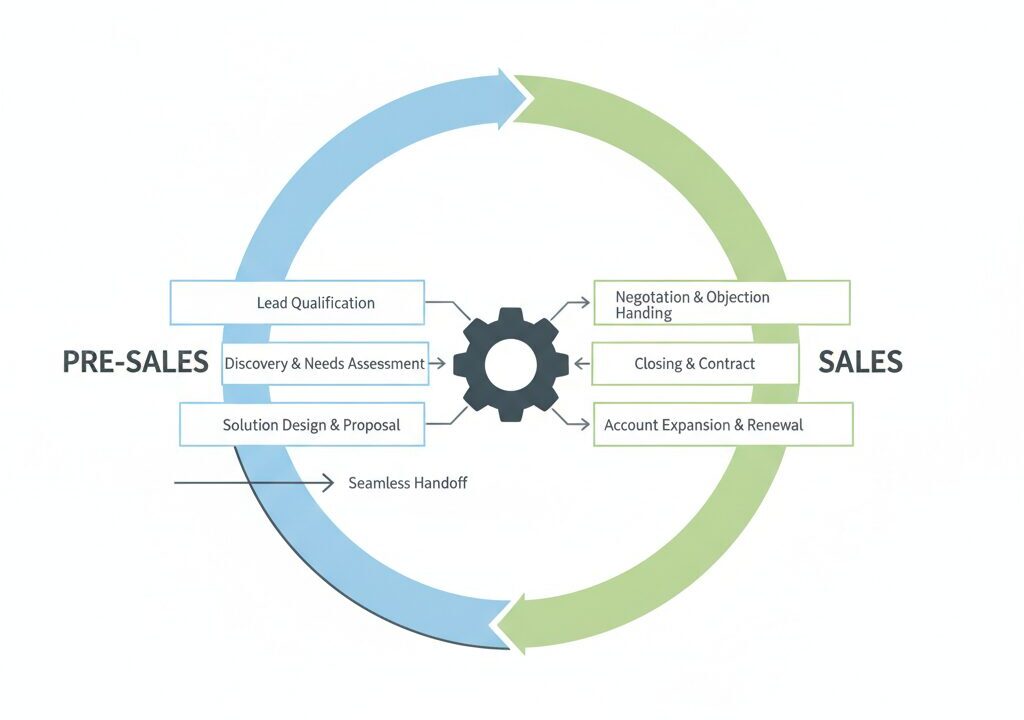
Stop founder-dependent revenue. Learn how to separate Pre-sales vs Sales in 2026 to build a scalable B2B sales engine and close real deals in India.
The Revenue Architecture Crisis in 2026
Most B2B founders in India struggle with a pipeline that feels like a black box. You hire a sales team, yet revenue remains founder-dependent. The diagnosis is often a fundamental confusion between pre-sales and sales functions. This lack of clarity creates friction that kills deals and wastes capital.

In 2026, the distinction between these roles has moved beyond simple job descriptions. It is now a matter of revenue transformation. Pre-sales acts as the architect of the deal, while sales operates as the closer. When these functions blur, your cost of acquisition (CAC) spikes because high-value sales talent spends time on technical validation rather than closing.
According to recent industry benchmarks from 2026, Indian B2B SaaS companies that separate these roles clearly see a 22% increase in win rates. This is not a luxury for large enterprises. It is a requirement for any startup aiming for a sustainable sales growth model that does not rely on burning investor cash.
The Architect: Pre-sales in the 2026 Ecosystem
Pre-sales is the technical and strategic filter of your revenue engine. In a B2B sales consulting context, the pre-sales lead ensures the solution actually fits the client’s problem. They own the discovery process and the technical proof of concept. Their objective is to eliminate risk before a contract is signed.
When you look at high-impact sales training for technical founders, the focus is often on this specific transition. A technical founder often acts as the first pre-sales person. They know the product inside out. The failure occurs when they try to be the closer simultaneously, failing to ask the hard commercial questions needed to move a deal forward.
In 2026, pre-sales professionals use real-time data to validate the Ideal Customer Profile (ICP). They prevent the sales team from chasing ‘garbage’ leads that will never convert or, worse, will churn within six months. They are the guardians of your product-market fit on a deal-by-deal basis.
The Builder: Sales and the Art of the Real Deal
The sales role in 2026 is about commercial execution and relationship management. While pre-sales handles the ‘how,’ sales handles the ‘who’ and the ‘when.’ They navigate the complex web of stakeholders within an Indian SME or enterprise. Their expertise lies in negotiation, overcoming procurement hurdles, and securing the final signature.
A common mistake in Bangalore and Mumbai startups is hiring a salesperson and expecting them to do their own technical demos. This creates a bottleneck. A salesperson focused on technical details often misses the subtle cues that indicate a buyer is stalling. By deploying a Fractional Sales Director, founders can install a system where sales reps focus purely on pipeline movement.
Sales is about predictability. In 2026, a scalable B2B sales engine requires a rep to manage the commercial narrative. They must ensure the buyer understands the ROI in terms of ₹ (INR) saved or earned. If they are bogged down in technical troubleshooting, the commercial urgency dies.
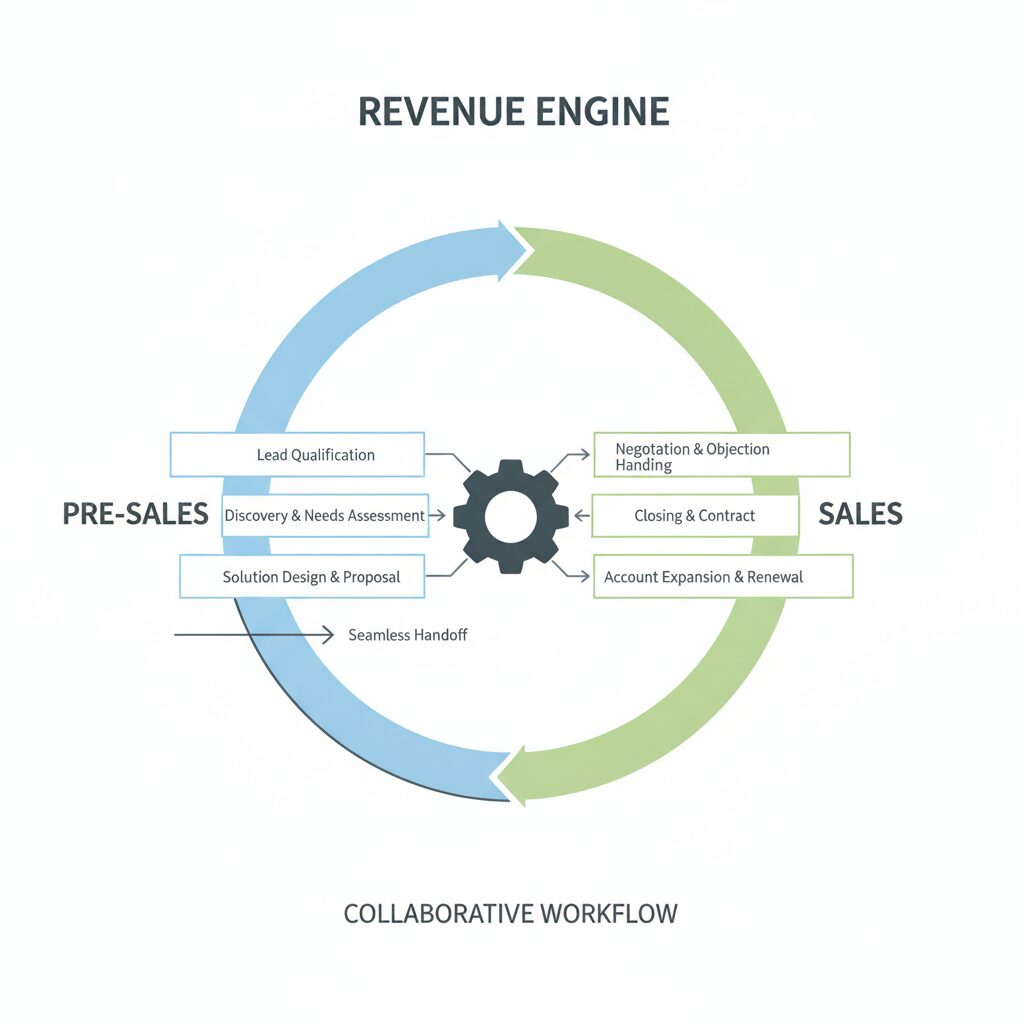
Strategic Friction: Where Deals Often Die
Friction between pre-sales and sales is a sign of a healthy revenue engine, provided it is managed. Sales wants to close every lead; pre-sales wants to ensure every lead is viable. This tension ensures that you only sign ‘real deals’ rather than ‘hope-based’ contracts.
In practice, we see many companies where this friction turns toxic. This happens when there is no shared definition of a qualified lead. Without a clear B2B sales process in India, the handover becomes a source of blame. Sales blames pre-sales for being too rigid; pre-sales blames sales for bringing in unqualified ‘fluff.’
To fix this, you need embedded leadership. This isn’t about more meetings. It is about a unified revenue architecture where both roles are incentivized based on successful implementation, not just the initial booking. This shift reduces the long sales cycles that plague the Indian market.
The 2026 Financial Reality of Split Roles
Founders often worry about the cost of hiring both functions. However, the data from 2026 suggests that the cost of a single, overstretched generalist is higher. A generalist sales rep in a Tier 1 city might demand a package of ₹18,00,000 to ₹35,00,000 per annum, yet their productivity drops by 40% when they handle technical pre-sales tasks.
Contrast this with a structured team. A dedicated pre-sales resource ensures that the high-cost sales closer is only talking to buyers who have been technically vetted. This efficiency is what allows a Fractional CSO to scale a startup’s revenue without doubling the headcount every year.
Revenue transformation requires looking at these roles as complementary investments. One builds the foundation; the other finishes the structure. If you try to save money by merging them, you end up with a shaky pipeline that collapses under the pressure of quarterly targets.
Frequently Asked Questions
What is the primary difference between pre-sales and sales in 2026?
Pre-sales focuses on technical validation and solution fit for the ICP. Sales handles the commercial negotiation and the final closing of the deal.
When should a B2B startup hire its first pre-sales person?
Hire for pre-sales when the founder can no longer handle technical demos without delaying the commercial stages of the deal. This usually happens around the ₹5 Crore ARR mark.
Can a salesperson handle pre-sales duties in a small team?
While possible in the early stages, it often leads to a shallow pipeline and poor technical discovery. Specialization is necessary for a scalable B2B sales engine.
How does pre-sales impact the B2B sales cycle in India?
A strong pre-sales function shortens the cycle by identifying technical blockers early. This prevents deals from stalling in the ‘proof of concept’ phase for months.
Is pre-sales only for software and SaaS companies?
No, any complex B2B service or high-value manufacturing requires pre-sales to handle the technical specifications and implementation planning. It is about solution architecture.
What are the key metrics for a pre-sales professional?
Monitor technical win rate, demo-to-qualified-opportunity ratio, and the accuracy of the initial implementation estimate. These metrics reflect their impact on revenue.
How do pre-sales and sales collaborate during the handover?
The handover should involve a joint discovery document that outlines both technical requirements and commercial goals. This ensures no guesswork during the final stages.
What is the role of a Fractional CSO in managing these roles?
A Fractional CSO provides the pipeline architecture to ensure pre-sales and sales work in tandem. They remove founder dependency by building a repeatable process.
Stop guessing why your revenue is stalling. Start building a predictable revenue engine by defining your team’s roles with precision. Schedule a free assessment of your sales architecture today.