

Let’s talk about the elephant in your P&L.

For most SMEs generating under ₹50 Cr in revenue, hiring a full-time VP of Sales isn’t just expensive. It is capital-inefficient. It is risky. And frankly? It is often a mistake.
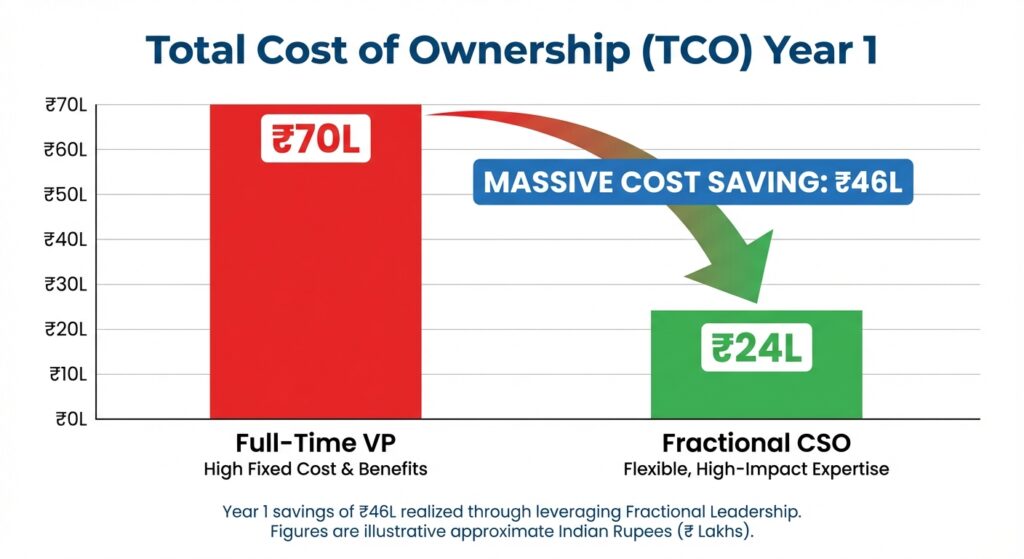
You look at the salary. You think, “I can afford that.” But you aren’t looking at the whole picture. By opting for a Fractional CSO, you access Fortune 500-level strategy and execution for ~60% less cost. That saves you upwards of ₹30 Lakhs in Year 1. Plus, you eliminate the risks of equity dilution and messy severance packages.
This isn’t just an opinion. This is math. Let’s break down the exact financial models, the costs hiding in the shadows, and the strategic triggers that tell you exactly which leadership style fits your current growth stage.
The “Sticker Price” vs. The Real Cost of Ownership (TCO)
Most Founders make a basic error here. They compare a Fractional CSO’s retainer against a Full-Time VP’s base salary.
This is bad math.
To see reality, you must calculate the Total Cost of Ownership (TCO). A full-time executive carries a heavy backpack of costs that don’t appear on the offer letter but definitely hit your bank account.
The Financial Breakdown (Indian Market Context)
Let’s look at the numbers. We are assuming a standard hiring scenario for a Tier-1 city in India.
| Cost Component | Full-Time VP Sales | Fractional CSO (Sales Fundas) |
|---|---|---|
| Annual Base Salary | ₹50,00,000 – ₹70,00,000 | ₹18,00,000 – ₹24,00,000 |
| Recruitment Fee (Agency @ 8.33%+) | ₹4,00,000 – ₹6,00,000 | ₹0 |
| Equity / ESOPs (1% – 2%) | Potential value: ₹50L+ (at exit) | ₹0 (Pure cash contract) |
| Benefits (Health, PF, Laptop, Perks) | ₹3,00,000+ | ₹0 |
| Severance Risk (3 Months) | ₹12,00,000+ | ₹0 (30-day notice) |
| Total Year 1 Liability | ₹70 Lakhs – ₹1.4 Crores | ₹18 Lakhs – ₹24 Lakhs |
The Math Verdict:
Hiring a Fractional CSO saves you a minimum of ₹30,00,000 in cash flow during the first year. Think about that. For a bootstrapped or lean company, that money isn’t just “savings.” That is the equivalent of hiring 3-4 aggressive SDRs to fuel the engine. Or doubling your ad spend. Or extending your runway by six months.
The “Hidden” Costs: Speed, Risk, and Agility
Money is a nice metric. But it isn’t the only currency in business. Time and Agility are arguably more valuable for a growing SME.
When you hire wrong, you don’t just lose money. You lose time. And in the startup world, lost time is the one thing you can’t earn back.
1. The “Ramp-Up” Lag
- Full-Time VP: Typically takes 3-6 months to “audit” the business before making impactful changes. You pay full salary during this learning phase. They need to understand the culture, the politics, and the product.
- Fractional CSO: Operates on a “Plug-and-Play” model. At Sales Fundas, we use standardized diagnostic frameworks like our 30-Point Health Check. We identify process leaks on Day 1 and start plugging them on Day 2. You pay for output, not attendance.
2. The “Equity” Trap
Founders often view ESOPs as “free money.” They are not. They are the most expensive currency you have.
Giving 2% equity to a VP who might leave in 18 months (the average tenure of a Sales VP) is a disaster. It complicates your cap table and gives ownership to someone who isn’t there to build the future. A Fractional CSO creates enterprise value without diluting your ownership. You keep your company. We just help you grow it.
3. The “Golden Handcuffs” of Severance
If a full-time VP fails to deliver, firing them is legally complex, culturally damaging, and expensive. You are often looking at 3-6 months of severance pay.
A Fractional engagement is a commercial contract. It isn’t an employment bond. If the fit isn’t right, or if you outgrow the need, you pivot with a simple 30-day notice. No drama. No lawyers.
The “Sales Fundas” Difference: Strategy + Training
Most “Fractional CSOs” are purely strategic. They will look at your CRM, build a nice PowerPoint deck, and tell you what to do.
This creates a new problem: You have a great strategy, but your current team lacks the skills to execute it. You have a Ferrari engine in a Maruti 800 body.
At Sales Fundas, we believe Strategy and Training are inseparable. You cannot fix one without the other.
- The Strategist (CSO): “We need to target the CFO persona with a value-based pitch.”
- The Trainer (Coach): “Here is the exact script to use. Let’s roleplay it for 30 minutes until you get it right.”
Jayant Kelkar’s approach bridges this gap. We don’t just build the roadmap; we get in the trenches. We equip your team to drive the car. This “Hybrid” model ensures that the strategy actually translates into revenue.
Key Takeaway: Don’t hire a strategist who can’t train. Don’t hire a trainer who doesn’t understand strategy. A Fractional CSO must be both.
The Maturity Model: When Should You Hire Which?
We aren’t saying you should never hire a Full-Time VP. We are saying you should hire them at the right time. Hiring too early is just as dangerous as hiring too late.
Stage 1: Founder-Led Sales (₹0 – ₹5 Cr)
- Who Sells: The Founder.
- Need: You need a “Sales Architect” to document what is in your head and build the first process. You are struggling to scale beyond your own time.
- Best Fit: Fractional CSO.
Stage 2: The “Scale-Up” Phase (₹5 Cr – ₹50 Cr)
- Who Sells: A small team (2-10 reps).
- Need: You need professional management, CRM architecture, KPI setting, and rigorous training. The team is too small to justify a ₹60L leader, but too complex for the Founder to manage part-time.
- Best Fit: Fractional CSO. (This is the “Sweet Spot”).
Stage 3: The “Enterprise” Phase (₹50 Cr+)
- Who Sells: Large teams (20+ reps), multiple regions/verticals.
- Need: You need a political figurehead to manage board relations, large internal HR issues, and multi-layered management.
- Best Fit: Full-Time VP Sales.
Not sure which stage you are in? Book a 30 Min Session.
Frequently Asked Questions (FAQ)
Q: Will a Fractional CSO be committed enough to my business?
A: Yes. Fractional leaders survive on reputation and referrals. Unlike a full-time employee who gets paid just for showing up, a Fractional CSO must deliver tangible results to retain the contract.
Q: Can a Fractional CSO manage my existing sales team?
A: Absolutely. They typically run your weekly sales reviews, pipeline meetings, and 1:1 coaching sessions, acting as the de-facto leader until you are ready for a full-time hire.
Q: How long does a typical engagement last?
A: Most engagements last 6 to 18 months—enough time to build the infrastructure, hire the right team, and groom a full-time successor.
Q: Is this just a consultant role?
A: No. Consultants give advice. Fractional CSOs execute. We own the number alongside you.
Q: What if I have zero sales process right now?
A: That is actually ideal. It is easier to build a new process on a blank canvas than to fix a broken one. We start by mapping your customer journey.
Q: Can you help hire the future Full-Time VP?
A: Yes. One of our key deliverables is to help you write the JD, interview candidates, and onboard your permanent VP when you cross the ₹50 Cr mark.
Q: Do you bring your own CRM?
A: We work with what you have, or we help you implement one. We often recommend free or low-cost CRM solutions for early-stage startups.
Q: How do we measure success?
A: We set KPIs in Week 1. Usually, these include pipeline growth, conversion rate improvements, and reduced sales cycle length.
The Verdict
If you are a growing SME, the math is undeniable. You don’t need a full-time badge on a chair. You need a full-time impact on your revenue.
A Fractional CSO gives you the expertise of a veteran leader, the agility of a consultant, and the training capability of a coach. All for less than half the cost of a traditional hire.
Stop paying for “overhead.” Start paying for “outcomes.”
Ready to do the math for your specific business?
Book a Free “Cost vs. Value” Audit with Jayant Kelkar
Let’s review your current sales structure and see if a Fractional model can save you ₹30L this year.




[…] Sales Consultant:Upfront investment. You pay a retainer or project fee. However, a consultant like Jayant Kelkar operates with efficiency. We don’t need 20 hours to figure out a lead is bad. We need 20 minutes. The ROI comes from time saved and systems built. Read about the math behind hiring fractional help here: Fractional CSO vs. Full-Time VP: The Math. […]
[…] You get high-level expertise immediately. You don’t pay for “down time” or office politics. You pay for output, strategy, and results. We have broken down the specific financial advantages in our article: Fractional CSO vs. Full-Time VP: The Math. […]
[…] If you want a deeper dive into the numbers, check out our analysis on Fractional CSO vs. Full-Time VP: The Math. […]
[…] Now, compare that to a Fractional CSO. […]