
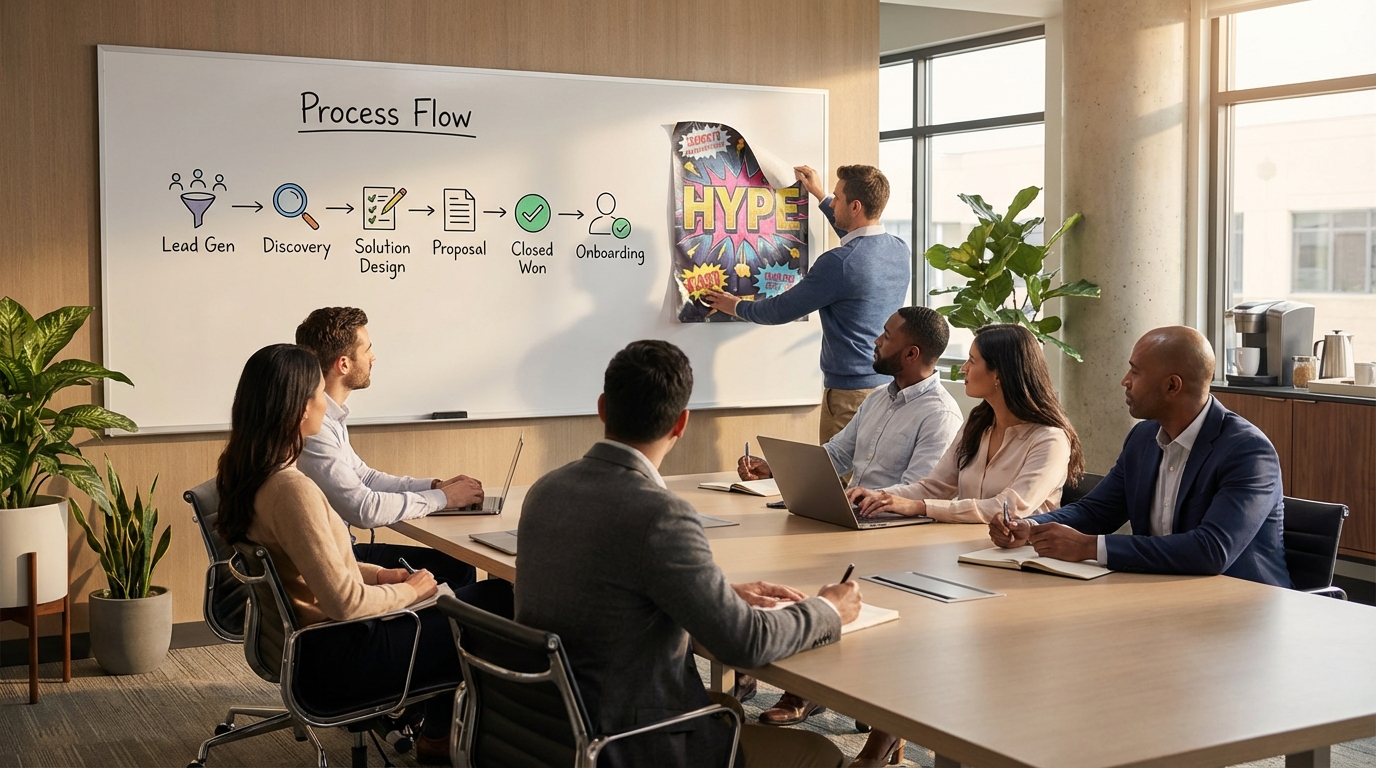
I have often observed a strange phenomenon in business. We treat sales as a matter of emotion, yet we demand results that are strictly mathematical.
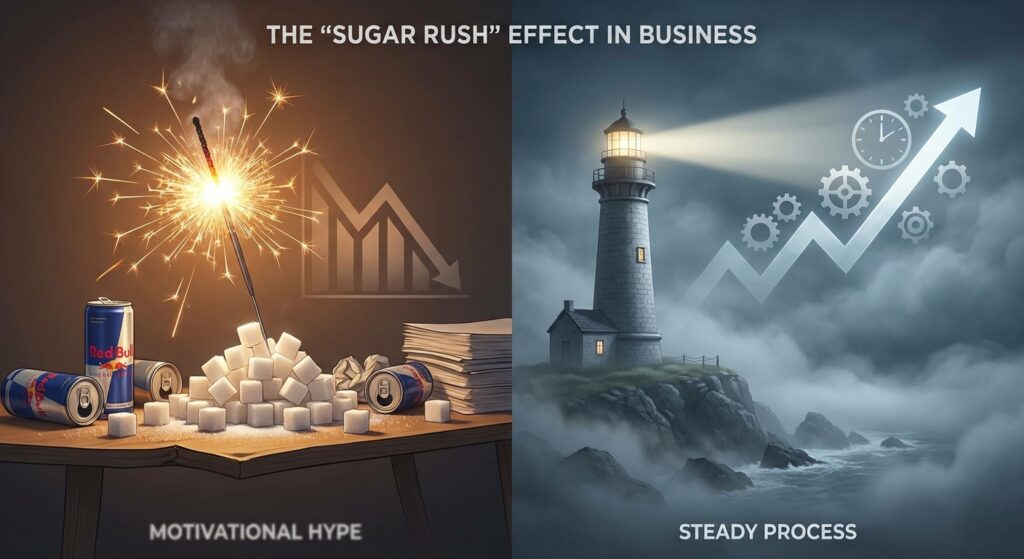
We have all seen the scenario. You hire a high-energy speaker for your annual sales kickoff. They run around the stage. They play loud music. They shout mantras about "unleashing the tiger within." Your sales team leaves the room buzzing, ready to conquer the market.
By Tuesday, the buzz has worn off.
By Friday, they are back to their old habits. And by the end of the quarter, your revenue numbers have not moved an inch.
Why does this happen? It is because you paid for a temporary emotional spike, not a sustainable business outcome. In the high-stakes environment of B2B sales, reliance on "motivational training" is a mistake we cannot afford to make. Motivation is a feeling. Sales is a process.
If you want consistent results, you must stop focusing on how your team feels and start focusing on what they do. This is not about being cold or mechanical. It is about giving people the dignity of knowing exactly how to succeed.
The "Sugar Rush" of Motivational Seminars
Imagine sending a soldier into battle. What do they need more: a speech about bravery or a fully loaded rifle and the training to use it?
Motivational seminars are the corporate equivalent of a sugar rush. They provide a quick spike in energy, followed inevitably by a crash. The "Forgetting Curve," hypothesized by Hermann Ebbinghaus, suggests that humans forget approximately 50% of new information within an hour. Within 24 hours, 70% is gone unless it is reinforced by practice and process.
Key Insight: If your training strategy relies on hype, you aren’t building a sales team; you’re renting enthusiasm.
When a sales rep faces a tough gatekeeper or a complex objection regarding pricing, "believing in themselves" won’t close the deal. They need a script. They need a framework. They need a reflex. They need to be equipped, not just excited.
To fix this, we must look at corporate sales training through the lens of engineering, not theater.
Why Sales Team Training Must Be Process-Driven
Effective sales team training isn’t about personality transformation; it’s about behavioral modification based on proven systems.
In the B2B sector, sales cycles are long. Stakeholders are multiple. Emotional selling rarely works on a CFO analyzing a spreadsheet. To succeed, your training must shift from abstract concepts to concrete mechanics. We see this often when helping startups; without a process, they flounder.
Read more about why sales teams fail due to process leaks here.
The Difference Between Motivating and Equipping
We must distinguish between these two very different activities.
- Motivating asks: "How can we get the team to work harder?"
- Equipping asks: "What tools and systems does the team need to make winning easier?"
When you equip a team, you remove the reliance on willpower. Willpower is a finite resource. It depletes throughout the day. Systems, however, are infinite. A rep doesn’t need "motivation" to update the CRM if the CRM is set up as a helpful tool rather than a surveillance device. They don’t need "courage" to cold call if they have a proven script that minimizes rejection.
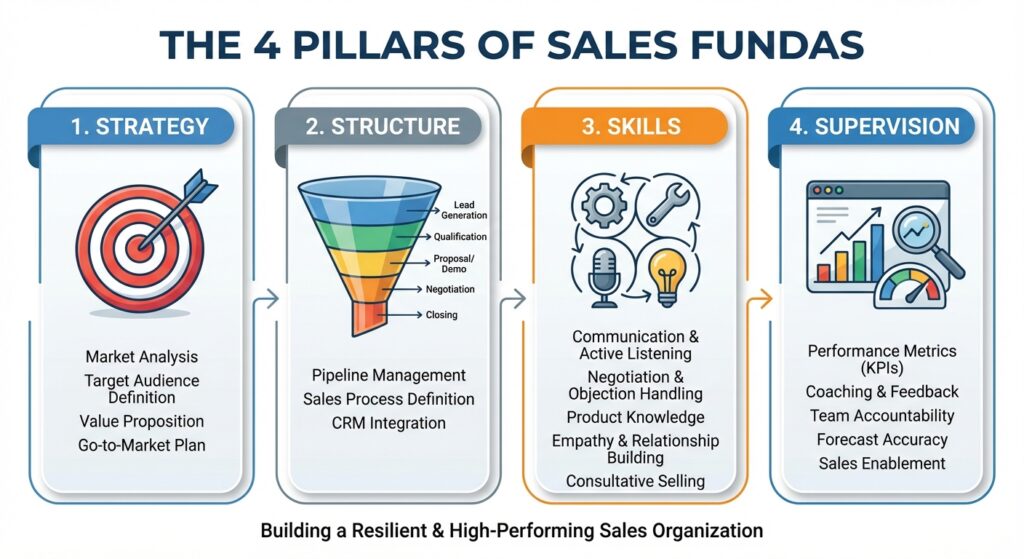
The 4 Pillars of Sales Fundas
At Sales Fundas, led by Jayant Kelkar, we have analyzed why B2B teams struggle. It is rarely a lack of desire; it is almost always a lack of definition. To build a lasting institution, you need a foundation.
To transition from a chaotic, personality-driven sales floor to a disciplined revenue engine, your sales team training must cover four distinct pillars:
1. Strategy (Targeting)
Does your team know exactly who they are calling? "Everyone" is not a target market. Training must define the Ideal Customer Profile (ICP) so reps don’t waste energy on low-probability prospects. This is often where early-stage companies lose their way.
If you are a startup, check this guide on why you need a B2B sales consultant to help define this strategy.
2. Structure (The Pipeline)
Do you have a defined sales funnel? A "warm lead" means different things to different people. A robust system defines clear exit criteria for every stage of the pipeline. You cannot build a skyscraper without blueprints. Similarly, you cannot build revenue without pipeline discipline.
Understanding the difference between leads is vital. See our breakdown of MQL vs SQL.
3. Skills (The "How-To")
This is the core of equipping. This includes:
- Opening techniques: How to grab attention in the first 7 seconds.
- Questioning skills: moving from "What do you need?" to "Why is this a problem now?" (SPIN selling techniques).
- Objection handling: Turning a "No" into a "Not yet" or uncovering the real hidden objection.
- Closing: Asking for the business without sounding desperate.
It is not just about aggressive pitching. It is about building trust. We explore this deeply in our article on the social qualities of a salesman.
4. Supervision (Review & Metrics)
Training is useless without accountability. This isn’t about micromanagement; it’s about course correction. You cannot manage what you do not measure. But be careful. If you measure the wrong things, you get the wrong behaviors.
For those struggling with tools, we have compiled a guide to free CRM solutions suitable for startups.
The ROI of Systems Over Hype
Let’s look at the data. According to research by the Sales Management Association, firms with effective sales training are 10% more likely to have high win rates. However, the key word is effective.
When you invest in sales team training that focuses on "The Fundas" (Fundamentals), you create a compounding asset.
- Scalability: A process-driven approach allows you to onboard new hires faster. You hand them the playbook, and they can start performing.
- Predictability: When everyone uses the same system, your forecasting becomes accurate. You stop guessing if a deal will close.
- Resilience: When a top performer leaves, they don’t take the "magic" with them. The system remains in the company.
Jayant Kelkar’s Philosophy: "Amateurs rely on their mood. Professionals rely on their method. We teach the method."
How to Audit Your Current Training Approach
If you are worried that your current approach lacks substance, conduct a quick audit of your sales floor. Ask your team these three questions:
- "What is the specific criteria for moving a prospect from ‘Lead’ to ‘Opportunity’?" (If you get five different answers, your system is broken).
- "Show me the script or framework you use to handle the ‘Your price is too high’ objection." (If they say "I just wing it," you have a problem).
- "What are your activity goals for this week?" (If they only talk about revenue targets but not the activities required to get there, they are dreaming, not planning).
If the answers to these questions are vague, it is time to bring in an expert who understands the mechanics of B2B selling. You might need a comprehensive 30-point health check.
Stop Cheering. Start Coaching.
There is a place for motivation. A happy team is a productive team. But motivation should be the result of competence, not the precursor to it.
There is nothing more motivating for a salesperson than closing a deal. There is nothing more de-motivating than working hard, facing rejection, and not knowing why you failed.
Sales team training that equips your staff with the skills to handle rejection, navigate complex organizations, and close deals will generate its own momentum. Success breeds success.
Frequently Asked Questions
What is the best training method for sales?
The best method combines process-driven instruction with role-playing and real-time feedback. It must move beyond theory into "active recall" exercises where reps practice handling objections in simulated environments.
How do you train a new sales team?
Start by defining the Ideal Customer Profile (ICP) and the exact stages of your pipeline. Before letting them call, ensure they master the product knowledge and the "opening pitch" script to build confidence early.
What are the 4 methods of sales training?
Common methods include eLearning modules, instructor-led workshops, on-the-job coaching (shadowing), and role-playing simulations. A blended approach usually yields the highest retention rates.
Why does most sales training fail?
Most training fails because it is treated as a one-time event rather than an ongoing process. Without reinforcement from management and integration into the CRM, reps revert to old habits within weeks.
How often should sales training occur?
Training should be continuous, not episodic. Weekly "micro-training" sessions focusing on specific skills (like closing or negotiation) are far more effective than annual two-day seminars.
What is the role of a sales manager in training?
The sales manager is the primary coach who must reinforce the training daily. If the manager does not hold the team accountable to the new methods, the training investment is wasted.
Can online sales training be effective?
Yes, but only if it includes interactive elements and assessments. Passive video watching is rarely sufficient for building complex communication skills required in B2B sales.
How do you measure sales training effectiveness?
Measure leading indicators like conversion rates between pipeline stages, not just final revenue. Look for improvements in "time to close" and average deal size post-training.
Ready to build a Sales Engine?
Stop wasting your budget on "rah-rah" sessions that vanish by Monday morning. It’s time to install a sales operating system that delivers measurable, repeatable results.
Jayant Kelkar and Sales Fundas specialize in transforming B2B sales teams from average performers into disciplined professionals. We don’t just tell you what to do; we show you how to do it, and we help you build the habits that make it stick.