

Stop losing revenue to endless trials. Learn how to exit B2B pilot purgatory and architect a predictable Proof of Concept to paid conversion process.
The ‘Yes’ That’s Actually a ‘No’: Escaping B2B Pilot Purgatory
A ‘yes’ to a pilot is often just a polite way of saying ‘no’ without the confrontation. B2B founders frequently mistake a Proof of Concept (PoC) for momentum, only to find their product trapped in a loop of endless testing and zero revenue. This is B2B pilot purgatory.

When a deal stalls during a pilot, the problem isn’t usually the software. It’s a failure of your sales architecture. You’re likely treating the pilot as a product demo rather than a commercial transition, which means you’ve given the client a reason to play with your tool, but no reason to pay for it. To fix this, you have to stop selling the trial and start selling the specific business outcome.
At Sales Fundas, we see this pattern in almost every founder-led startup we audit. The founder provides free access, hopes the client “sees the magic,” and then wonders why the contract is still unsigned after 90 days. You won’t close more deals by dumping more data on the client; you close them by enforcing a strict, documented path to purchase.
The hidden cost of sales friction in the Indian market
The psychology of the ‘free trial’ trap
Indian B2B buyers are historically risk-averse. They don’t just want to see the product work; they want to shift 100% of the risk onto the vendor. When you offer a free PoC, you remove the buyer’s skin in the game. This creates a dangerous gap where the client views the pilot as a free experiment rather than a strategic business investment.
In my experience, a free trial often signals that your solution is a commodity. If your tool actually delivered a revenue transformation, the buyer would be terrified to delay its implementation. By removing the cost, you’re inadvertently telling the client that your value is negotiable.
Why founders chase logos instead of logic
Founders are often too close to their “baby.” They believe that if a user just sees the feature work, the sale is guaranteed. It’s a dangerous assumption. The person clicking the buttons during a pilot is rarely the person who signs the cheque.
The real failure here is a lack of qualification. I’ve seen founders accept pilots from any company with a recognizable brand name, regardless of whether they fit the Ideal Customer Profile (ICP). They chase the logo for the prestige, not the logic of the deal. This fills your pipeline with “hope,” which is the opposite of predictable revenue.
The brutal math of unpaid PoCs
Unpaid pilots aren’t actually free. They cost your engineers in support hours, your account managers in sanity, and your company in opportunity cost. If a pilot drags on for 60 days and requires 20 hours of manual onboarding, you are essentially paying for the privilege of being rejected.
Let’s look at the numbers. Suppose a startup spends ₹2,00,000 in manpower costs to run a pilot for a client who eventually ghosts them. If this happens across five deals a quarter, you’ve burned ₹10,00,000 in raw resources. That’s money that should have gone into marketing or product dev, but instead, it funded a client’s free education. This friction kills your runway.
The Blueprint: Moving from PoC to Paid Conversion
Mutual Action Plans: Killing ‘hope’ as a strategy
Hope is not a sales strategy. To escape purgatory, you need a Mutual Action Plan (MAP). Think of this as a shared contract of intent—a document you and the buyer sign that outlines every step from the first login to the final signature.
A MAP must include specific dates for weekly reviews, the names of the stakeholders who must sign off on results, and a hard expiration date. If a buyer refuses to agree to a MAP, they aren’t a buyer; they’re a window shopper. Disqualify them immediately to save your team’s time.
Setting “Hard” Success Criteria
A pilot without success criteria is just a free trial with a deadline. You must define exactly what ‘success’ looks like in numbers. Stop using vague phrases like ‘the client will see value.’ Instead, write: ‘The system must reduce lead response time from 24 hours to 4 hours over a 30-day window.’
Once these numbers are hit, the conversion to a paid contract should be automatic. This shifts the final conversation from ‘Do you like the product?’ to ‘We’ve hit the agreed-upon targets; let’s execute the master service agreement.’
The ‘Paid Pilot’ filter
The fastest way to kill pilot purgatory is to charge for the PoC. A paid pilot acts as a high-pass filter. It separates the companies with a genuine, bleeding pain point from those who are just benchmarking your features to help a competitor.
Even a nominal fee—₹50,000 to ₹1,00,000—completely changes the power dynamic. It transforms the client from a passive observer into a committed partner. This is how you build a scalable B2B sales engine. (Pro tip: Track these paid transitions in your CRM with a specific ‘PoC-to-Paid’ stage so you can measure your actual conversion rate.)
Closing the Deal: Navigating Stakeholder Inertia
The User vs. The Buyer
The technical user loves the features. The economic buyer loves the ROI. Purgatory happens when you spend 60 days talking to the user. In the Indian SME landscape, the MD or CEO makes the final call based on cash flow and risk, not “cool” features.
Secure a meeting with the economic buyer before the pilot begins. If you wait until the end of the trial to meet the CEO, you’ll likely find there is no budget allocated for your tool. The technical user can give you a glowing review, but only the economic buyer can give you a contract.
Fighting the ‘We Need More Data’ stall
When a client asks for ‘more data’ after you’ve already hit the success criteria, they aren’t lacking information. They’re lacking the courage to change. They are experiencing inertia.
Stop talking about what they will gain and start talking about what they are losing. Based on our observed sales trends, companies that delay implementation by just 30 days typically lose about 12% of their projected first-quarter gains. Frame the delay as a daily tax on their revenue. Make staying in purgatory more expensive than buying the software.
The Business Review Closing Call
The final call of a pilot should not be a sales pitch; it should be a business review. Present the hard data, prove the success criteria were met, and tie those results to the company’s quarterly KPIs.
The script should be direct: ‘We agreed that a 10% increase in pipeline velocity was the goal. We hit 14%. For your average deal size, that’s an additional ₹40,00,000 in projected revenue. Let’s finalize the onboarding for the full rollout today.’
Building a System to Prevent Purgatory
Architecting your pipeline for revenue
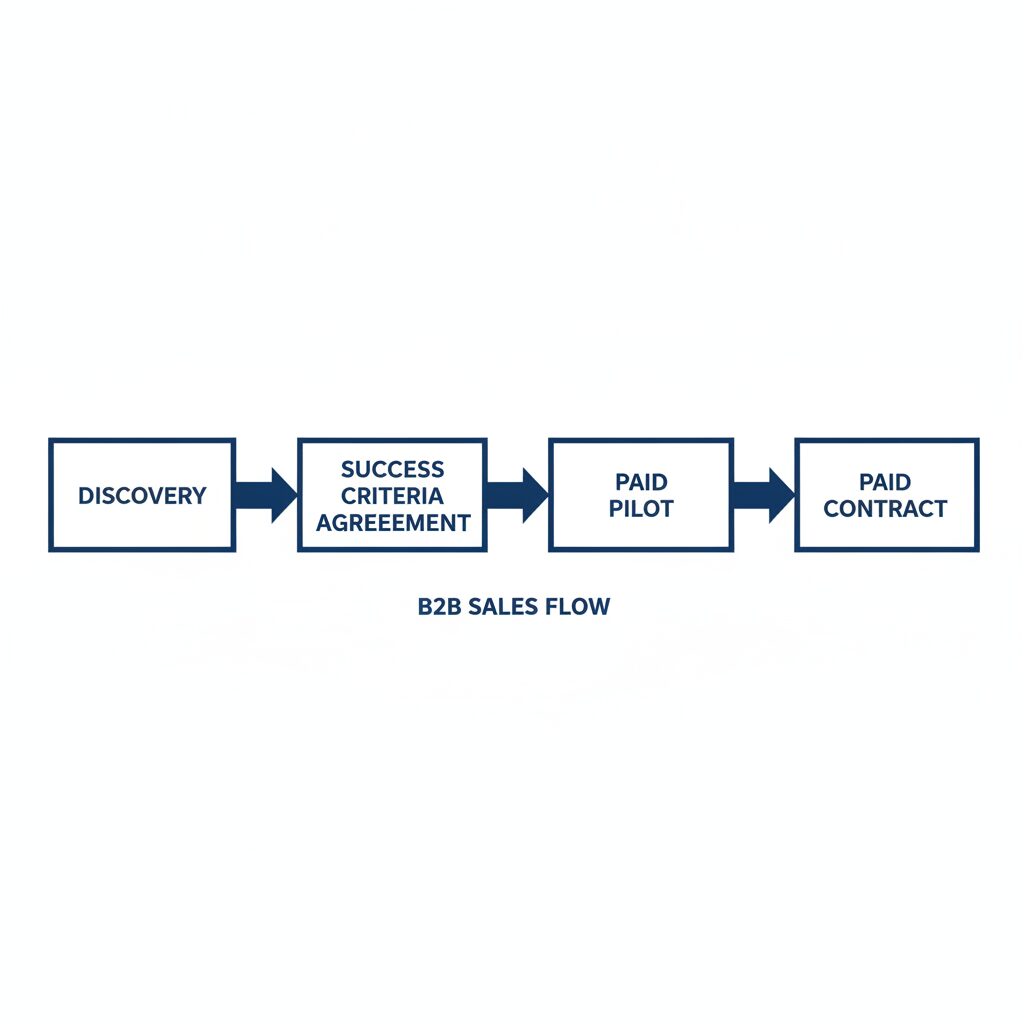
Your pipeline shouldn’t be a simple list of leads. It should be a pipeline architecture designed to scrub out friction. You need distinct stages: ‘Discovery,’ ‘Success Criteria Alignment,’ ‘Pilot Execution,’ and ‘Commercial Closing.’
If a deal jumps from Discovery straight to a Pilot without written success criteria, it’s a red flag. A disciplined process ensures no one enters a trial without a clear, written path to a paid contract. This is the essence of removing critical blockers in the buyer’s journey.
The ‘Bad Cop’: When to use a Fractional CSO
Many founders struggle here because they are too emotionally invested. They hate being the ‘bad cop’ who demands a paid pilot or disqualifies a big-name lead. This is where embedded leadership is a game-changer.
A Fractional CSO provides the objective distance needed to enforce a rigorous process. They implement the frameworks, handle the awkward objections, and ensure your pipeline is built on real deals rather than hopeful projections. They move you from founder-led chaos to a repeatable system.
From ‘One-Off Wins’ to a Repeatable Process
B2B success isn’t about winning one massive deal through charisma; it’s about the ability to win the same way every single time. When you rely on a documented process instead of a founder’s personality, you achieve true stability.
A repeatable process includes a standard PoC playbook, pre-approved metrics for different customer segments, and a strict disqualification checklist. With these in place, your revenue becomes predictable. You stop wondering if the pilot will close and start knowing exactly when the check will arrive.
Frequently Asked Questions
Should B2B pilots always be paid?
Ideally, yes. Even a small fee filters for high-intent buyers and ensures the client is actually committed to solving the problem.
How long is too long for a B2B Proof of Concept?
Anything beyond 30–45 days. Beyond that, you’re usually dealing with a lack of urgency or a broken internal decision-making process.
What are the red flags that a pilot will never convert?
The biggest red flags are a refusal to sign a Mutual Action Plan or the economic buyer skipping the alignment meetings.
How do you handle a client asking for a PoC extension?
Ask exactly which data point is missing. If the original success criteria were met, an extension is a sign of inertia, not a need for more testing. Stand your ground.
What is the difference between a pilot and a Proof of Value (PoV)?
A pilot tests if the product *works*; a Proof of Value proves the product creates a *specific, measurable financial gain*.
Stop letting your pipeline leak
Pilot purgatory is a symptom of a broken sales process, not a product failure. By enforcing strict success criteria and aligning with your ICP, you move from guesswork to predictable revenue. You cannot afford to treat high-value solutions like free samples.
Book a consultation with Sales Fundas to architect a scalable B2B sales engine and stop losing deals to inertia. Get a professional pipeline audit today with no upfront commitment.
Sales Fundas operates as an embedded leadership partner for ambitious B2B founders and CEOs, specializing in pipeline architecture and predictable revenue growth. By combining rigorous sales consulting frameworks with advanced digital advertising and performance marketing, we build sustainable, high-performing sales engines that complement and scale the founder's strategic vision.
- B2B Sales Consulting & Pipeline Architecture Frameworks
- Advanced Performance Marketing & Conversion Rate Optimization
- Search & Generative Engine Optimization (SEO/GEO) Specialists
- B2B Digital Advertising & Lead Generation Experts
This content was drafted using AI-assisted research and meticulously reviewed by the Sales Fundas consulting team to ensure strategic accuracy and alignment with our B2B sales frameworks.