

Stop relying on founder-led sales. Use CLV for revenue transformation to build a predictable B2B sales architecture and scale your SME revenue.
CLV for Revenue Transformation: Building a Predictable B2B Sales Engine
Most B2B founders in India are stuck in a cycle of high-stress hustle, treating revenue as a lucky byproduct of hard work rather than the result of a deliberate architecture. If your pipeline depends entirely on your personal network and your ability to “charm” a client, you don’t actually have a sales process. You have a founder’s trap. I’ve seen this play out dozens of times: SMEs hit a hard ceiling because the founder can’t be in every Zoom meeting, and they certainly can’t clone their intuition across a team of five or ten sales reps. It’s exhausting, and it’s not scalable.

True revenue transformation happens the moment you stop chasing every lead that breathes and start securing high-value accounts that fuel a repeatable engine. The primary lever for this shift is Customer Lifetime Value (CLV). Instead of treating CLV as a vanity metric tucked away in a board deck, the most successful firms use it as a filter. This allows them to decide which leads to ignore and exactly how much they can afford to spend to win the right ones, which means your marketing budget stops being a gamble and starts being an investment.
Why B2B sales architecture starts with CLV
Think of sales architecture as the blueprint for how your company finds, closes, and keeps customers. If that blueprint only focuses on “closing more deals,” the whole structure will eventually collapse under its own weight. Too many founders obsess over Customer Acquisition Cost (CAC) alone. They sweat over the cost per lead, but they ignore what that lead is actually worth over time. This is a dangerous mistake.
The problem with a CAC-only mindset is that it treats all revenue as equal. It isn’t. A ₹5,00,000 contract that churns after six months is a nightmare—it consumes resources and leaves you with a gap to fill. Contrast that with a ₹3,00,000 contract that grows into ₹20,00,000 over three years. If you only track the cost to get them in the door, you’ll likely overspend to acquire low-value, high-maintenance clients who drain your team’s energy and kill your margins.
When you define your Ideal Customer Profile (ICP) through the lens of lifetime value, the game changes. In our work at Sales Fundas, we see founders targeting companies based on generic traits like “Industry: IT” or “Size: 50-200 employees.” That’s too vague. Instead, target based on predicted CLV. When you analyze your top 20% of clients, you’ll find common traits that have nothing to do with company size and everything to do with how they use your service to make more money. This is how you handle defining your ICP in sales without wasting six months on dead-end leads.
Connecting CLV to your pipeline removes the “gambling” element of running a business. If you know the average CLV of a high-fit customer is ₹15,00,000, you can reverse-engineer your entire year. You no longer have to guess how many calls your team needs to make. You can calculate exactly how many qualified leads are required to hit a ₹5 Crore target, based on a realistic close rate and expected lifetime value. This is the difference between a “hope-based” strategy and a professional pipeline architecture.
Executing strategic sales to maximize account value
Most B2B sales teams are trained in transactional selling. They focus on the “close,” the signature, and the immediate win. That works for cheap software or commodity services, but it fails miserably in high-impact consulting or complex B2B SaaS. To actually increase CLV, you have to stop selling and start partnering.
A strategic partnership means identifying the customer’s business gap before you ever deliver a pitch. In the real world, this looks like a diagnostic approach. Instead of reading off a list of features, the sales lead identifies a specific revenue leak in the prospect’s business. When you sell the solution to a business-critical problem, you aren’t just another vendor on a spreadsheet. You become part of their operational infrastructure, which means your contract becomes “un-cuttable” and expansion revenue becomes a natural conversation rather than a forced upsell.
I call this “embedded leadership.” It’s a method where sales leadership isn’t just a manager staring at a CRM report, but a strategist who steps into high-stakes stages of the deal. When a leader helps architect the value proposition, the sales rep stops guessing. They stop using generic scripts and start using data-backed arguments. This precision can move win rates from a mediocre 15% to a dominant 25% or more, ensuring the customer is onboarded with a clear understanding of the value they are paying for.
However, the highest retention happens when delivery and sales are in total lockstep. We often see the “sales promise gap,” where a rep promises the moon to close the deal, but the delivery team can only provide a pebble. This kills CLV instantly. To fix this, your architecture must include a formal handover based on the diagnostic performed during the sale. When the delivery team knows exactly which business outcome the client expects, churn rates plummet. You can see how this directly affects your bottom line in our guide on the impact of churn on CLV.
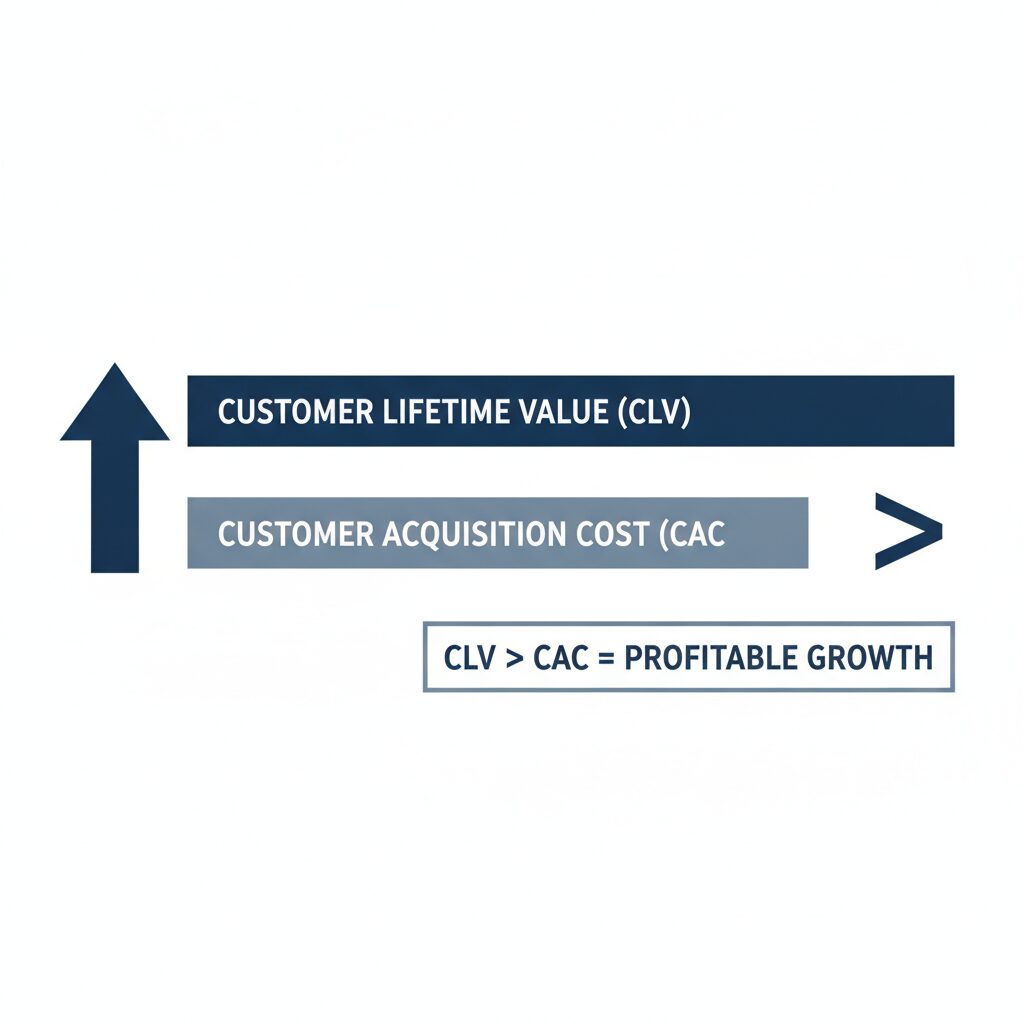
The math of revenue transformation: Calculating CLV for Indian SMEs
You can’t fix what you don’t measure. For B2B service businesses in India, CLV calculations have to account for long sales cycles and the reality of variable contract lengths. Forget the simplified formulas used by B2C apps; B2B is a different beast.
Here is a practical B2B CLV formula for the Indian market: (Average Monthly Revenue per Account × Gross Margin %) × Average Customer Lifespan in Months. For example, if a consulting client pays ₹1,00,000 per month, your margin is 70%, and the average relationship lasts 24 months, the CLV is ₹16,80,000. This is the actual profit value of the client, not just the top-line billing.
The real danger for most founders is the “leaky bucket”—adding new clients while losing old ones at the same rate. Expansion revenue—upselling a new module or increasing a retainer scope—is the fastest way to grow CLV without spending a single rupee on new acquisition. Industry benchmarks show that companies focusing on a 10% annual expansion rate often see a 30% increase in overall company valuation compared to those only chasing “new logos.”
Once you have this number, you can set your maximum allowable acquisition cost. A healthy LTV:CAC ratio for a scaling B2B SME is typically 3:1. If your CLV is ₹15,00,000, spending ₹5,00,000 to acquire that customer is a smart move. But if you’re spending ₹2,00,000 to acquire a customer with a CLV of only ₹4,00,000, you aren’t scaling—you’re burning cash. Mastering these B2B unit economics in India is what separates sustainable companies from those that crash after their first round of funding.
Scaling growth with Fractional CSO services in India
There is a fundamental tension in being a founder. You cannot build a scalable engine while you are the one driving the car at 100 mph. Most founders spend 80% of their time closing deals and only 20% building the process. That ratio is backwards. To achieve true revenue transformation, you need professional sales leadership that isn’t bogged down by the daily fires of operations.
This is where a Fractional CSO (Chief Sales Officer) comes in. A Fractional CSO provides the strategic architecture without the eye-watering cost of a full-time C-suite executive. They don’t just “manage” your team; they install the system. They build the lead scoring models, design the playbooks, and implement the CLV-based ICP. They transition the company from founder-led sales to a repeatable process where any qualified rep can produce a predictable result.
The impact on your pipeline is usually immediate. Instead of a list of “hopeful” leads, the CSO implements a rigorous qualification framework. In one case, we helped a B2B SaaS firm reduce its lead volume by 40%—which sounds bad until you realize they increased their closed-won revenue by 25% in the same period. They simply stopped talking to the wrong people. That is the power of replacing guesswork with architecture.
Stepping away from the closing call is often a psychological struggle for CEOs. It requires trusting a process more than your own gut. But the alternative is a business that can never grow beyond your own personal bandwidth. By using Fractional CSO services, you turn your company into an asset that works for you, rather than a high-paying job that owns you. You move from a world of unpredictable monthly spikes to a world of scalable, predictable revenue.
Frequently Asked Questions
How do you calculate CLV for a B2B service business in India?
Multiply your average monthly revenue per client by your gross margin percentage, then multiply that by the average number of months a client stays. This gives you the net profit value of the customer over the life of the relationship.
What is the difference between CLV and average contract value?
Average contract value is a snapshot of a single deal. CLV is the full movie—it includes renewals, upsells, and the ongoing cost of servicing that client over several years.
How does a Fractional CSO help in improving Customer Lifetime Value?
A Fractional CSO tightens the ICP to ensure you only sign high-value clients and builds account management systems that stop churn and identify expansion opportunities.
Why is CLV more important than monthly recurring revenue (MRR) for startups?
MRR tells you where you are today. CLV tells you if you’ll still be here tomorrow. High MRR with low CLV is just a sign of a churn problem that will eventually stall your growth.
How often should a B2B company review its CLV-based ICP?
Every quarter. Market needs shift and your own product evolves. Regular reviews reveal new traits of your most profitable clients that you might have missed.
Can a low CLV be fixed with better marketing?
No. Marketing gets people in the door, but CLV is a result of your product-market fit, pricing, and customer success. You fix CLV by delivering more actual value.
Does a high LTV:CAC ratio always mean a company is healthy?
Not always. If your CAC is tiny because you’re only taking “easy” low-growth deals, you might be leaving massive market opportunities on the table. Efficiency is great, but don’t let it kill your ambition.
What is the biggest mistake founders make with CLV?
Assuming that “long-term” equals “high-value.” Some customers stay for years but demand so much support and custom work that their actual net CLV is negative.
Revenue transformation happens when you stop guessing who your best customers are and start using data to build your pipeline. By anchoring your B2B sales architecture in CLV, you move from unpredictable growth to a scalable engine. If your revenue is still too dependent on your personal hustle, it’s time to install professional sales leadership. Book a consultation to build your predictable revenue engine today—no commitment required for the initial audit.