

Stop chasing low-margin leads. Learn how to align your Ideal Customer Profile (ICP) with profitability to build a scalable B2B sales engine in India.
The cost of a generic buyer persona
Most B2B founders define their Ideal Customer Profile (ICP) by who can use the product. This is a fatal mistake. The ability to use a tool does not equal the ability to generate profit. When you target based on utility rather than margin, you end up with a pipeline full of high-maintenance, low-yield clients—the kind who demand a 24/7 concierge service for a mid-market price. This doesn’t just create an unpredictable pipeline; it burns out your best A-players.

I see this constantly in Indian startups. A founder closes a ₹5,00,000 deal and celebrates the win. But three weeks later, they realize the account requires 40 hours of manual onboarding and a constant stream of “quick calls” to keep the client happy. The revenue is on the books, but the profit has evaporated. To build a B2B sales engine that actually scales, you have to stop chasing “users” and start chasing profitability-driven ICPs.
The difference between a buyer persona and ICP profitability
Here is the distinction: a buyer persona describes a person—their job title, their daily frustrations, and their professional goals. ICP profitability describes a financial relationship. It focuses on the specific segment that delivers the highest lifetime value (LTV) relative to what it costs you to acquire them (CAC) and keep them happy.
Why ‘ability to pay’ is a failing metric
Many CEOs target companies simply because they have a big budget. But budget is just a prerequisite, not a strategy. I’ve seen enterprises with the budget to pay ₹20,00,000, yet their procurement process takes nine months and requires ten different stakeholders to sign off. By the time the deal closes, your cost of sale has skyrocketed. You might show a high top-line number, but on a per-hour basis, you’re losing money.
Real profit lives at the intersection of high willingness to pay and low friction to close. When these align, you get predictable revenue, which means you can actually forecast your growth without praying that your operational budget doesn’t run dry.
The hidden costs of low-profitability clients
Low-margin clients are almost always the loudest. It’s a known pattern: the bottom 20% of your customer base usually swallows 80% of your support and account management time. It’s a leak in your boat that you’re ignoring while rowing harder.
When your team is bogged down by these “noisy” accounts, they can’t hunt for high-ticket B2B deals. This creates a massive opportunity cost that doesn’t show up on a P&L statement but kills your ability to scale. You are effectively paying your most talented people to babysit your least profitable customers.
Conducting a rigorous ICP analysis for margin growth
Stop guessing who your best customers are. You need a data-backed audit of your existing clients. Pull your CRM data and segment every account by their actual contribution to the bottom line—not just the contract value.
Calculating Customer Acquisition Cost (CAC) per segment
CAC is never uniform. It costs significantly more to land a Tier 1 enterprise than a mid-market SME. You need to calculate the CAC for each specific vertical to see where you’re wasting spend. For example, if acquiring a fintech client costs ₹50,000 in ad spend and sales hours, but a manufacturing client costs ₹1,50,000 for the same deal size, the fintech segment is the only one that makes sense to scale.
Use revenue intelligence tools to track every touchpoint from the first lead to the “closed-won” notification. This shows you exactly where your pipeline is leaking cash.
Lifetime Value (LTV) and the churn correlation
LTV isn’t just the first check they write. It’s about how long they stay and how much they expand. Based on current B2B SaaS benchmarks in India, an LTV:CAC ratio of 3:1 is the gold standard for health. If you’re dipping below 2:1, you’re essentially paying for the privilege of working for your clients.
Look closely at who churns first. Often, the customers who are the easiest to close (low friction) are the first to leave (low value). It’s a classic trap for founders who prioritize volume over value.
Measuring the ‘Founder Tax’ on specific account types
The “Founder Tax” is a silent killer. It happens when a deal can only be closed if the founder is in the room. If your sales team can’t close a specific segment without your direct intervention, that segment isn’t a growth opportunity—it’s a liability.
When you run this analysis, you’ll likely find that your most profitable segments are those where the value proposition is so clear that a trained rep can close it. If you’re still the only one who can sell to your “best” clients, you don’t have a sales engine. You just have a high-paying job.
Identifying high value customer segments in the Indian B2B market
The Indian market is unique. Decision-making is usually centralized and price sensitivity is high, but once you prove your value, the loyalty is incredibly strong.
Analyzing vertical-specific margins in India
Not all industries are created equal. Right now, verticals like AI-driven logistics and specialized healthcare B2B are showing higher margins because the pain is acute and the alternatives are few. On the flip side, general “digital transformation” services have become a commodity, and margins are crashing.
Direct your sales targeting India efforts toward verticals where the cost of the problem is 10x higher than the cost of your solution.
The sweet spot: Company size and decision speed
There is a “Goldilocks” zone for company size. Micro-SMEs often lack the budget and churn the moment they hit a bump. Massive conglomerates have the money, but their decision speed is glacial. For most B2B startups, the mid-market (companies with ₹50 crore to ₹500 crore turnover) is the sweet spot. They have the budget to pay your full price, but the agility to sign a contract in weeks, not years.
A ₹5,00,000 deal that closes in 30 days is almost always more profitable than a ₹10,00,000 deal that takes 180 days when you factor in the cost of your sales rep’s salary and sanity.
Identifying the ‘Power User’ segment that drives referrals
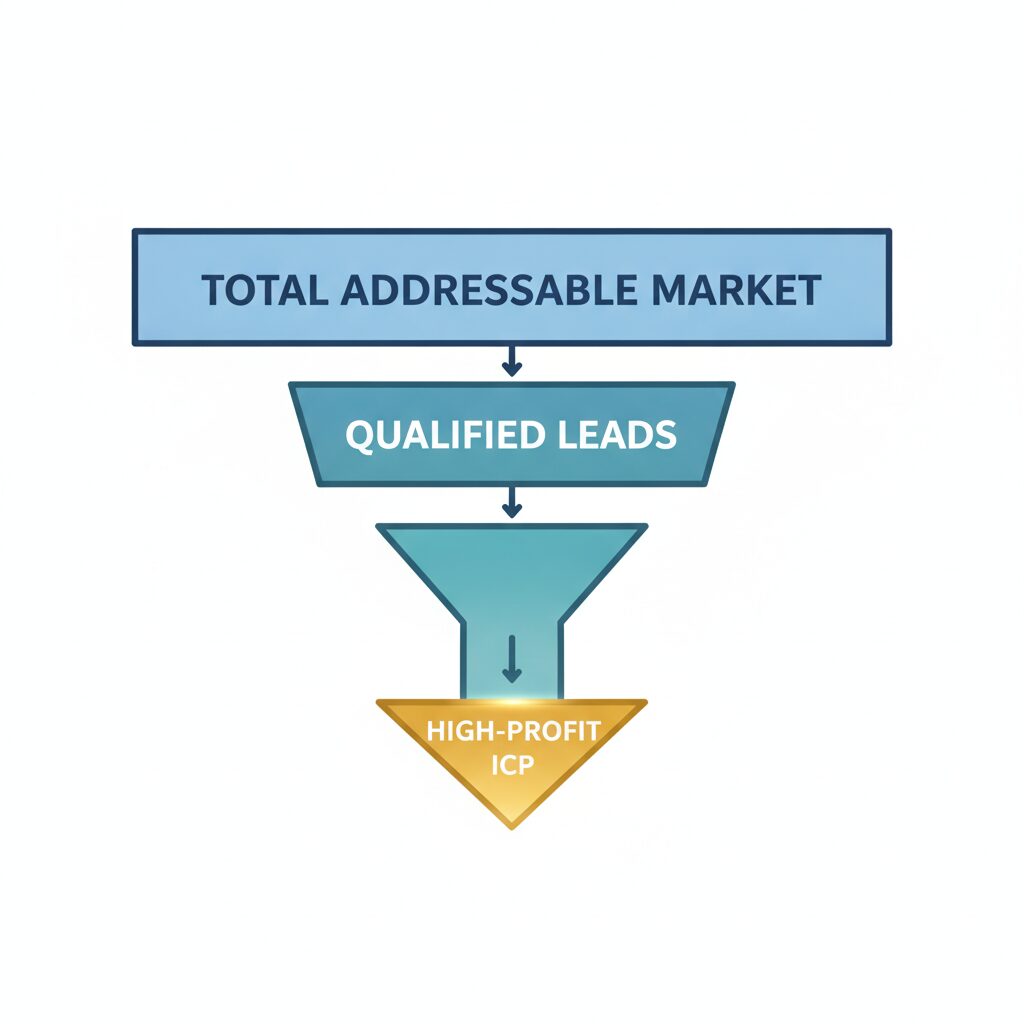
Some customers provide value that transcends their retainer. These are your “Power Users.” They give you the social proof and the warm introductions that drop your overall CAC. When you map the common traits of these clients—their industry, their internal structure, their growth stage—you’ve finally found your true ICP.
Strategies for sales targeting India to maximize ROI
Once you’ve locked in your profitable ICP, you have to align your entire go-to-market strategy to protect those margins. No exceptions.
From volume-based prospecting to value-based targeting
Stop measuring your team by the number of calls they make. That’s a vanity metric. Start measuring them by the quality of the accounts they target. Volume-based prospecting attracts “window shoppers” who waste your time. Value-based targeting focuses only on accounts that fit your profitability matrix.
This requires a fundamental shift in your pipeline architecture. Your top-of-funnel should act as a filter, not a vacuum.
Adjusting the pipeline architecture for high-ticket B2B deals
High-ticket deals need a different rhythm. You cannot rush a ₹50 lakh deal with a generic 4-call sequence. You need a strategic diagnosis. This means deep discovery and building a business case that makes the investment a “no-brainer” for the CFO.
If you don’t have this framework, bringing in a Fractional CSO can help you build it without the overhead of a full-time executive salary.
Qualifying for profitability during the first discovery call
The most valuable word in a sales rep’s vocabulary is “No.” If a lead doesn’t fit your profitable ICP, end the conversation early. Do not let a “maybe” clog up your pipeline.
Ask questions that expose the cost of inaction. If a client can’t quantify how much money they are losing every day without your solution, they are a high-risk, low-profit lead. They will haggle on price and demand excessive support.
Building a predictable revenue engine through ICP alignment
Alignment isn’t a one-time project. It’s a continuous feedback loop between sales, marketing, and finance.
Aligning marketing spend with high-profit segments
If your data shows that manufacturing firms in Maharashtra are your most profitable segment, stop wasting your ad budget on “B2B leads” across India. Narrow the focus. Use account-based marketing (ABM) to target the top 100 companies in that specific niche.
This eliminates waste and spikes your conversion rate because your messaging hits the exact pain points of that specific group.
Training sales teams to disqualify fast
A sales rep who closes every lead is often a liability to the company. You want a rep who can spot a bad fit within ten minutes. This saves you money and prevents your delivery team from inheriting a nightmare client.
Train your team on “Red Flags”—indicators that a lead will be low-margin. Look for a lack of clear goals, resistance to sharing data, or an obsession with the lowest price over the highest value.
The impact of embedded leadership on ICP execution
Sticking to a profitability-driven ICP requires discipline. When the quarter is ending and you’re short of your goal, it’s tempting to take any deal that comes your way. This is where embedded leadership is vital. A Fractional Sales Director provides the objective distance needed to say no to the wrong revenue so you can say yes to the right growth.
This shift moves your company away from founder-dependent revenue and toward a predictable revenue model.
Frequently Asked Questions
How do you calculate the profitability of a specific customer segment?
Take the total lifetime value (LTV) of the segment and subtract both the customer acquisition cost (CAC) and the ongoing cost to serve (onboarding, support, account management). The remaining number is your net profit per account type.
What is the difference between an ICP and a buyer persona?
Think of it this way: an ICP defines the ideal company that gets the most value from your product. A buyer persona defines the human beings inside that company who actually sign the check.
How often should a B2B startup update its Ideal Customer Profile?
Review your ICP every six months or immediately after a major product pivot. B2B market dynamics in India shift rapidly, and what was profitable last year might be a commodity today.
Why do high-revenue customers sometimes have low profitability?
Because “big” doesn’t always mean “profitable.” High-revenue clients often demand extreme customization, have payment cycles that stretch into months, or require constant hand-holding. These operational costs eat the margin alive.
How do I transition my sales team to target a new, more profitable ICP?
Update the qualification criteria in your CRM immediately. Give your team new scripts that emphasize value over features. Most importantly, change the incentives: reward them based on the profitability of the deal, not just the total contract value.
Stop guessing who your best customers are
Revenue is a vanity metric; profit is sanity. A profitability-focused ICP is the only way to break the cycle of founder-dependency and build a sales engine that actually scales. If your pipeline is a rollercoaster and your team is exhausted, you don’t have a lead problem—you have an ICP problem.
Stop leaking revenue on low-value leads. Book a consultation for a Fractional CSO to audit your ICP and architect a high-margin pipeline today. No guesswork, just real deals.
Sales Fundas operates as an embedded leadership partner for ambitious B2B founders and CEOs, specializing in pipeline architecture and predictable revenue growth. By combining rigorous sales consulting frameworks with advanced digital advertising and performance marketing, we build sustainable, high-performing sales engines that complement and scale the founder's strategic vision.
- B2B Sales Consulting & Pipeline Architecture Frameworks
- Advanced Performance Marketing & Conversion Rate Optimization
- Search & Generative Engine Optimization (SEO/GEO) Specialists
- B2B Digital Advertising & Lead Generation Experts
This content was drafted using AI-assisted research and meticulously reviewed by the Sales Fundas consulting team to ensure strategic accuracy and alignment with our B2B sales frameworks.