
It usually starts with a panic hire.

You look at your revenue goals. You look at your empty calendar. Then, you decide it’s time to bring in the “Big Gun.” The VP of Sales.
You scour LinkedIn. You find someone with a pedigree. Maybe they did a stint at Salesforce or Oracle. You offer equity. You pay a salary that makes your CFO weep. And you wait.
Six months later? You have a very expensive dashboard, a few new acronyms, and the same flat revenue line.
What went wrong?
You didn’t need a captain. You needed an architect. You hired someone to drive a Ferrari, but you handed them a box of parts and a wrench.
This is the single most expensive mistake B2B founders make. They confuse management with building. And in that confusion, they burn cash they can’t afford to lose. The solution often isn’t a full-time executive. It’s a strategic partner who builds the engine before you hire someone to race it.
Let’s break down the real difference between a Virtual Chief Sales Officer (vCSO) and a traditional VP of Sales.
The VP of Sales: The Captain of the Ship
Let’s be clear about one thing. A VP of Sales is a vital role. But timing is everything.
A VP of Sales is a manager of people and capacity. Their superpower? Taking a proven process and making it run faster, smoother, and louder. They are excellent at recruiting quota-carriers. They are great at pipeline reviews. They know how to motivate a team to hit the gong at the end of the quarter.
But here is the catch.
A VP of Sales expects things to exist. They expect:
- A defined Ideal Customer Profile (ICP).
- A sales playbook that actually converts.
- A CRM that isn’t a digital dumpster fire.
- Marketing collateral that supports the sales conversation.
If those things don’t exist, your high-priced VP spends their first year trying to build them. And guess what? Most VPs of Sales aren’t builders. They are scalers. Asking a scaler to build your infrastructure is like asking a pilot to build the runway while flying the plane.
The Typical VP Focus:
- Recruiting & Retention: Keeping seats filled.
- Pipeline Management: Forecasting revenue for the board.
- Deal Closing: Stepping in to push big deals over the line.
- Territory Planning: carving up the map.
Key Takeaway: Hire a VP of Sales when you have a predictable engine and you need someone to press the gas pedal.
The Virtual Chief Sales Officer: The Architect of Revenue
Now, look at the other side of the table.
A Virtual Chief Sales Officer (vCSO) operates differently. They are not there to manage the status quo. They are there to challenge it, dismantle it, and rebuild it better.
Think of the vCSO as the person who designs the car and builds the assembly line. They are senior strategists who have “been there, done that” multiple times. They don’t just want to know what your number is. They want to know how you plan to hit it mathematically.
At Sales Fundas, Jayant Kelkar, we often see founders stuck in “founder-led sales” purgatory. You are doing everything yourself. You know you need help, but you aren’t ready for a $250k headcount. This is where the Virtual Chief Sales Officer: The High-Growth Cheat Code for Founders comes into play.
The vCSO is a fractional executive. They step in to build the infrastructure so your future sales team can succeed. They are process-obsessed. They are data-driven. And they are temporary.
The vCSO Focus:
- Sales Process Design: Mapping the buyer journey step-by-step.
- Tech Stack Architecture: Ensuring your CRM talks to marketing automation.
- Playbook Creation: Writing the scripts, email templates, and objection handling guides.
- Hiring Strategy: Defining who you actually need to hire (Hunter vs. Farmer).
Key Takeaway: Hire a vCSO when you need to build the machine, fix a broken process, or transition out of founder-led sales.
The Core Difference: Building vs. Driving
Let’s simplify this. Because complexity kills execution.
If your sales department were a house:
- The vCSO is the Architect and the General Contractor. They draw the blueprints. They pour the foundation. They ensure the walls are load-bearing. They install the plumbing (CRM) and the electrical (Lead Gen).
- The VP of Sales is the Property Manager. They move the tenants in. They collect the rent. They make sure the lawn is mowed and the repairs are done on time.
If you hire the Property Manager before the house is built, you just have a very expensive person standing in an empty lot yelling at piles of lumber.
In our work auditing B2B sales processes, we find that process leaks usually happen because a company tried to scale (VP work) before they stabilized (vCSO work). You can’t multiply zero.
The Financial Reality Check (Let’s Do the Math)
We need to talk about money. It’s the elephant in the boardroom.
A full-time VP of Sales is expensive. In major tech hubs (and increasingly in remote global roles), a competent VP commands a base salary of $200k–$300k, plus commissions (OTE $400k+), plus equity, plus benefits. If you hire a recruiter to find them? Add another $50k-$80k finder’s fee.
Total First-Year Cost of a VP: $450,000+
And remember the risk. If they fail (and average tenure is < 18 months), you haven't just lost half a million dollars. You've lost a year of growth.
Now, compare that to a Virtual Chief Sales Officer.
A vCSO usually works on a retainer basis. You get C-level expertise for a fraction of the cost because you aren’t paying for 40 hours of “face time.” You are paying for high-impact strategy and execution. You pay for outputs, not attendance.
Total First-Year Cost of a vCSO: Typically 30-40% of a Full-Time VP.
For a bootstrapped or Series A startup, that difference is the runway. That capital can be redeployed into lead generation, product development, or actually hiring the sales reps the vCSO will train.
If you want a deeper dive into the numbers, check out our analysis on Fractional CSO vs. Full-Time VP: The Math.
When to Hire Which? A Cheat Sheet
Still on the fence? Let’s make it binary. Use this checklist to decide.
Hire a Virtual Chief Sales Officer IF:
- You are still in the “Founder-Led Sales” phase and need to detach.
- You have leads, but they aren’t closing (process issue).
- Your CRM is a mess or non-existent.
- You can’t afford a $400k OTE executive yet.
- You need to transition from founder intuition to scalable science.
Hire a VP of Sales IF:
- You have a repeatable sales process documented.
- You have a team of 5+ reps who are hitting quota, and you need to grow to 20.
- You need someone to manage daily behavior and motivation.
- Your revenue engine is predictable, and you need to pour fuel on the fire.
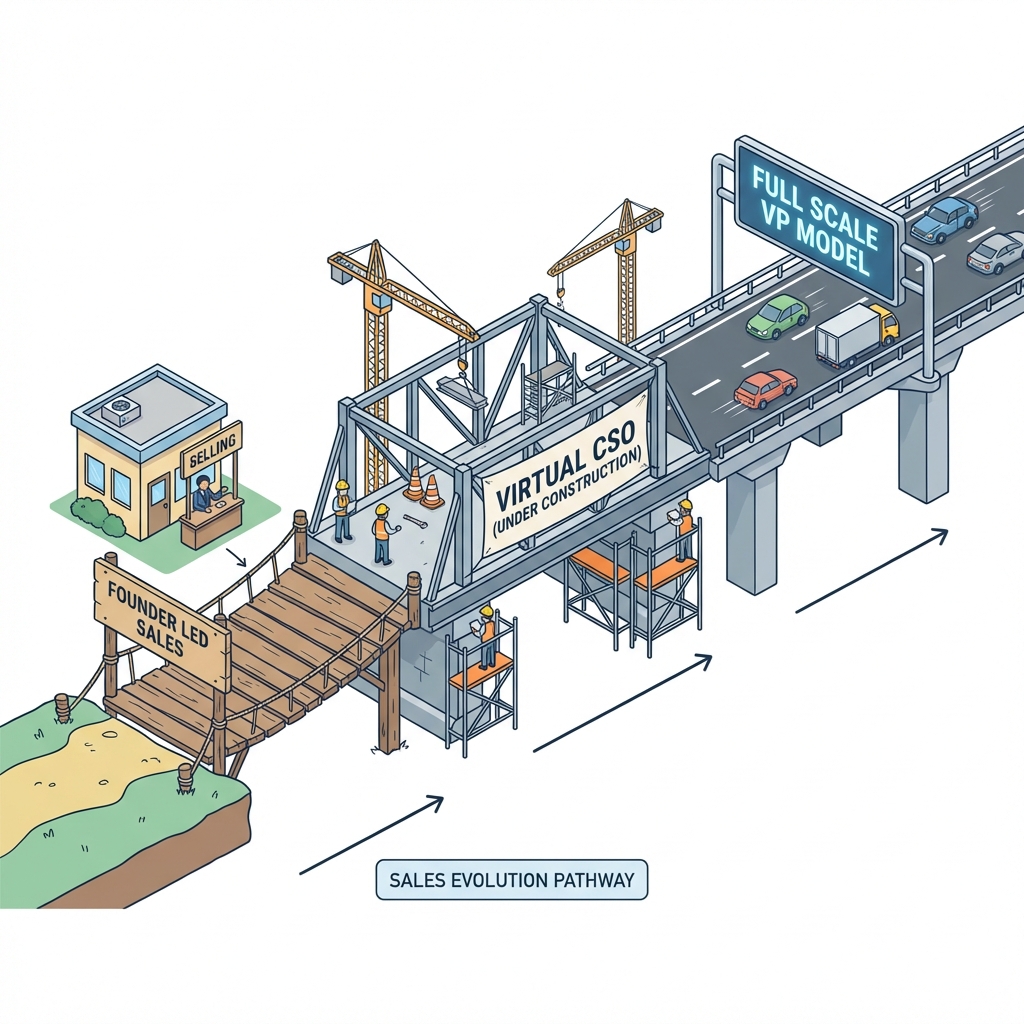
The “Hybrid” Strategy: The Handoff
Here is the secret most consultants won’t tell you.
It doesn’t have to be an “either/or” forever. It is usually a sequence.
The smartest founders we work with at Sales Fundas start with a vCSO. They bring us in to clean up the data, define the stages, and build the playbook. We help them hire their first 2-3 killer sales reps.
Once that engine is humming? Once the revenue supports the salary?
Then, the vCSO helps you hire the full-time VP of Sales. We hand them the keys to a Ferrari that is tuned up, gassed up, and ready to race. The new VP looks like a hero because they walk into a system that works. You look like a genius because you didn’t burn cash on a premature hire.
Why Sales Fundas Recommends the Process-First Approach
Sales is not magic. It’s engineering.
Too many companies treat sales like an art form that requires a “rainmaker” artist. At Sales Fundas, Jayant Kelkar, we believe sales is a science. It relies on physics (velocity), chemistry (team dynamics), and architecture (process).
A Virtual Chief Sales Officer is your structural engineer. They ensure the building won’t collapse when you add more floors.
If you are struggling to answer the question, “Why did we miss our target this quarter?” you don’t need a cheerleader. You need a diagnostic expert. You need someone who can look at the data and say, “Your conversion rate from Demo to Proposal dropped 15% because your value proposition isn’t landing.”
That is the level of insight a vCSO brings.
Frequently Asked Questions
What is the main difference between a fractional CSO and a consultant?
A consultant usually gives you a PDF of recommendations and leaves. A fractional CSO (vCSO) rolls up their sleeves, joins your leadership team, and executes the strategy they proposed. They own the outcome.
Can a vCSO manage my existing sales team?
Yes. They often serve as the interim manager. They run the weekly pipeline meetings and hold reps accountable while simultaneously rebuilding the underlying process.
How long should I keep a Virtual Chief Sales Officer?
Engagements typically last 6 to 12 months. The goal is to build the system and fire themselves by helping you hire a full-time replacement once you’ve outgrown the fractional model.
Is a vCSO effective for complex B2B sales?
Absolutely. Complex B2B sales require rigorous process adherence and stakeholder mapping. This is exactly where a vCSO shines, unlike transactional sales which are more volume-based.
How much time does a vCSO dedicate to my business?
It varies, but usually 1-2 days per week. Because they operate at a strategic level, they don’t need to be in the office 40 hours a week to have a transformative impact.
What if I already have a Sales Manager?
A Sales Manager is tactical; a vCSO is strategic. The vCSO mentors your Sales Manager, helping them grow into a VP role, while the vCSO handles the high-level architecture.
Does a vCSO help with hiring?
Yes. One of the primary roles of a vCSO is to design the candidate profile and vet talent to ensure you stop hiring “resume sellers” who can’t actually close.
Why shouldn’t I just promote my best sales rep?
The skills required to close deals are the opposite of the skills required to build processes and manage teams. Promoting a top rep often results in losing your best seller and gaining a mediocre manager.
Stop Guessing. Start Building.
You can keep burning cash on expensive hires and hoping one of them is the Messiah. Or, you can build a sales engine that generates revenue regardless of who is driving it.
If you are ready to stop the chaos and start the science, let’s talk. At Sales Fundas, Jayant Kelkar, we don’t just advise; we build. Let’s engineer your revenue growth together.