
We often make the mistake of thinking business is about numbers. It is not. At its core, business is about people. We spend hours refining our CRM data. We train our young colleagues to recite technical specifications until they are exhausted. We obsess over the logic of the deal.

Yet, I have observed a curious pattern. You likely have that one individual in your team who may not know the product as intimately as the engineers. They may not have the sharpest presentation slides. But they consistently bring in the most value. Why is this?
Because the buyer on the other side of the table—whether a founder or a C-suite executive—is human first. They do not buy from spec sheets. They buy from people they trust. People they like. People who make them feel understood.
The differentiator is rarely the product alone; it is the social qualities of a salesman. It is the character of the person representing the firm.
While technical competence permits you to enter the room, it is your social intelligence that allows you to remain there. In our work at Sales Fundas, Jayant Kelkar and I have seen brilliant deals collapse simply because the human connection was absent. Here, we examine the critical soft skills that distinguish a mere vendor from a trusted partner.
The Role of Social Intelligence in Modern Commerce
There was a time when a salesperson was a gatekeeper of information. That time has passed. Today, a buyer has likely completed their research before they even greet you. They do not need you for data. They need you for insight. They need you for assurance.
If you lack social polish, you risk appearing transactional. Robotic, even.
When you master these social qualities, you achieve something far greater than a signed contract:
- Trust Velocity: Trust is built faster. Decisions are made sooner.
- Navigating Complexity: You can read the room. You understand the unspoken dynamics within a buying committee.
- Value Preservation: Clients rarely haggle over price with partners they value. They pay for the relationship.
If your team struggles here, it is not a pricing problem. It is a process leak. See Why Is My Sales Team Failing? The 5 Hidden "Process Leaks".
Level 1: The Foundation of Connection
These are the non-negotiables. Without these fundamental social qualities, the door remains closed.
1. Active Listening (The Discipline of Silence)
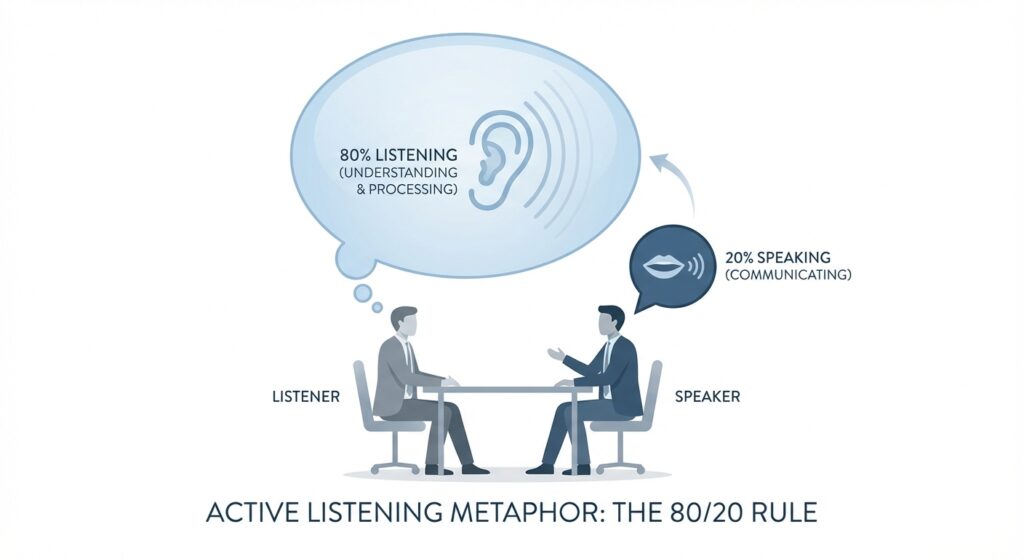
Most people do not listen to understand; they listen to reply. They are waiting for a gap in the noise so they may launch their pitch. This is a mistake. The most effective professionals follow a simple ratio: Listen 80% of the time, speak 20%.
Silence is a powerful tool. It allows the other person to think, to elaborate, to trust.
- The Approach: Do not just nod. Use "labeling" techniques. "It sounds like you are worried about the implementation timeline." This proves you were present in the moment.
2. Commercial Empathy
Empathy is often misunderstood as simply being kind. In our context, we need Commercial Empathy. It is the ability to understand the business pain behind the emotion. If a manager is anxious about a deadline, it is not just about the schedule. It is about their reputation. It is about how they appear to their own superiors.
- The Approach: Frame your solution as a shield for their reputation. Help them succeed internally.
3. Radical Integrity
Reputation is built over decades and lost in moments. In sales, integrity is your only true currency. If you do not know the answer, say, "I do not know, but I will find out." To bluff is to destroy credibility.
We advise startups on this often. See Scaling Beyond Founder-Led Sales requires transferring this integrity to your first hires.
- The Approach: Sometimes, advising a client not to buy a specific module because they are not ready creates more trust than a quick sale ever could.
Level 2: Navigating Friction and Negotiation
The easy conversations do not test character. The difficult ones do. This is where your social qualities are truly measured.
4. Emotional Resilience (Grace Under Pressure)
You will face rejection. It is inevitable. Deals you felt were certain will vanish. The average individual takes this personally. The professional views "No" as data, not defeat. You must have the strength to bounce back without bitterness.
- The Approach: Conduct a "post-mortem" without blame. Ask, "What is the one thing I could have done differently in the discovery phase?"
5. Adaptability (Respecting the Other)
You might speak to a creative visionary in the morning and a conservative accountant in the afternoon. If you use the same language for both, you will fail. Adaptability is not being fake; it is respecting the communication style of the person across from you.
- The Approach: Match their energy. If they speak slowly and thoughtfully, slow down. If they are brisk, be concise.
6. Patience in Conflict
Objections will arise. It is natural. An aggressive response is to fight the objection. A socially intelligent response is to explore it. Patience allows you to sit in the tension without panicking.
- The Approach: When a client pushes back, pause for three full seconds before responding. It demonstrates that you are thinking, not just reacting.
Are your processes causing friction? It might be time to review. Read How to Audit B2B Sales Process: The 30-Point Health Check.
Level 3: The "X-Factors" of Leadership
These are the subtle qualities that build what we call "Executive Presence."
7. Intellectual Curiosity
This is the genuine desire to know why. Instead of asking about budget immediately, a curious mind asks, "How does this project fit into your larger vision for the year?" Curiosity signals that you are a consultant, not a peddler.
8. Digital Sensitivity
In a world where we meet through screens, reading body language is difficult. It requires heightened sensitivity. Are they distracted? Did they lean back when you mentioned the price? Digital sensitivity involves picking up on these micro-signals and checking in: "I noticed silence on that last point—does that timeline concern you?"
9. Quiet Confidence
There is a fine line between arrogance and confidence. Arrogance shouts "I am the best." Confidence whispers "I can help you." Clients want to be led. They are looking for a guide. If you are timid, they will doubt the path.
10. Brevity
Time is the most valuable asset your prospect possesses. To ramble is a sign of disrespect. The ability to distill a complex value proposition into two clear sentences is perhaps the most profound social skill of all.
11. Gratitude and Decency
People buy from people they like. It sounds simple, but we forget it. A handwritten note. Remembering a detail about their life. These are not "tactics." They are acts of decency. They build the fabric of a long-term relationship.
Can These Qualities Be Taught?
A common myth is that you are either born with these social qualities of a salesman or you are not. I disagree.
At Sales Fundas, we believe social intelligence is a muscle. It must be exercised. It can be trained through role-play, observation, and structured coaching. Just as we learn to drive or to code, we can learn to listen.
If your team is technically proficient but socially clumsy, you are leaving value on the table. You might be winning the argument, but you are losing the relationship. And in business, the relationship is everything.
For those building teams, consider how you equip your people. Read about Sales Team Training: Stop Motivating, Start Equipping.
Frequently Asked Questions
What are the most important social qualities of a salesman?
Beyond basic communication, the most critical qualities are active listening, commercial empathy, and integrity. These three build the foundation of trust required for high-value B2B transactions.
Can introverts be good salespeople?
Absolutely. Introverts often excel at active listening and empathy, which are more valuable in complex sales than the "gift of the gab." Quiet confidence is often more persuasive than loud aggression.
How do I improve my sales social intelligence?
Start by auditing your conversations; aim to listen 80% of the time. Practice "labeling" emotions you see in others to validate their feelings and build connection.
Why is empathy important in sales?
Empathy allows you to understand the risk the buyer is taking. When you address their fears and internal pressures, you move from being a vendor to a trusted advisor.
What is the difference between hard skills and soft skills in sales?
Hard skills involve product knowledge, CRM usage, and pipeline management. Soft skills (social qualities) involve communication, emotional intelligence, and negotiation capability.
How does social intelligence affect sales performance?
High social intelligence shortens sales cycles because trust is established faster. It also leads to higher customer lifetime value as relationships are maintained over years, not just quarters.
Is integrity a sales skill?
Yes, it is the most vital one. Integrity creates predictability and safety for the buyer. Without it, no amount of charm or product data will close a high-stakes deal.
How do you assess social qualities in a sales interview?
Use role-play scenarios that include conflict or rejection. Observe if the candidate gets defensive or remains curious and empathetic under pressure.
Is Your Team "Socially" Ready to Sell?
Do not let a lack of soft skills sabotage your hard work. It is time to audit the human side of your sales process.
Jayant Kelkar and the Sales Fundas team specialize in blending the art and science of sales. We do not just teach scripts; we teach situational awareness, empathy, and the psychology of influence.
Explore our Sales Training Programs and elevate your team’s EQ today.