
Let’s rip the band-aid off right now.
If you think Artificial Intelligence is just a fancy spell-checker for your cold emails, you’re already behind. And if you think it’s coming for your job, you’re wrong. Probably.

Here is the bottom line.
AI isn’t replacing salespeople. It’s replacing the 70% of the job that salespeople hate.
We are talking about data entry. Research. Note-taking. The mind-numbing administrative drudgery that keeps your best closers from actually, well, closing. At Sales Fundas, Jayant Kelkar, we have watched this shift happen in real-time. It is messy. It is fast. But it is undeniable.
So, how is AI changing sales? It’s shifting us from a world of “I think” to a world of “I know.” It’s moving B2B selling from an art based on charisma to a science based on predictability. And it is doing it right now.
The Great Unburdening: Killing the Admin Beast
Ask any sales rep what they did today.
If they are honest, they’ll tell you they spent two hours researching prospects on LinkedIn, an hour fighting with the CRM, and maybe thirty minutes actually talking to a human being. It’s inefficient. It’s expensive. It’s a waste of talent.
This is the first and most immediate impact of how AI is changing sales.
Generative AI and automation tools are becoming the ultimate executive assistant. We aren’t just talking about writing a slightly better subject line. We are talking about autonomous agents.
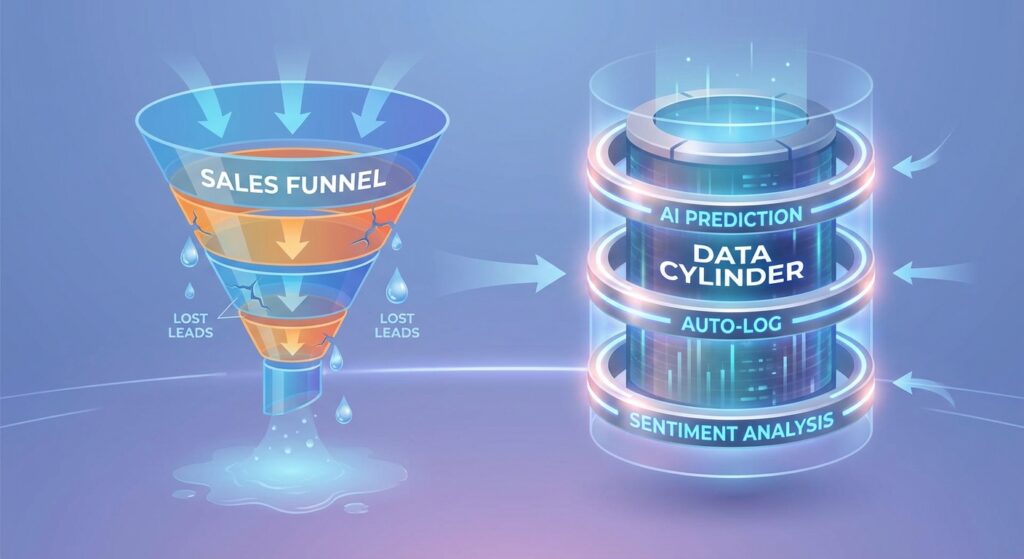
- Auto-Logging: AI listens to your calls (with permission), transcribes them, extracts the action items, updates the deal stage in your CRM, and schedules the follow-up task. No human fingers required.
- Meeting Prep: Instead of spending 20 minutes Googling a CEO before a call, an AI agent scrapes the web, reads their last three annual reports, analyzes their recent tweets, and hands you a one-page summary with three suggested conversation starters.
We’ve seen this with clients. When you remove the admin burden, you don’t just get happier salespeople. You get more revenue. Why? Because your team suddenly has double the time to sell.
But wait.
If your underlying process is broken, automating it just helps you fail faster. Before you buy the shiny tools, you need to fix the engine. Check out our guide on how to audit your B2B sales process to see if you’re even ready for this.
From “Spray and Pray” to Sniper Precision
Remember buying lists? You’d get a CSV file with 10,000 names, half of which were outdated, and you’d just hammer the phones.
That is dead.
AI has fundamentally altered prospecting by analyzing intent signals. It’s not about who could buy from you. It’s about who is trying to buy from you right now.
The Data Doesn’t Lie
Modern AI tools scrape the internet for “digital exhaust.” They look for companies hiring for specific roles, technologies being installed on websites, and specific content consumption patterns.
If a VP of Engineering at a manufacturing firm reads three articles about “reducing downtime” and visits your pricing page twice, that is not a cold lead. That is a hand-raiser. But a human can’t track that across thousands of prospects. AI can.
In our consulting work at Sales Fundas, we often see teams struggle to differentiate between a curious window-shopper and a serious buyer. This creates friction. By utilizing predictive scoring, AI tells you exactly who to call first.
Curious about the difference between a lead and a real opportunity? We broke it down here: The Difference Between MQL and SQL Explained.
The Death of the Generic Pitch
“Hi [Name], I hope this email finds you well.”
Delete.
We are all tired of bad outreach. And ironically, the first wave of AI made this worse. Lazy reps used ChatGPT to spam thousands of people with generic nonsense. But the smart ones? They are using AI to achieve hyper-personalization at scale.
This is how AI is changing sales outreach specifically:
- Contextual Relevance: AI tools can ingest a prospect’s LinkedIn profile and your case studies, then generate an email that bridges the gap specifically for that person.
- Video Prospecting: Synthetic video (Avatars) allows reps to send personalized video messages where they address the prospect by name, without recording 100 separate videos. (Use with caution—authenticity still rules).
- Dynamic Content: Sales decks that auto-adjust based on the industry of the person you are pitching.
But here is the catch. You still need a human to sanity-check it. An AI might hallucinate a connection that isn’t there. Trust, but verify. If you sound like a robot, you lose.
Forecasting: No More Sandbagging
Sales managers, listen up.
You know the Sunday night dread. You look at the pipeline. You ask your reps, “Is this deal coming in?” They say, “I feel good about it.”
“Feeling good” is not a strategy. It’s a hope. And hope is not a plan.
AI is stripping the emotion out of forecasting. By analyzing thousands of data points—email response times, the number of stakeholders involved, the sentiment of recorded calls, the frequency of meetings—AI can predict with frightening accuracy whether a deal will close.
It doesn’t care that your rep went to college with the buyer. It cares that the buyer hasn’t opened an email in three weeks and cancelled the last demo.
Key Takeaway: AI provides a “reality score” for your pipeline. It flags risks before they become losses.
This allows leaders to step in earlier. Instead of asking “what’s the number?” they can ask “how do we save this deal?” This shift requires strong leadership. Read more on that in Leadership Skills and Qualities: The Architecture of Trust.
The Conversation Coach in Your Pocket
Imagine having your best sales manager sitting next to every single rep on every single call, whispering advice in their ear.
Impossible? Not anymore.
Real-time AI conversation intelligence is a game-changer. These tools listen to live calls. If a competitor is mentioned, a battle card pops up on the rep’s screen with the perfect rebuttal. If the rep is talking too much (we all know that rep), a notification flashes: “Slow down. Ask a question.”
Why this matters:
- Faster Ramp Time: New hires don’t need 6 months to learn the script. They have guardrails from Day 1.
- Consistency: Your best pitch becomes everyone’s pitch.
- Objection Handling: No more freezing up when a prospect asks about pricing too early.
This is critical for technical industries. Whether you are in SaaS or heavy engineering, the details matter. For those in the industrial sector, check out our thoughts on Industrial Sales Training.
The Elephant in the Room: Will AI Replace You?
No.
But a salesperson using AI will replace a salesperson who doesn’t.
B2B sales is high-stakes. It involves risk. Buyers aren’t just buying a product; they are putting their reputation on the line. They need to trust the person across the table. AI cannot look a client in the eye (literally or metaphorically) and say, “I’ve got your back.”
AI cannot take a nervous client out to dinner. AI cannot read the subtle hesitation in a CEO’s voice that isn’t captured in the transcript. AI cannot empathize.
This is where the “Human-in-the-Loop” theory comes in. We need to double down on the things machines can’t do.
The Skills You Need Now
- Emotional Intelligence (EQ): Understanding the politics and emotions behind a purchase.
- Strategic Thinking: connecting your solution to their 5-year business goals, not just their immediate pain.
- Prompt Engineering: Yes, you need to learn how to talk to the machines to get the best data out.
We wrote about the softer side of selling recently. It’s more relevant than ever. See: Social Qualities of a Salesman: Building Trust Beyond the Pitch.
Implementing AI: A Warning Label
At Sales Fundas, Jayant Kelkar advises startups and established firms alike. We see a common mistake.
Companies buy a $50,000 AI tool suite, plug it in, and expect magic. Then they wonder why their data is garbage and their team is revolting.
Technology amplifies behavior.
If your sales process is chaotic, AI will just help you create chaos faster. You need a structured, scientific sales engine first. AI is the turbocharger, not the engine block.
If you are a startup founder trying to figure this out, stop looking for software and start looking at your workflow. Are you ready to scale? Read this: Scaling Beyond Founder-Led Sales.
The Future is Hybrid
So, how is AI changing sales in the next 12 months?
We are going to see the disappearance of “entry-level” sales roles as we know them. The SDR (Sales Development Rep) role isn’t dying, but it is evolving into a “Junior AE” role. Because AI does the appointment setting, the human needs to be ready to have a value-based conversation immediately.
We will see CRMs that you talk to, rather than type into. We will see “Digital Twins” of buyers that we can practice pitching to before the real meeting.
It sounds sci-fi. But it’s just efficiency.
The winners won’t be the ones with the best AI. The winners will be the ones who use AI to become more human. They will use the time saved to build deeper relationships, understand complex problems, and serve their clients better.
Key Takeaways
- AI is an Admin Killer: Use it to remove non-selling activities.
- Data over Gut: predictive forecasting beats optimism.
- Hyper-Personalization: Generic outreach is dead; AI enables scale with relevance.
- Don’t Automate Chaos: Fix your sales process before adding AI layers.
- Humanity is the Premium: As AI handles the logic, you must handle the emotion.
FAQ: Rapid Fire Answers
1. Will AI replace B2B sales reps?
Unlikely for complex sales. It will replace order-takers and admin-heavy roles, but high-ticket B2B deals still require human trust, negotiation, and empathy.
2. What is the best AI tool for sales?
There is no single “best” tool. Start with a robust CRM (like HubSpot or Salesforce) that has integrated AI features, then look at specialized tools for recording calls (like Gong) or outreach.
3. How can I use AI for prospecting?
Use AI to analyze intent data (who is searching for you), scrape LinkedIn for specific triggers (hiring, funding), and draft personalized opening lines based on that data.
4. Is AI in sales expensive?
It can be, but many tools have free tiers. The real cost is the time spent implementing it incorrectly. Start small with free CRM extensions before buying enterprise software.
5. How does AI improve sales forecasting?
AI analyzes historical data and real-time activity (emails, meetings) to assign a probability score to each deal, removing human bias and optimism from the equation.
6. Can AI negotiate contracts?
Not yet, and you probably shouldn’t let it. AI can analyze contracts for risks or suggest clauses, but the final negotiation requires human judgment.
7. What skills do I need for the AI sales era?
Data literacy, prompt engineering, and heightened emotional intelligence. You need to be able to interpret what the AI tells you and apply it to a human relationship.
8. How do I start implementing AI in my sales team?
Audit your current process to find the biggest time-wasters. Is it data entry? Email writing? Fix the biggest leak first with a specific tool, then expand.
Is your sales process ready for the AI revolution, or are you just speeding up a mess?
At Sales Fundas, Jayant Kelkar helps organizations build the scientific, scalable sales architecture needed to thrive in this new era. Don’t guess. Contact us today to re-engineer your revenue engine.