
Today, I want to talk about something nobody really talks about in sales strategy.

Time.
Not targets. Not dashboards. Not CRM features.
Time.
Real, limited, non-refundable time.
Most advice you read assumes you have space to experiment. It assumes you have the luxury to redesign your funnel, test three different automation tools, or rebuild your reporting structure from scratch. The gurus tell you to optimise endlessly.
But if you are running a growing business, that is not your reality.
You are handling clients. You are chasing collections. You are solving internal HR issues. You are hiring. You are likely still closing deals yourself. Sales operations is not your only job. It is one of many.
And when that is your reality, complexity is not an asset. It is a liability.
Here is the mistake I see founders and sales leaders make, time and time again.
They think, "Once things settle down, I will build a proper sales system." Or they think, "We need a Salesforce-level enterprise setup to look professional."
But things never really settle down. In fact, the more you grow, the less time you have. And that massive, perfect system? It usually collapses under its own weight within three months.
I learned this the hard way. I used to think systems were a luxury. Something you build when you have time.
The truth is the opposite.
You build systems because you do not have time.
When you only have an hour to review the pipeline on a Friday afternoon, you do not want to experiment. You want clarity. You want to open one dashboard. See the numbers. Spot the gaps. Decide the next action.
That is it.
Why simple beats perfect in sales operations is not just a catchy headline; it is a survival strategy for scaling companies.
The High Cost of "Perfect"
Perfectionism in sales ops is a trap. It wears a disguise. It looks like high standards, but it is actually procrastination dressed up in a tuxedo.
When you try to build the "perfect" sales process, you inevitably introduce friction. You create a stage definitions document that is ten pages long. You add twelve required fields to the CRM because "we might need that data later." You set up automation rules that are so specific they break if a rep sneezes.
Here is what happens next.
1. Data Decay
If a sales rep has to click seven times to log a call, they won’t log the call. Period. They will do it in their head. And data that exists only in your sales rep’s head is data you cannot scale. Simple systems get used. Perfect systems get ignored.
2. Decision Fatigue
Complexity drains you. If every pipeline review requires you to interpret conflicting data points or explain to the team what "Stage 3" means again, you are wasting mental energy. That energy should go toward closing deals or coaching your team.
3. The "shadow" Process
When the official process is too hard, your team creates a shadow process. They keep their own spreadsheets. They use sticky notes. Now you have two companies: the one inside your CRM, and the one actually making money. This disconnect is dangerous.
In our work at Sales Fundas, Jayant kelkar, we often walk into companies where the CRM is a ghost town. The sales team is failing not because they can’t sell, but because the operations are fighting them.
Reliability Over Features
I always recommend systems that are simple. Not fancy. Not overloaded with tools. Just reliable.
Reliability is the currency of sales operations.
Think about your car. Do you want a car with fifty buttons on the dashboard that works 80% of the time? or do you want a car that starts every single morning, no matter how cold it is?
Your sales operation is your vehicle. It needs to start every morning.
If your funnel stages are unclear, you waste time. If definitions keep changing, you waste time. If every review meeting feels different, you waste energy. Small confusion. Every week. Compounds.
This is why so many sales initiatives slow down halfway. Not because the team is weak. Not because the founder lacks intent. But because the process itself is heavy.
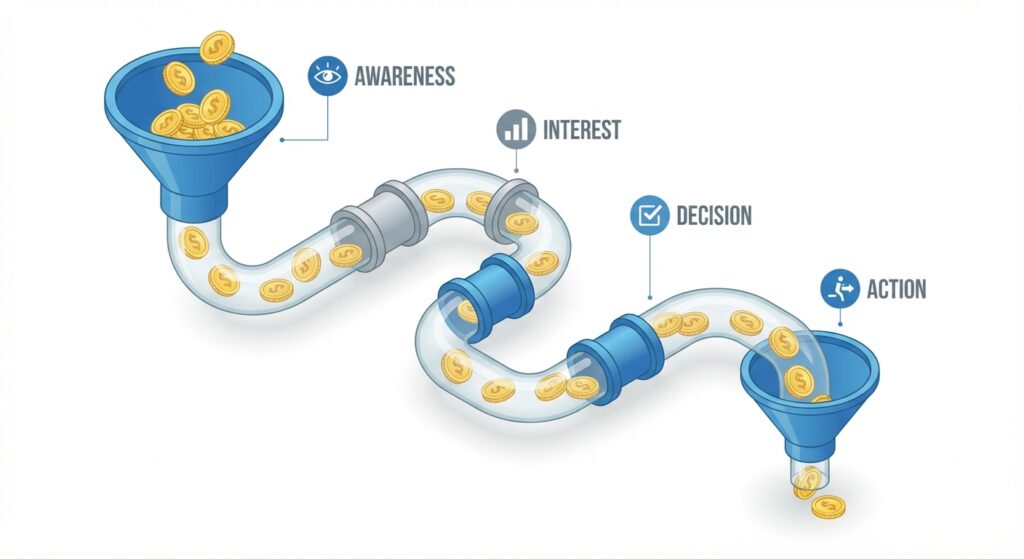
A simple sales operations framework changes everything. It protects your time. It protects your focus. It reduces decision fatigue. It creates rhythm.
And rhythm creates momentum.
The "Good Enough" Audit
So, how do you strip it back? How do you embrace the idea that simple beats perfect without losing control?
You need to perform a "Good Enough" audit. Look at your current setup (or the lack of one) and ask these three questions:
1. Can a new hire understand this in 20 minutes?
If you need a three-hour workshop to explain your pipeline stages, your stages are wrong. B2B sales is complex, but the flow shouldn’t be. Setting up a sales CRM should follow the logic of a conversation, not a computer program.
- Prospect: We found them.
- Engaged: We are talking to them.
- Proposal: We gave them a price.
- Won/Lost: It is over.
Start there. You can add nuance later.
2. Does this report change my behavior?
I see dashboards with twenty widgets. "Calls per hour," "Email open rates by region," "Average sentiment analysis."
Ask yourself: If this number goes down, do I know exactly what to do? If the answer is no, delete the widget. You only need metrics that drive action. Usually, for a growing team, that is just Pipeline Velocity, Win Rate, and Activity Volume.
3. Is the friction worth the insight?
Every required field is a tax on your sales team’s time. Is knowing the "Secondary Industry Sub-Category" worth the frustration it causes your top closer? Probably not. If you aren’t going to use the data for a marketing campaign next week, don’t ask for it.
The Momentum of Rhythm
Here is the secret weapon of simple operations: Rhythm.
When the system is simple, you can establish a cadence. Weekly pipeline reviews. Monthly forecasting. Quarterly business reviews.
When the system is complex, these meetings turn into arguments about data accuracy. "Why isn’t this updated?" "Oh, I didn’t know I had to click that button."
But when the system is simple, the data is trusted. And when the data is trusted, the meeting shifts from "fixing the CRM" to "fixing the strategy."
This is particularly vital if you are transitioning from founder-led sales to a sales team. The founder can operate on gut feel. A team needs a scoreboard. But if the scoreboard is broken, the game stops.
Start Small, Stay Consistent
If this sounds like your situation, then you do not need a more complex system. You need a simpler one.
You do not need AI to predict your revenue yet. You need a spreadsheet that is updated every Friday without fail. You do not need a 50-step sequence. You need a team that follows up on every lead within 24 hours.
That is the essence of why simple beats perfect in sales operations.
It is about building a machine that works even when you are tired. Even when you are busy. Even when the market is chaotic.
Don’t build for the perfect world. Build for the real one.
Frequently Asked Questions
1. Why is a simple sales process better than a detailed one?
A simple process reduces friction, ensuring your sales team actually uses it. Detailed processes often lead to "process fatigue," resulting in poor data entry and a lack of adoption.
2. How do I know if my sales operations are too complex?
If onboarding a new sales rep takes weeks instead of days, or if you spend more time fixing CRM data than coaching your team, your system is too complex.
3. Can a simple system handle enterprise B2B sales?
Yes. Even complex deals follow a linear progression. You can manage intricate deal structures with simple operational milestones; complexity belongs in the strategy, not the admin work.
4. What is the minimum viable CRM setup?
You need four clear pipeline stages, contact information, and a record of the last interaction. Everything else is secondary until you master the basics.
5. How does simplicity help with sales forecasting?
Simple stages have clear definitions, meaning everyone categorises deals the same way. This consistency makes forecasting accurate, whereas complex systems often hide bad data.
6. Should I use automation in a simple sales setup?
Only automate what is already working manually. Automating a bad process just creates chaos faster; establish the rhythm first, then use tools to speed it up.
7. How often should I review my sales operations?
Audit your process quarterly. Ask your team where the friction is, and look for steps you can remove rather than steps you can add.
8. Does simple mean manual?
No. Simple means "low friction." A simple system can be highly automated, but the logic behind it should be transparent and easy for humans to understand.
Ready to strip away the chaos?
If your sales process feels like a burden rather than a boost, it’s time to rethink your approach. At Sales Fundas, Jayant kelkar, we specialise in building lean, effective sales engines that grow with you. Let’s simplify your path to revenue.