The statistic is staggering: 87% of sales training information is forgotten within 30 days.
Imagine investing thousands of dollars and hundreds of hours into a corporate sales training initiative, only to have your team return to their desks and revert to their old habits by next month. It’s the corporate equivalent of a sugar rush—a temporary spike in energy and motivation, followed by an inevitable crash.
For business leaders, HR heads, and technical founders, this is more than just frustrating; it is a massive leak in revenue.
The problem isn’t usually the content of the training. The problem is the context. Most organizations treat sales training as an event—a two-day workshop at a nice hotel—rather than a system. They try to fix “people problems” (laziness, lack of closing skills) without realizing they actually have “process problems.”
If you are looking to build a sales organization that doesn’t just rely on the charisma of a few star performers but runs like a predictable, high-performance engine, you need a different approach. You need to stop looking at sales as an art and start treating it as a science.
This guide will walk you through exactly how to design corporate sales training that sticks, scales, and drives measurable revenue growth.

1. The “Engineering Mindset” in Sales Training
In the world of Business Consulting and Services, particularly for companies led by technical founders or engineers, there is often a disconnect. The product is built on logic, data, and precision. The sales team, however, is often managed on “gut feeling” and “hustle.”
Jayant Kelkar, founder of Sales Fundas, argues that this disconnect is fatal. To succeed, you must apply an engineering mindset to your sales operations.
Why “Generic” Training Fails
Most off-the-shelf training programs focus on tactics: “How to handle objections” or “How to close the deal.” While useful, these are merely features of a larger system. If you teach a rep how to close, but your lead generation process brings them unqualified prospects, the training will fail.
Effective corporate sales training must cover three dimensions:
- The Mechanics (Process): CRM hygiene, pipeline stages, and lead qualification frameworks.
- The Message (Product): value propositions, competitive differentiation, and use cases.
- The Mindset (Psychology): Empathy, resilience, and active listening.
Key Takeaway: Don’t train your team to just “sell better.” Train them to follow a system that makes selling easier.
2. Diagnosing the Gap: Do You Need Training or a New Process?
Before you book a venue for your next training session, you must perform a “root cause analysis” of your sales struggles. A training program cannot fix a broken product-market fit or a flawed compensation model.
Use this checklist to identify where your actual gap lies:
- The “Knowledge Gap”: Do reps know what they are selling? (Solution: Product Bootcamp)
- The “Skill Gap”: Do they know how to sell it? (Solution: Methodology Training)
- The “Will Gap”: Are they motivated to sell it? (Solution: Incentives & Culture)
- The “Process Gap”: Are there roadblocks preventing them from selling? (Solution: Sales Ops Consulting)
Sales Fundas specializes in identifying these invisible cracks in the foundation. Often, what looks like a “lazy sales team” is actually a team exhausted by an inefficient, undefined sales process.
3. Structuring a World-Class Corporate Sales Training Curriculum
A high-performing training curriculum isn’t a laundry list of videos; it’s a structured journey. Whether you are onboarding new hires or upskilling veterans, your curriculum should follow a logical hierarchy.
Phase 1: The Fundamentals (The “Nuts and Bolts”)
This is where you standardize the language. Everyone must agree on what a “lead” is versus an “opportunity.”
- Company Vision: Why do we exist?
- Ideal Customer Profile (ICP): Who are we not selling to?
- The Sales Stack: Mastery of the CRM and sales enablement tools.
Phase 2: The Methodology (The “Science”)
This phase replaces improvisation with choreography.
- Discovery Frameworks: moving from “What keeps you up at night?” to data-driven diagnostic questions.
- Pipeline Management: How to forecast accurately, not optimistically.
- The Science of Follow-up: Using cadences and multi-channel touchpoints.
Phase 3: The Advanced Psychology (The “Art”)
Once the science is mastered, the art can flourish.
- Negotiation Dynamics: moving from price to value.
- Storytelling: How to use case studies to paint a “before and after” picture for the client.
- Emotional Intelligence (EQ): Reading the room and mirroring the prospect’s tone.
4. The “Forgetting Curve” and How to Beat It
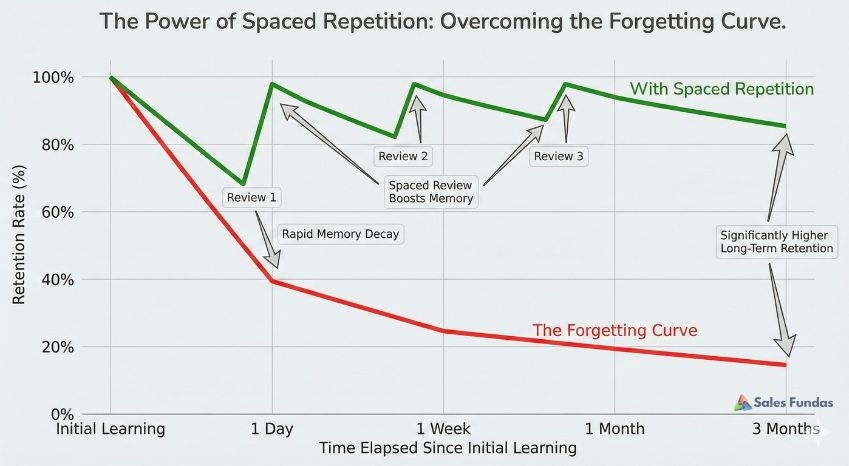
As mentioned earlier, retention is the enemy. To combat the Forgetting Curve, you must move from “Event-Based Training” to “Continuous Enablement.”
Micro-Learning and Spaced Repetition
Instead of an 8-hour marathon session, break content into 15-minute “pills” delivered weekly.
- Monday: 10-minute video on a new competitor feature.
- Wednesday: 5-minute role-play exercise with a peer.
- Friday: Quiz on the week’s learning.
The Role of the Manager as a Coach
Your sales managers are the linchpins. If they don’t reinforce the training, it dies. Sales Fundas emphasizes “Train the Trainer” models where managers are equipped to coach their teams in real-time, using live call reviews rather than hypothetical scenarios.
5. Measuring ROI: Data Over Opinions
How do you know if your corporate sales training was successful? “Everyone liked the speaker” is not a metric.
You must measure Leading Indicators and Lagging Indicators.
| Metric Type | What to Measure | Why it Matters |
| Leading Indicators | Adherence to process, CRM completeness, call volume, discovery meetings booked. | Tells you if the behavior has changed. |
| Lagging Indicators | Win rates, average deal size, sales cycle length, revenue per rep. | Tells you if the business has improved. |
Jayant Kelkar advises focusing heavily on Sales Velocity—a composite metric that tracks how quickly deals move through your pipeline. If training is effective, velocity should increase because reps are qualifying out bad deals faster and closing good deals sooner.
6. Integrating Technology and Tools
Modern training cannot exist without a tech stack. However, tools should serve the process, not dictate it.
- Call Recording Software: Essential for “Game Tape” reviews.
- Learning Management Systems (LMS): For hosting your “evergreen” content.
- CRM Playbooks: Embedding the training prompts directly into the CRM interface so reps are guided in the flow of work.
Our guide to setting up a Sales CRM for the first time
Conclusion: Stop Training, Start transforming
Corporate sales training is not a checkbox item for HR compliance. It is the fuel for your revenue engine. By shifting your focus from temporary motivation to permanent process improvement, you build an asset that pays dividends for years.
The most successful companies don’t just hire star salespeople; they build a system that creates them.
Is your sales team performing at its peak potential?
Don’t let process gaps and lack of training stall your growth. Sales Fundas helps businesses simplify the complex world of sales, turning technical founders and sales leaders into revenue architects.
Ready to build a scientific sales operation? Book a Discovery Call with Jayant Kelkar today and let’s diagnose your sales engine.
Frequently Asked Questions (FAQs)
1. How long does a typical corporate sales training program last?
Effective training is continuous, but initial intensive programs typically range from 2 days (workshop style) to 8 weeks (bootcamp style). For long-term results, we recommend a 3-6 month engagement that includes coaching and reinforcement.
2. How do we measure the success of sales training?
Success should be measured by behavioral changes (CRM adoption, better qualification) and business outcomes (increased win rates, shorter sales cycles, and higher revenue per rep).
3. Can sales training help technical founders who hate selling?
Absolutely. In fact, technical founders often make the best salespeople once they realize that sales is just a process of problem-solving and logic, much like engineering. This is a core specialty of Sales Fundas.
4. Is online training as effective as in-person workshops?
Online training is excellent for knowledge transfer (product facts, theory), while in-person or live virtual workshops are superior for skill building (role-playing, negotiation practice). A “blended” approach usually yields the best ROI.
5. What is the difference between sales training and sales enablement?
Sales training focuses on the skills of the seller (e.g., how to negotiate). Sales enablement focuses on the resources the seller needs (e.g., brochures, case studies, CRM tools). You need both to succeed.
6. How much should we budget for sales training?
Industry standards suggest budgeting $2,000–$5,000 per rep annually. However, the cost of not training (lost deals and turnover) is exponentially higher.
7. Why do sales reps forget training so quickly?
This is due to the “Forgetting Curve.” Without reinforcement, 87% of knowledge is lost in 30 days. To fix this, you must implement spaced repetition, ongoing coaching, and “just-in-time” learning tools.
8. Should we build training in-house or hire a consultant?
In-house training is good for product knowledge. However, external consultants bring fresh perspectives, industry benchmarks, and specialized methodologies that internal teams often lack.
9. What are soft skills in sales?
Soft skills include active listening, empathy, emotional intelligence, and communication. These are critical for building trust, which is the foundation of all B2B sales.
10. How do I customize training for my specific industry?
Start by analyzing your specific customer journey and common objections. A generic “sales generic” course won’t work. Partner with a trainer like Sales Fundas who customizes the curriculum to your niche (e.g., SaaS, Manufacturing, Services).