
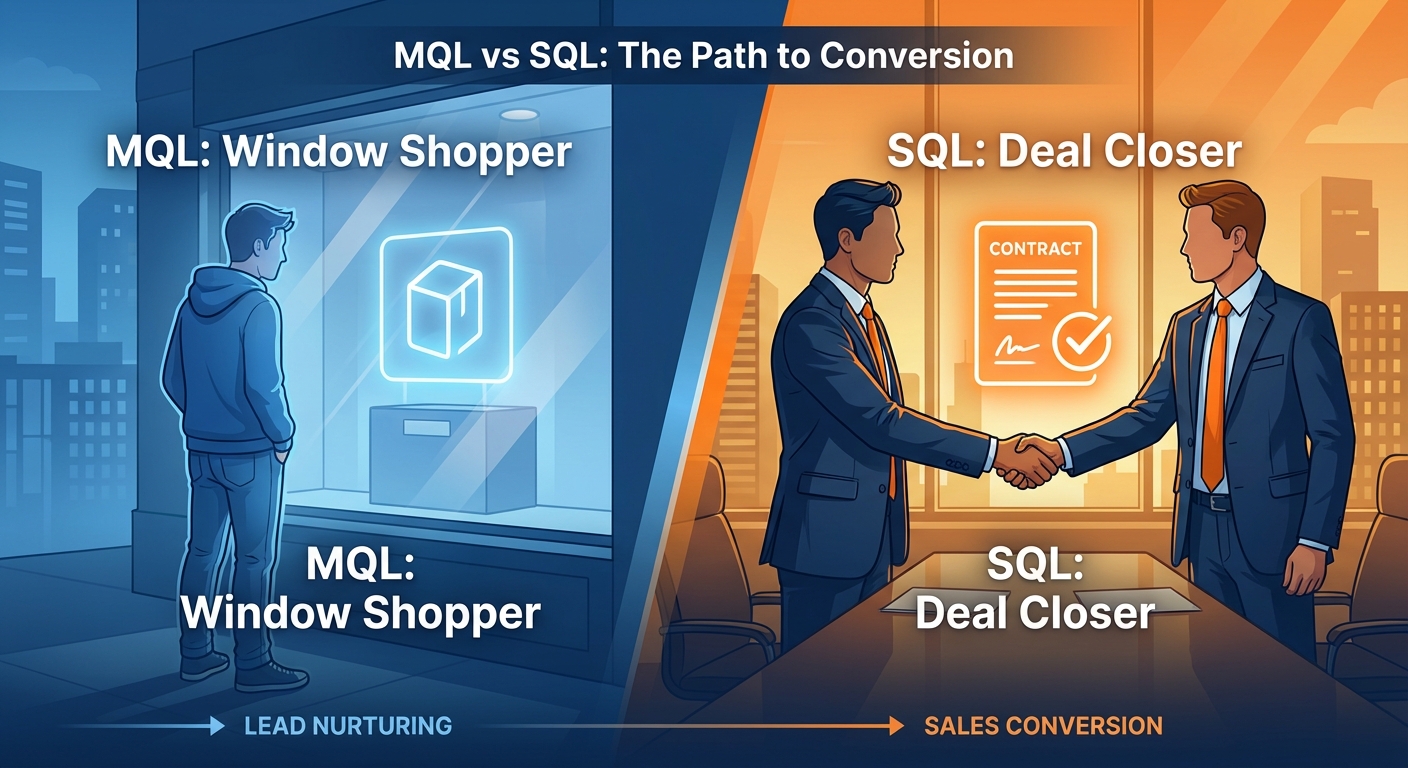
Here is the bottom line up front: An MQL (Marketing Qualified Lead) is a hand-raiser. They are curious. They downloaded a PDF or sat through a webinar. An SQL (Sales Qualified Lead) is a wallet-opener. They have a specific pain, a budget, and they want to talk to a human right now.

The difference isn’t just semantics. It is the difference between “I am just looking” and “Do you have this in my size?”
Get this wrong, and your sales team wastes hours chasing ghosts while your marketing team celebrates vanity metrics.
We see it constantly at Sales Fundas, Jayant Kelkar. The marketing team high-fives over a record month of lead generation. Meanwhile, the sales floor is dead quiet. Why? Because the “leads” are actually just college students researching a thesis. Or competitors spying on your pricing. Or, worse, they are real buyers who got handed off too early and got scared away by an aggressive pitch.
You don’t need another dictionary definition. You need a peace treaty between your departments. Let’s fix your funnel.
The Great Divide: Why Everyone Hates Each Other
Process leaks happen in the gap. That specific messy middle ground between a marketing automation trigger and a sales rep picking up the phone.
Marketing usually says: “We sent you 500 leads this month! Why aren’t you closing them?”
Sales replies: “Because they are junk! Half of them have fake phone numbers and the other half thought we were a free charity service.”
This friction destroys revenue. It happens because nobody agreed on what “Qualified” actually means. Without a clear definition, you are relying on vibes. And vibes do not scale. If you feel like your team is slipping, you might want to check our guide on Why Is My Sales Team Failing? because the issue is often structural, not personal.
The MQL: The Hand-Raiser
An MQL is a lead that marketing has deemed worthy of passing along. But worthy based on what? Usually, engagement.
They have interacted with your brand. They know you exist. But they might not be ready to buy. Think of them as window shoppers. They walked into the store. They are touching the merchandise. But they haven’t made eye contact with the clerk yet.
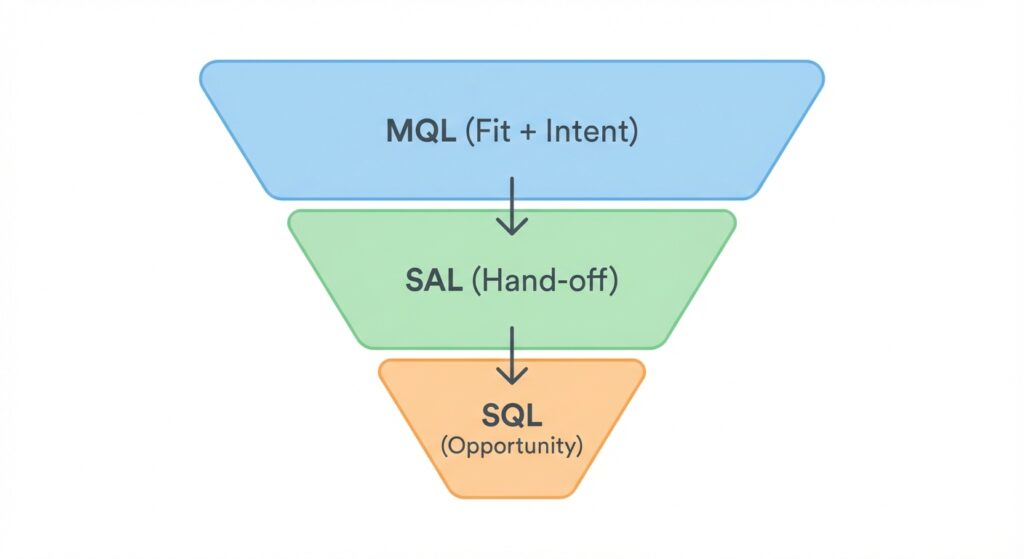
In our consulting work, we define MQLs by looking at two specific dimensions: Fit and Intent.
- Fit: Do they look like your ideal customer? (Right industry, right company size, right job title).
- Intent: Are they acting like they have a problem? (Visited the pricing page, downloaded a bottom-of-funnel case study).
If you have high fit but low intent, that is just a name in a database. If you have high intent but low fit (like a student downloading a whitepaper), that is noise.
An MQL is the intersection: High Fit + Moderate Intent.
The SQL: The Real Deal
An SQL is ready for a conversation. This lead has been vetted. We know they aren’t just kicking tires.
Typically, an SQL has passed a secondary filter. This filter is often applied by a BDR (Business Development Rep) or a strict automated scoring threshold. The key differentiator? Qualification.
At Sales Fundas, we advise clients to look for the transition point where “Education” turns into “Evaluation.” An SQL is evaluating you as a vendor. An MQL is just educating themselves on a topic.
The Danger Zone: Why Definitions Aren’t Enough
You can write definitions on a whiteboard all day. It won’t save you. You need parameters.
We audited a B2B SaaS company recently. They had plenty of MQLs. But their conversion rate to SQL was less than 2%. The problem? They were marking anyone who visited the blog as an MQL. That is not a lead. That is a reader. Treating a reader like a buyer is the fastest way to annoy your audience and burn out your sales team.
Lead Scoring: The Logic Behind the Label
How do you mechanically distinguish the two? You need a scoreboard. If you aren’t scoring leads, you are guessing.
Here is a simplified model we use to help startups build their first engines:
- Demographic Score (The Fit): CEO? +20 points. Intern? -50 points. SaaS Company? +10 points. Retail store? -100 points (if you don’t sell to retail).
- Behavioral Score (The Intent): Opened email? +1 point. Clicked link? +5 points. Visited pricing page? +30 points. Requested demo? +100 points (Instant SQL).
Set a threshold. Maybe 50 points is an MQL. 90 points is an SQL. This removes emotion from the decision. Marketing isn’t passing leads because they “feel good.” They are passing leads because the math says they are ready.
Need help setting this up tech-wise? Read our Guide to Setting Up a Sales CRM for the First Time.
The Hand-Off: Where Deals Die
The moment an MQL becomes an SQL is critical. It is a baton pass in a relay race. Drop the baton, lose the race.
This is where the SLA (Service Level Agreement) comes in. You need a contract between Sales and Marketing.
The Marketing Promise: “We will only pass leads that meet these specific criteria (Score > 70, verified email, proper geo).”
The Sales Promise: “We will contact every SQL within 4 business hours and update the status in the CRM within 24 hours.”
Without this agreement, Sales will ignore the leads (“Marketing sends junk”) and Marketing will stop caring about quality (“Sales never calls them anyway”).
In our experience at Sales Fundas, Jayant Kelkar, the biggest failure point is speed. An SQL is a perishable good. Like fresh fish. If you don’t cook it immediately, it stinks. If you wait 48 hours to contact an SQL, you have already lost. The prospect has moved on or spoken to a competitor.
The Feedback Loop
This is the secret sauce. Most companies miss this entirely.
What happens when Sales rejects an SQL? Usually, nothing. The lead goes into a black hole labeled “Closed-Lost” and dies.
This is a massive waste of money.
Sales must tell Marketing why they rejected the lead. Was it the wrong budget? Wrong timing? Just a student? This data is gold. Marketing needs this feedback to tune their scoring model. If Sales keeps rejecting leads from “Source A,” Marketing needs to turn off the ad spend for “Source A.”
If you don’t have this loop, your marketing budget is leaking. For a deeper look into the tech side of this loop, see Why Integrating Your Marketing Tools With Sales CRM Is Critical.
Is There a Step Between? (The SAL)
Yes. Sometimes the jump is too big. Enter the Sales Accepted Lead (SAL).
This is a safety valve. It is a bucket where Sales says, “Okay, I see this MQL. I agree it looks decent. I am going to accept it and start working on it.”
It acts as a confirmation receipt. It prevents the “I never saw that lead” excuse.
- MQL: Marketing says it is good.
- SAL: Sales reviews it and agrees to work it.
- SQL: Sales speaks to them and confirms a real opportunity exists.
This granularity helps you spot exactly where the process fails. If MQL to SAL is high, but SAL to SQL is low, your sales team might be bad at prospecting. If MQL to SAL is low, your marketing team is sending bad leads.
Founder-Led Sales Context
If you are a founder doing the selling, this might feel like overkill. It isn’t.
Even if you are a team of one, you need to mentally separate these buckets. You cannot treat every LinkedIn connection like they are ready to buy. You will come across as desperate. You need to nurture the MQLs (content, newsletters) and hunt the SQLs (calls, demos).
Founders often struggle to make this shift. They pitch to everyone. This is why Non-Sales Founders Need a Founder-Led Sales Consultant. You need to protect your time. Only spend your expensive founder hours on SQLs.
Practical Steps to Align MQL and SQL Today
So, what do you do now? Don’t just read this and nod. Take action.
1. The Summit.
Get the heads of Sales and Marketing in a room. Lock the door. Do not leave until you have a written definition of an MQL.
2. The Audit.
Look at your last 20 closed deals. Trace them back. What did they look like as leads? What behaviors did they show? Now look at your last 20 lost deals. Spot the patterns. We often perform a 30-Point Health Check for clients to uncover these specific patterns.
3. The Tech Check.
Is your CRM actually capturing this? Or are you using a spreadsheet from 2019? If your tools don’t support the process, the process will fail. Check our guide on Free CRM Solutions Suitable for Startups if you need a quick fix.
4. The Review.
Meet weekly. Not monthly. Weekly. Review the rejected SQLs. Argue about them. It is healthy conflict. It refines the machine.
Stop Guessing
The difference between MQL and SQL isn’t academic. It is the difference between activity and productivity.
Activity is generating 1,000 MQLs. Productivity is generating 50 SQLs that close.
Stop obsessing over volume. Start obsessing over conversion. Your sales team doesn’t need more leads. They need better leads. And your marketing team needs to know what “better” looks like.
Key Takeaways
- MQL = Interest. They are looking.
- SQL = Intent. They are buying.
- SLA is Mandatory. Define the handoff or expect failure.
- Feedback Loops Save Money. Sales must tell Marketing why leads get rejected.
- Context Matters. A student downloading a PDF is not an SQL, no matter how much they click.
Sales is simple, but it isn’t easy. It requires discipline. It requires you to say “no” to bad leads so you can say “yes” to the revenue.
Frequently Asked Questions
1. What is the main difference between MQL and SQL?
An MQL is a lead that has shown interest based on marketing engagement, while an SQL is a lead that the sales team has vetted and deemed ready for a direct sales conversation.
2. Can an MQL skip the SQL stage?
Technically, yes, if they show extreme intent (like requesting a contract immediately), but for reporting purposes, they should still be tagged as SQL to track conversion rates accurately.
3. What is a good MQL to SQL conversion rate?
It varies by industry, but generally, a conversion rate of 13% to 15% is considered healthy for B2B. Anything below 5% indicates a problem with lead quality or definition alignment.
4. Should startups use MQL and SQL definitions?
Yes, absolutely. Even early-stage startups need to differentiate between casual browsers and serious buyers to prioritize their limited time effectively.
5. What tools help manage MQLs and SQLs?
You need a CRM (like HubSpot, Salesforce, or Zoho) integrated with marketing automation tools to track scores and trigger handoffs automatically.
6. How do I calculate lead score?
Assign points for positive actions (webinars, pricing page visits) and demographic fit (job title, industry), and subtract points for negative attributes (competitors, students).
7. Why is my sales team ignoring MQLs?
Usually because trust has been broken. If past MQLs were low quality, Sales assumes future ones will be too; fixing the qualification criteria restores this trust.
8. What is a Sales Accepted Lead (SAL)?
An SAL is an intermediate stage where the sales team reviews an MQL and agrees to accept it into their pipeline, confirming it meets the basic criteria before working it.
Is Your Funnel Leaking Revenue?
If your marketing team is celebrating while your sales team is struggling, you have a process gap. We can fix that.
At Sales Fundas, Jayant Kelkar, we don’t just give you advice; we build the engine. From CRM setup to sales team training, we align your teams to stop the blame game and start closing.
Book a Strategy Call Today and let’s turn those MQLs into revenue.



[…] The difference between MQL and SQL explained […]
[…] New Lead: Unqualified raw material. (Need help distinguishing leads? Read about MQL vs SQL here). […]
[…] Define the Stages: When does a lead become an opportunity? What are the exit criteria for a demo? (See: The Difference Between MQL and SQL Explained). […]
[…] Qualified Leads (MQL) with Sales Qualified Leads (SQL)? This is a common error. Read our guide on MQL vs SQL to stop the blame game between marketing and […]
[…] Curious about the difference between a lead and a real opportunity? We broke it down here: The Difference Between MQL and SQL Explained. […]
[…] The system then automatically notifies a rep. This removes the guesswork. You need to understand the difference between MQL and SQL to stop wasting time on tire-kickers. When you focus only on the hottest leads, your conversion […]